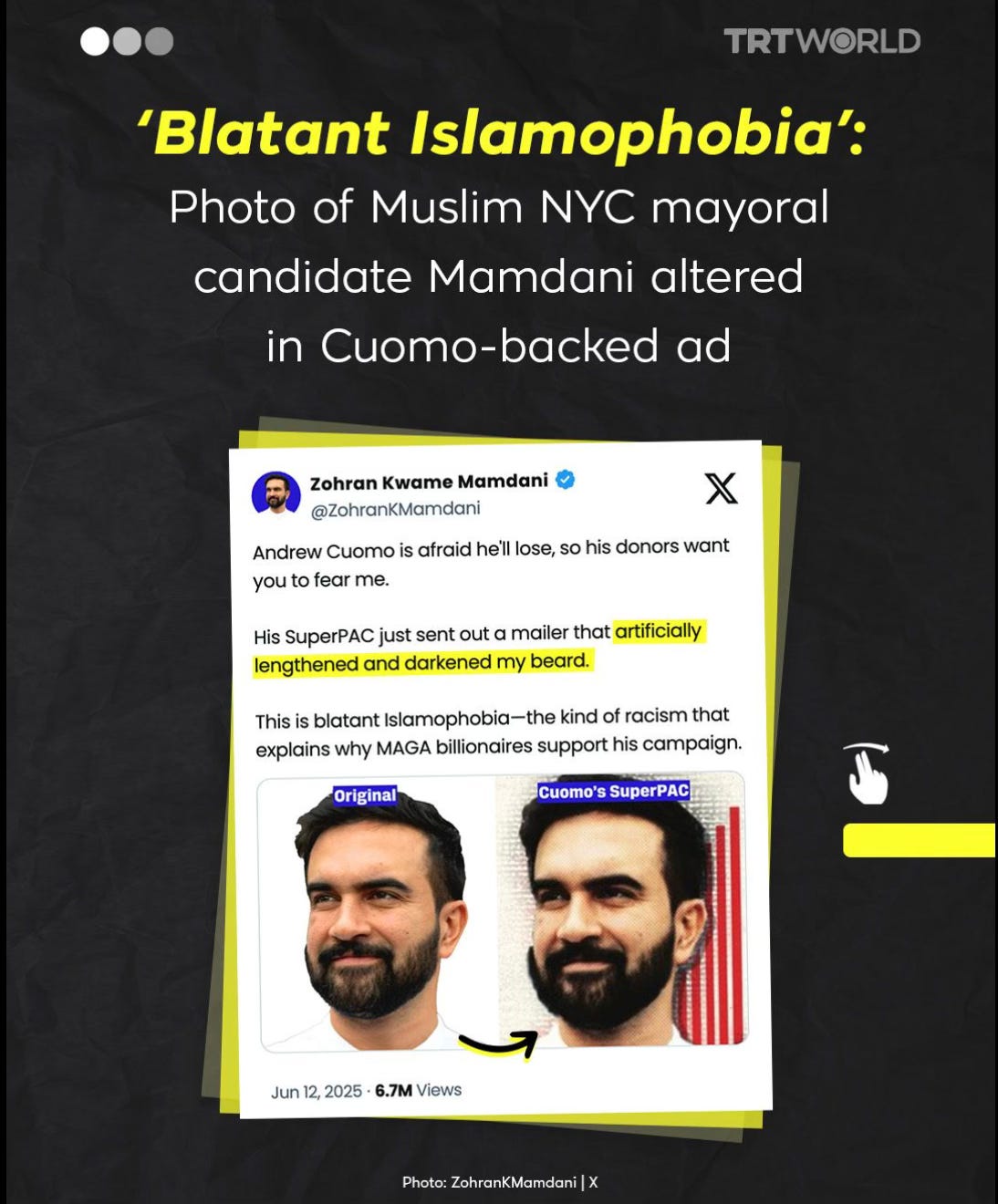
From the long and darkened beard flyers, “uncivilized” eating to the arrival of Sharia fear mongering, the New York mayoral election witnessed the deployment of every tested and tried Islamophobic trope in the books. As Zohran Mamdani mounts his campaign for Mayor of New York City in the 2025 elections, the political stakes transcend the usual issue-focused debates over free bus rides, housing for the homeless, taxes, and trash collection or Democrat versus Republican ideas. His candidacy for the city’s highest office represents a confrontation with a powerful, pervasive force in American political life, atmospheric Islamophobia that is funded by billionaires and fear mongers.
A Democratic Socialist of Indian and Ugandan Asian heritage, Mamdani is no longer just a state assemblyman from Queens; he is a Islamophobia target number one figure stepping onto the city’s most significant stage, and his campaign is set to become a litmus test for how deeply the currents of Orientalism and racism are woven into the fabric of New York’s political consciousness and the nation by extension.
To understand this atmosphere is to move beyond the simplistic framework of individual bigotry, Democrats vs Republicans, or even the left-right political split. It requires the theoretical tools of those who have mapped the psychic and political landscapes of racism, including, interestingly enough, Mamdani’s own father, who wrote about it from a decolonial lens in several publications. Mamdani’s mayoral run becomes a high-stakes case study in resisting what Frantz Fanon, Edward Said, and Jack Shaheen have identified as forms of structural racism and also symbolic violence. Mamdani’s mayoral campaign has activated what I call atmospheric Islamophobia like never before and has set in motion a new tidal wave of bigotry, xenophobia, and racism. Islamophobia got a new extended lease on life, as if the genocide denial over Gaza is not bad enough, the biogtry cadre has taken over public discourse in an attempt to scare people away from the ballot box.
Frantz Fanon, in his seminal work “The Wretched of the Earth,” provides a framework for understanding violence and racism not as a personal failing, but as a structural condition firmly embedded in the colonial project. He writes, “Violence is a cleansing force. It frees the native from his inferiority complex and from his despair and inaction; it makes him fearless and restores his self-respect.” While often discussed in the context of anti-colonial warfare, this concept of psychological and structural violence is key to understanding the “atmosphere” of Islamophobia. The constant targeting of Muslims in the public arena, media, and political discourses is intended to inflict symbolic violence and use it as a tool to produce compliance.
For Muslim and perceived-as-Muslim communities, this violence is not physical like that Fanon wrote about in the colony, but is a constant ambient. It is the surveillance program in your neighborhood, the suspicious glance on the subway, the sudden need to explain and justify your identity in the wake of a terror attack committed by someone you’ve never met. This is a form of “atmospheric pressure” that seeks to induce the “inferiority complex” Fanon describes. It is a low-frequency hum of alienation, a constant reminder that you are the “Other” within your own home. The political system, until challenged, often acts as an enabler of this environment, codifying suspicion into law and policy, and unleashing atmospheric Islamophobia in public and media discourses.
Edward Said’s twin works, Orientalism and Covering Islam, are the perfect lenses through which to view this atmospheric construction. Orientalism, as Said defined it, is the Western corporate institution for dealing with the Orient—”dealing with it by making statements about it, authorizing views of it, describing it, by teaching it, settling it, ruling over it.” It is a discourse of power that creates a timeless, irrational, and exotic “East” as a counterpoint to the rational, modern “West.”
In his later work, Covering Islam, Said argued that this tradition had been seamlessly updated for the modern media age. He noted how Western media treats “Islam” as a single, monolithic entity, devoid of internal diversity, history, or nuance. “The hold of these stereotypes,” Said wrote, “is that they are held indiscriminately, and that they are in the main unchallengeable.”
This is the “atmosphere” in its most potent form. The Muslim, or anyone perceived as such (like Mamdani, who now represents the Muslim), is not an individual but an abstract symbol. They are “covered” not as neighbors or constituents, but as potential threats, representatives of a faith and culture framed as inherently antagonistic. This creates a political environment where a candidate’s very name or appearance can trigger a pre-packaged set of assumptions, a phenomenon that produces the racialized political Islamophobic rhetoric.
Nowhere is this atmospheric pressure more concentrated than on the issue of Palestine. Mamdani’s unwavering solidarity with the Palestinian cause, including his support for the Boycott, Divestment, and Sanctions (BDS) movement, made him a prime target for accusations of anti-Semitism. This is a predictable yet potent political tactic, one that the late Edward Said, a Palestinian-American himself, presciently understood. He observed that any meaningful critique of the Israeli state and its settler-colonial project is instantly and deliberately conflated with hatred of Jewish people. This conflation operates as a silencing mechanism, attempting to place Palestinian rights—and their advocates—outside the boundaries of acceptable political discourse. For a Brown man like Mamdani, this attack carries the added weight of the Orientalist trope, invoking the specter of the “irrational, anti-Western” subject. The accusations, therefore, were not merely a policy disagreement; they were an atmospheric Islamophobic event, an attempt to leverage one form of bigotry to enforce another and to re-center a candidate who challenges U.S. and Israeli foreign policy back to the marginalized “fringe” where the Orientalist frame insists he belongs.
This atmospheric Islamophobia is not confined to news desks or political speeches; it is the cultural air we breathe. The late scholar Jack Shaheen, in his groundbreaking book Reel Bad Arabs, meticulously documented how Hollywood has for a century served as a propaganda arm for this Orientalist vision. By cataloging thousands of films that depicted Arabs and Muslims almost exclusively as villains, terrorists, or oil-rich sheikhs, Shaheen revealed how popular culture manufactures consent for political prejudice.
This “atmospheric” conditioning is profound. It shapes the subconscious biases of voters, journalists, and even policymakers. When politicians like Andrew Cuomo seeks to fearmonger, they are not creating an image from scratch; they are activating a well-worn neural pathway laid down by decades of cinematic and media representation. The “terrorist” trope is a readily available cultural shorthand, making it easier to cast entire communities as a fifth column.
In this context, Zohran Mamdani’s successful campaign was a form of what we might call, following Fanon, a “cleansing” counter-violence—not physical, but political and representational. It was an act of breaking the “unchallengeable” frame that Said described.
His campaign speech to challenge Islamophobia, his policy focus on housing as a human right and defunding carceral systems, and his unapologetic solidarity with Palestinian rights, were all declarations that a Brown man with a “suspicious” name could represent the collective interests of a multi-ethnic, multi-faith working class. He refused to be abstracted. He refused to be “covered” as a symbol. Instead, he presented a concrete political agenda that spoke to the material needs of his constituents—New Yorkers of all backgrounds struggling with rent, healthcare, and a punitive state.
By the ongoing campaign, Mamdani demonstrated that the atmospheric Islamophobia, while powerful, is not absolute. The concrete power of organized, class-and race-conscious politics can dispel it. His presence before in this mayoral campaign is a constant, living rebuttal to the Orientalist fantasy, proving that the “Orient” is not “over there” but is here, in New York, and it has a voice that will no longer be spoken for.
The fight is far from over. The atmosphere, sustained by a multi-billion-dollar Islamophobic industry of fear and a political establishment that often profits from division, is resilient. But the possible election of figures like Zohran Mamdani creates a rupture. It is a testament to the idea that the most potent response to an atmospheric violence and atmospheric Islamophobia is to build a political home where everyone, regardless of how they are stereotyped, can finally breathe free.

