
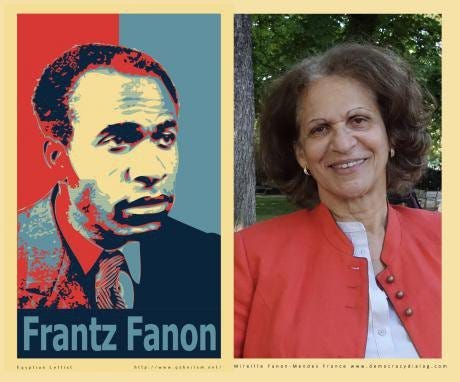
Fanon’s work on race, racism and violence in the colonial context are as relevant today as they were during the heydays of anti-colonial struggles of the late 1950s and 60s. While Fanon wrote specifically on the context of anti-colonial movements, the debate on armed struggle and revolutions, nevertheless his analysis on colonial violence as an instrument of domination is relevant to our discussion on black lives in America and across the globe. More importantly, the recent police murder of Jayland Walker and countless other Blacks is better understood by introducing Franz Fanon’s Wretched of the Earth’s framing on colonial violence and the divided world of the colonized and the colonizer.
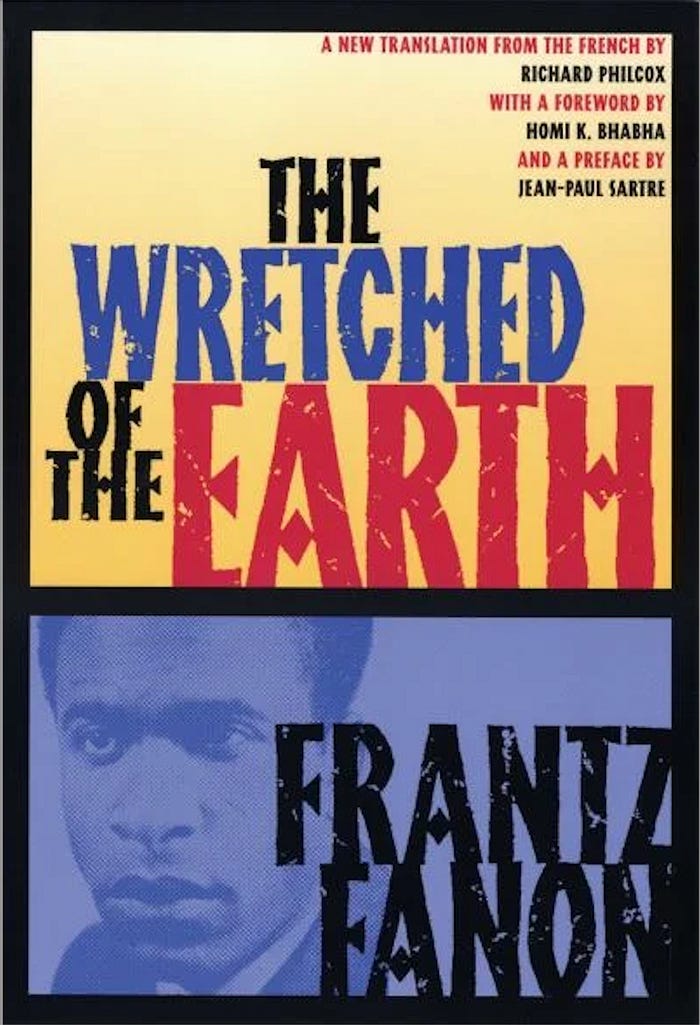
Fanon’s framing centered on the violent relationship between the White colonial European powers and the colonized populations, which consists of the darker complexion indigenous people inhabiting colonies. The relationship was founded and stoked through a regime of violence and terror that is intended to bring about the total domination and surrender of the colonized population. Violence, according to Fanon, rather than being viewed as incidental, is foundational to the colonial structure and is used to demarcate the two worlds, the one inhabited by the colonial and the other is the domain of the colonized. Death and murder of the colonized is premeditated and is the only way for the colonial to set himself up as a master of colonized land and population. Genocide, slavery, violence and terror are ontological and paradigmatic in the colonial system.
Here, Jayland Walker’s murder by the police is premeditated, pre-determined and expected when the colonial-colonized relationship is understood properly. Yes, the specific circumstances of each murder and how the encounter unfolds are often unique, but the colonial superstructure pre-determine the relationship, the daily encouters and the expected outcome for the Black subject, death at the hands of the police.
The Black person in the United States is a colonial subject-category that lives within the confines of the violent epistemology of White colonial supremacy, which sets at the root of US’s structure and society. Nothing escapes race and White supremacy in the United States, even attempts to undo it often ends up affirming it. Fanon accurately points out that “The colonized world is a world divided in two. The dividing line, the border, is represented by the barracks and the police stations,” which means violence directed at the colonized population, Blacks as a group, and Jayland Walker, as an individual, and all those who look like him/her in the internal colonial, is constitutive, expected and staged to bring about control.
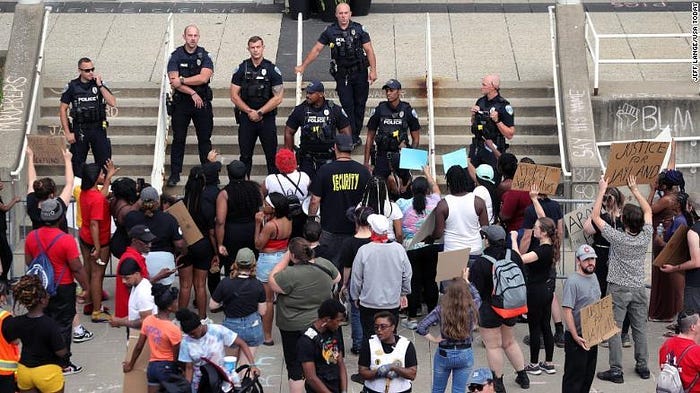
Image from https://edition.cnn.com/2022/07/03/us/jayland-walker-police-shooting-video/index.html
Institutional and structural violence is used to train the Black subject at knowing his/her place in society and geographical border in the internal colonial. “In the colonies,” Fanon observed that “the official, legitimate agent, the spokes-person for the colonizer and the regime of oppression, is police officer or the soldier’” and the same applies in America’s inner cities and the internal colonial. The colonial discourse and language is rooted in violence, not only the police but also the official institutions and the political leadership who use language of pure violence and discipline to keep the colonized population under total domination.
Fanon observes: “In colonial regions, however, the proximity and frequent, direct intervention by the police and the military ensure the colonized are kept under close scrutiny, and contained by rifle butts and napalm. We have seen how the government’s agent uses a language of pure violence. The agent does not alleviate oppression or mask domination. He displays and demonstrates them with the clear conscience of the law enforcer and brings violence into the homes and minds of colonized subject.”
Fanon’s understanding is applicable and accurately describes the lynching era. Indeed, the end of America’s civil war witnessed a serious attempt at challenging and possibly ending White supremacy and privilege but the regime of terror and almost daily lynchings across the country made it possible to more efficiently reconstitute the colonial White supremacist power structure. The police, government institutions, economic resources and religious order all were directed at keeping the Black person and society in their “native” colonial quarters and dominated through the use of pure violence to bring about the pacification of the population.
A secondary and as important of a goal was at hand, the use of unrestrained terror on the Black subject made it possible for White colonial supremacy to garner and establish White solidarity and affirm the existence of a distinct “superior racial” category. Violence against Blacks brought about the only meaning and the sense of belonging for Whites in the post-civil war era (we can account for some whites who struggled to bring an end to racism but they were in the minority). Violence was the instrument used to make a free Black person regulate themselves to the dictate and power of the White colonial supremacist structure. Think of all the Black mothers and fathers who have to set down and talk to their kids on how, and what to do when encountering the police: the structure of control and domination is bearing fruits.
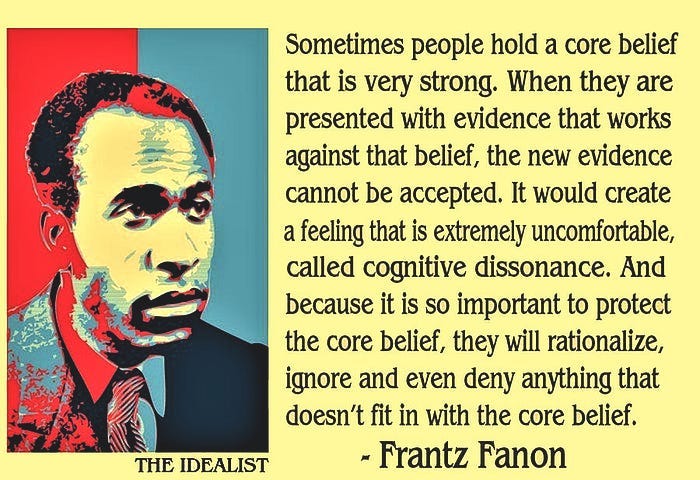
In the past, it was overt but today police violence and the prison industrial complex are the tools deployed to bring about the same results and even more successful. Indeed, we never miss an opportunity to blame Blacks for their predicament and the society is very skilled at using cultural racism to explain away the premature death of so many on the hands of the police (please no Black on Black violence cultural racism trope or missing dads from the home).
I like this principle: “if you can’t help the oppressed, then the least you can do is not to be an aid to the oppressor.”
The political leadership, the media, the intellectuals, academics and religious figures all use cultural racism to explain away the daily death count of Blacks across the country. Some even talk and approach the topic from what they think is a sensitive and supposedly a friend of the Black community vantage point, while, in all reality, are apt and skillfully reproducing White supremacist cultural racism at every turn. Yes, we all need to take responsibility for our actions but if you say that Black American cultural norms produces the death we are witnessing, then how do you explain the non-stop killing and mayhem directed at Blacks in Africa, where most of the wealth and raw materials exist! Did the Congo had a missing father figure that made it possible for the genocide of almost 50% of the population by the Belgium or current French intervention in Mali and Chad! People can’t help themselves in reproducing White supremacy and adopting its negative epistemological construction of Blackness and everything related to it. This epistemological adoption reaches to the extent that the murder and death of a Black person is transformed into blaming him/her for their own death and their community-the supposed Black cultural inadequacy, inferiority and criminality.
The assault and producing the negative images of Blackness in the most recent era can be traced to the 1980s Reagan campaign and presidency, which deployed the Black woman Welfare Queen trope to win the elections, then move to change America’s economic, political, religious and social systems. Reagan used the image of the single Black mother, the Welfare Queen, to shift the society’s focus from a “war on poverty” to one vested on “a war on the poor” with Blackness serving as the foil to accomplish this goal, even though the majority of those on welfare at the time were white. Trickle down economics was rooted in trickle down racism, White supremacy and the abandonment of the poor of all races. White Americans loved and voted for Reagan in the same way that Whites voted and loved Trump because both used race to mobilize White victimhood from a supposed unfair privilege attained by Blacks and minorities, who are taking our America away.
“The colonized’s sector, or at least the ”native” quarters, the shanty town, the Medina, the reservation, is a inhabited by disreputable people. You are born anywhere, any-how. You die anywhere, from anything. It’s a world with no space, people are piled one on top of the other, the shacks squeezed tightly together. The colonized’s sector is a famished sector, hungry for bread, meat, shoes, coal, and light. The colonized’s sector is a sector that crouches and cowers, a sector on its knees, a sector that is prostrate. It’s a sector of n…..s, a sector of towel heads.”
Fanon’s descriptions of the colonized sector applies to Black neighborhoods, which if understood correctly would go a long way to explain the total disregard for the people who live there and their daily suffering. The economic disparity and lack of real resources is structural and not incidental. Fanon further makes an immediate connection between race and wealth when stating: “In the colonies the economic infrastructure is also a superstructure. The cause is effect: You are rich because you are white, you are white because you are rich. ” Thus, the reverse holds true, you are poor because you are Black and your blackness is a source of your poverty. Here, don’t let the few Black millionaires or billionaires distract you from assessing the total structural impoverishment of Black communities in the US and across the world. The two world are distinct and structured around race.
Fanon’s descriptions above are hauntingly accurate of Black suffering in America: “You die anywhere, from anything. It’s a world with no space, people are piled one on top of the other, the shacks squeezed tightly together. The colonized’s sector is a famished sector, hungry for bread, meat, shoes, coal, and light.” The image also applies to the conditions in the prison industrial complex.
Two separate and distinct worlds that are shaped around race and maintained through organized and institutionalized violence: “…This compartmentalized world, this world divided in two, is inhabited by different species. The singularity of the colonial context lies in the fact that economic reality, inequality, and enormous disparities in lifestyles never manage to mask the human reality. Looking at the immediacies of the colonial context, it is clear that what divides this world is first and foremost what species, what race one belong to.”
In the United States, Black communities inhabit a colonized geography governed by police force and the racist structure of domination that permeates every element of society and all interactions. The dividing line in politics, economics, social positioning and religious discourses are governed by race, which also is sets at the crossroads of police violence directed at the Black subject and Black communities. Here, the cases of police violence we get riveted about and mobilize to oppose are those that take the violence rooted relationship to its logical conclusion: the Black body is a threat to the superior White supremacist shinning city upon the hill. Thus, the every day violence directed at Blacks, caught or not caught on camera, gets a passing grade. Violence against the Black subject is atmospheric and nothing escapes it.
America’s cities are “a colonial world that is cut in two.” Indeed, anyone that examines America’s racial reality closely will arrive at Fanon’s conclusion: “The dividing line, the frontiers, are shown by barracks and police stations. In the colonies it is the policeman and the soldier who are the official, instituted go-betweens, the spokesmen of the settler and his rule of oppression.” Consequently, Jayland Walker and every other Black person that comes into contact with the police, or the internal White supremacist settler colonial power structure, the Black subject, “is always presumed guilty,” and his/her death is justified, even when it is egregious with 60 holes in the body.

