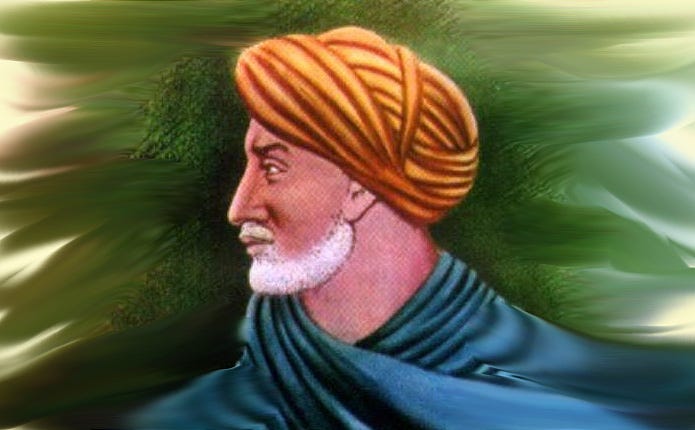
There is something almost eerie about reading the Muqaddimah today, which is on my desk that I turn to regularly. Written in the fourteenth century by the North African polymath ʿAbd al-Raḥmān ibn Khaldūn, it reads less like a medieval historical treatise and more like a diagnostic report filed in advance on the empires of our own time. Ibn Khaldūn had no knowledge of the United States. He had never heard of Tehran, the F-35, aircraft careers, or the doctrine of “maximum pressure.” Yet he described, with a precision that should unsettle any serious reader, the precise pathology now consuming American power, an empire that has passed its peak of ʿaṣabiyya, grown comfortable on luxury and delusion, and now sends unqualified rulers chasing glory through wars they cannot win and do not understand.
The war on Iran is not an aberration of American foreign policy. It is its logical culmination.
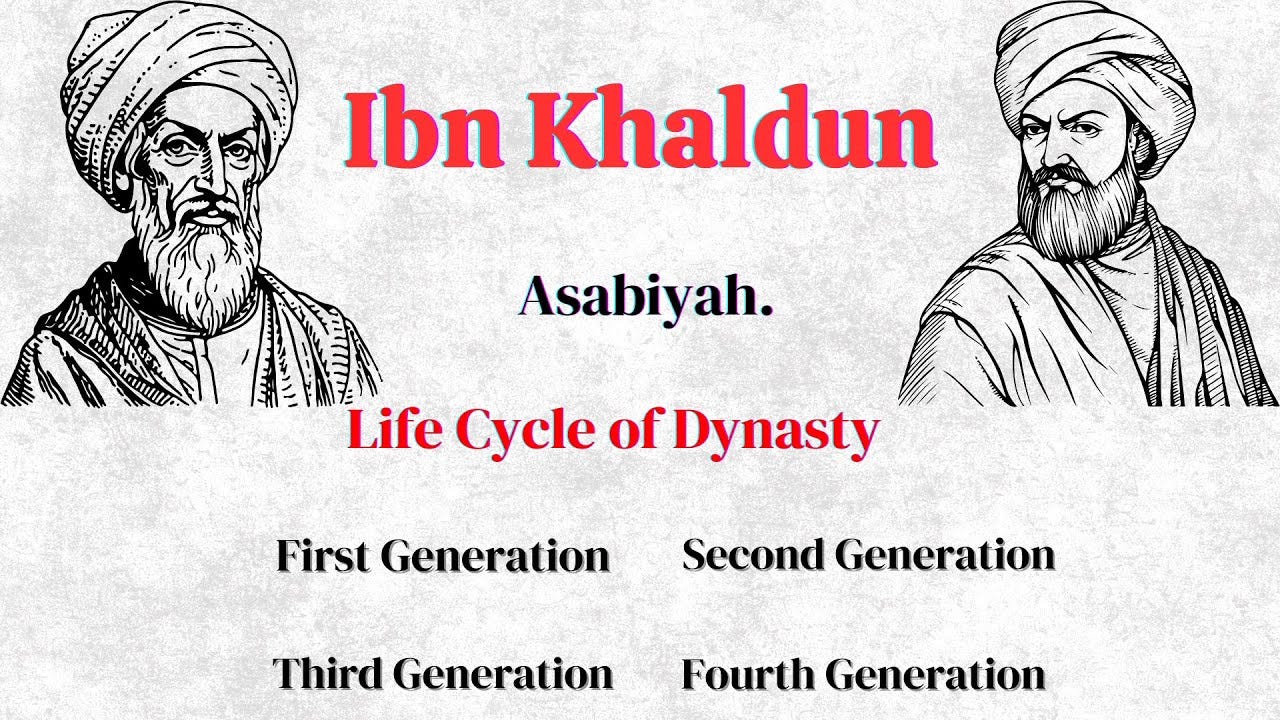
To apply Ibn Khaldūn seriously, one must first understand his central concept: ʿaṣabiyya (عصبية). Often translated as “group solidarity” or “social cohesion,” ʿaṣabiyya is the animating force that allows a civilization or political community to rise, conquer, and govern. It is not merely loyalty. It is the moral and martial energy born of shared sacrifice, shared purpose, and a governing class that still lives close enough to hardship to remember what it is fighting for.
Ibn Khaldūn observed that every civilization moves through a generational arc. The founding generation possesses ʿaṣabiyya in its most potent form — they are austere, purposeful, and willing to die for something larger than themselves. Their successors inherit the state those founders built, but begin to mistake the inheritance for a birthright. By the third and fourth generation, the ruling class has grown accustomed to luxury (taraffuh), softened by comfort, distracted by internal competition for privilege, and increasingly dependent on mercenaries — hired foreign soldiers, contractors, proxies — to do the dangerous work the original founders once did themselves.
At that stage, Ibn Khaldūn tells us, the decline is not merely possible. It is inevitable. The only question is how long the façade can be maintained before the structure beneath it gives way.
Look at the United States honestly and tell me this is not the portrait of our moment.
Ibn Khaldūn was particularly sharp on the question of leadership quality in periods of decline. He wrote that as ʿaṣabiyya deteriorates, the ruling class increasingly produces leaders who have the trappings of power without its substance, men who have known only comfort, who confuse personal ambition with national interest, who are animated not by strategic wisdom but by the desire for the appearance of dominance.
Such rulers, he observed, are especially prone to wars of adventure, military engagements not grounded in genuine strategic necessity, but in the psychological need to demonstrate strength precisely because genuine strength has been hollowed out. They make these wars loudly, righteously, wrapping aggression in the language of civilization, security, and even God, the Second coming of Jesus. What they cannot do is finish them.
Cast your eyes over the American leadership class that has prosecuted the confrontation with Iran over the past few weeks. We are not speaking of statesmen formed by study, sacrifice, or the humility of genuine strategic failure. We are speaking of a political and military establishment that has presided over the destruction of Iraq, the fragmentation of Libya, the endless catastrophe of Afghanistan, and the arming of proxy wars across four continents and has drawn from those experiences not accountability, but an even deeper certainty in its own righteousness. When men who have never been held accountable for failure are handed the machinery of war against Iran, Ibn Khaldūn’s analysis is not merely relevant. It is prophetic.
There is a second dimension to Ibn Khaldūn’s analysis that Western commentators almost never apply, because to apply it honestly would require a level of intellectual humility that American strategic culture has not yet demonstrated: his observations about what happens to the challenger in these encounters.
Iran, whatever one thinks of its government or its policies, is not a young nation-state on the make. It is one of the oldest continuous civilizations in human history, a people whose sense of collective identity, whose ʿaṣabiyya if you will, has been forged not in boardrooms or think tanks, but in actual siege and actual sacrifice. The Iran-Iraq War of the 1980s — in which the United States backed Saddam Hussein with intelligence, financing, and chemical weapons precursors — did not break the Iranian state or the Iranian people. It consolidated them. In the Khaldūnian model, external pressure does not necessarily weaken ʿaṣabiyya. Often it renews it.
An empire in decline, attacking a civilization that has survived far worse than American sanctions, is not a formula for victory. It is a formula for accelerated self-destruction.
Ibn Khaldūn was also among history’s first serious political economists, and his analysis of how declining empires manage their fiscal affairs is particularly instructive. He identified a pattern he called ẓulm al-ʿummāl — the oppression of the productive class through taxation, extraction, and the redirection of national resources toward the ruling class and its military adventures, at the expense of the builders, teachers, traders, farmers, innovators, and craftsmen who actually produce wealth.
The United States has spent, by conservative estimates, over eight trillion dollars on its post-September 11 wars. American infrastructure crumbles. American cities hollow out. American students drown in debt while seeking the education that might lift them. American workers have watched their productive capacity being exported and their wages stagnate for four decades. And the response of the American ruling class to this domestic decay has been, with almost perfect consistency, to point outward, to Iran, to China, to Russia, to whatever foreign menace can be made to serve as the explanation for problems that are entirely self-inflicted.
Ibn Khaldūn identified another reliable marker of late-stage imperial decline that receives far too little attention in Western discourse: the penetration of the failing state's decision-making apparatus by outside interests whose ambitions do not coincide with the empire's own survival. As ʿaṣabiyya deteriorates and the native ruling class loses its coherent sense of collective purpose, it becomes susceptible — even eager to adopt the strategic priorities of external patrons who supply what the hollowed-out empire can no longer generate from within, a sense of mission, a named enemy, a cause worth fighting for. What the empire provides in return is its military machinery, its treasury, and the lives of its soldiers.
It is a ruinous bargain, and Ibn Khaldūn observed that declining empires almost always make it. In the American case, that external interest is not difficult to name. Israeli Prime Minister Benjamin Netanyahu stood before the United States Congress many times and again and again across three decades, explicitly lobbying for American military confrontation with Iran, receiving standing ovations from legislators who represent American constituents, not Israeli ones. The organized pro-Israel lobby, led institutionally by AIPAC and flanked by a dense network of think tanks, media relationships, and campaign finance architecture, not to forget the Epstein Mossad operation, has systematically worked to ensure that American Iran policy reflects Israeli strategic preferences rather than American strategic interests. Scholars John Mearsheimer and Stephen Walt documented this infrastructure exhaustively in The Israel Lobby and U.S. Foreign Policy, and were met with precisely the kind of institutional fury that greets anyone who names what the powerful prefer to leave unnamed.
Ibn Khaldūn would not have been surprised by either the phenomenon or the reaction to describing it. He understood that the most dangerous external influence is the one that has convinced the host empire that its own subjugation is its strength and that going to war for another government's interests is the highest expression of its own values. A civilization with vigorous ʿaṣabiyya would recognize this smoke screen and reject it. A civilization in the Khaldūnian third and fourth generation, its ruling class fragmented, its sense of collective purpose hollowed out, its politicians dependent on outside money for elections to hold their offices, cannot. It nods, applauds, and marches for a foreign leader’s drumbeat.
Ibn Khaldūn would recognize this immediately. It is what ruling classes do when they have lost the capacity for honest self-examination. They make war abroad to avoid reckoning at home
.I want to be precise here, because intellectual honesty requires it; Ibn Khaldūn was an analyst, not a moralist in the simple sense. His framework does not tell us that the Iranian government is virtuous, or that military force is never justified, or that American power has never served any legitimate purpose. His framework tells us something more structural and, in some ways, more sobering that the logic of history is indifferent to the self-image of the actors within it.
The United States believes itself to be, in the words repeated by every American president in living memory, the “indispensable nation,” the necessary guarantor of world order, the final defender of civilization. Ibn Khaldūn would note, gently but firmly, that every empire in its period of decline has said something very like this. That the Romans believed it. That the Abbasids believed it. That the British believed it. Self-belief of this kind is not a symptom of strength. In the Khaldūnian model, it is a symptom of the particular blindness that accompanies the third and fourth stage of civilizational decline, when the ruling class has become so accustomed to dominance that it cannot perceive, let alone prepare for, its own approaching limits.
There is a reason I turn to Ibn Khaldūn rather than to Western international relations theory to analyze this moment. It is not nostalgia, and it is not parochialism. It is because the intellectual tradition that produced the Muqaddimah, a tradition rooted in the Quranic insistence that history is a sunna, a patterned divine law operating in human affairs, offers a framework for understanding power that does not begin from the assumption that Western civilization is the terminus of history.
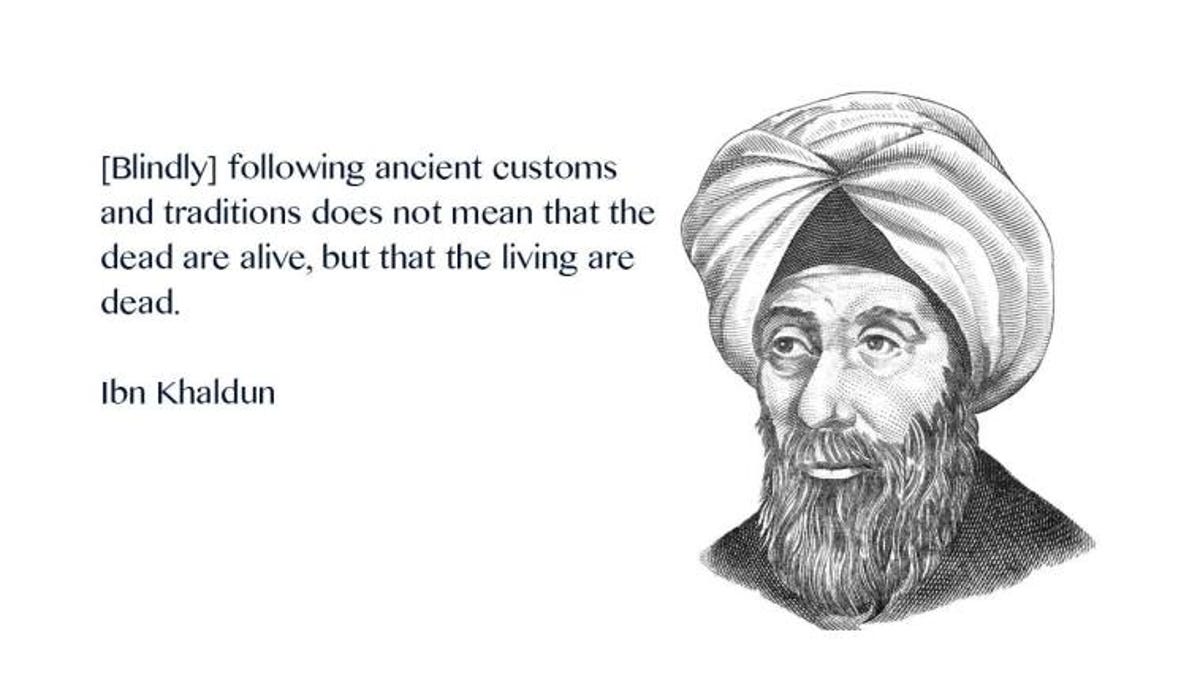
The Quran tells us: “Have they not traveled through the land and seen what was the end of those who came before them? They were greater than them in power” (40:21). Ibn Khaldūn spent his life fleshing out the mechanisms of that Quranic principle and showing, in granular historical detail, how power rises and falls not by accident but by the working-out of definite social and moral laws.
When I read those laws in light of what is unfolding between Washington and Tehran, I do not feel triumphalism. I feel grief for the Iranians who will suffer, for the Americans who will suffer, for a region that has already suffered immeasurably. But I also feel the weight of an intellectual obligation; to say clearly, using the best tools our tradition provides, what is actually happening, rather than what the powerful would prefer us to believe.
What is actually happening is that an empire in the late stages of Khaldūnian decline is pursuing a war of adventure under the leadership of men not qualified to lead it, against a civilization with deeper reserves of ʿaṣabiyya than American strategic planners have been willing to acknowledge, at a cost that the American domestic order can no longer sustainably absorb.
Ibn Khaldūn would not be surprised. The question is whether we will be.

