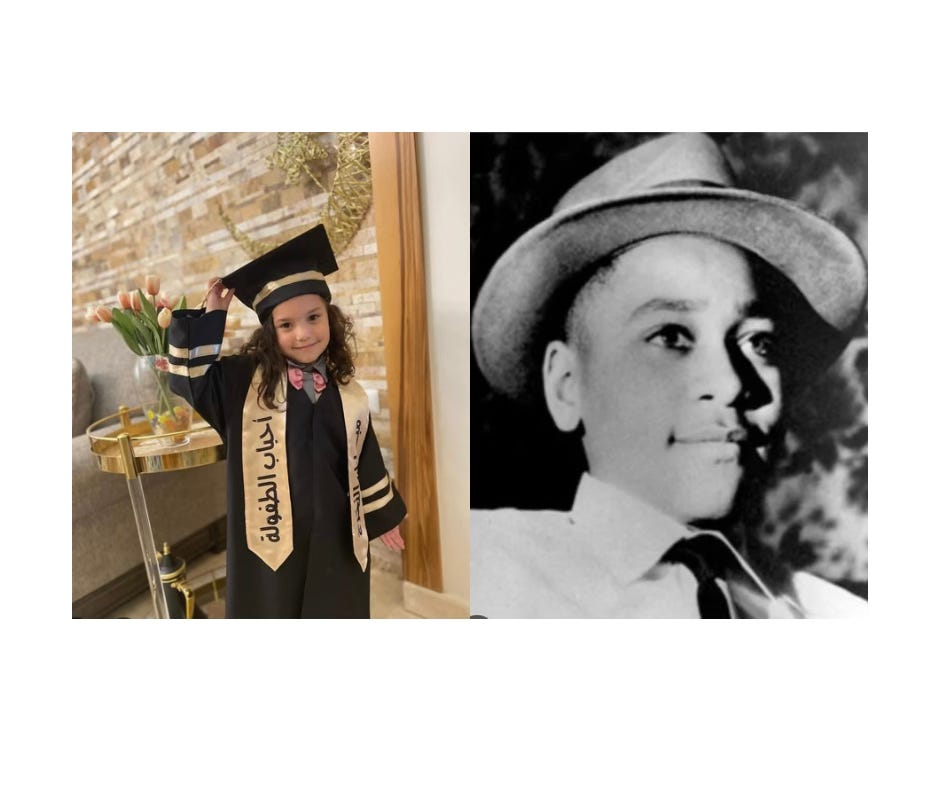
The light was gentle — not blinding, not distant — just enough to make the air shimmer like dawn. There was no sound except for the quiet hum of creation, the kind that felt like breathing before words began.
Emmett sat by a flowing stream, his fingers tracing ripples on the water’s surface. His laughter — that same boyish laugh stilled too soon in Mississippi — now rang with peace.
He noticed her before she spoke. A small girl, dark curls falling around her face, eyes wide with the kind of wonder that still remembered fear.
“Are you Emmett?” she asked softly.
He turned, smiling. “Yes, ma’am. And you must be Hind.”
She nodded. “You know my name?”
He gestured to the horizon — a place where memories drifted like clouds, carrying whispers of the world below. “The names of those taken unjustly echo louder than thunder. They reach even here.”
Hind walked closer, sitting beside him. For a moment, neither spoke. Then she said, “They said I was trapped in the car. I called, the Palestinians rescue came.” Her voice trembled. “Why didn’t anyone stop the army and the bullets?”
Emmett looked down, his reflection shimmering beside hers. “I asked that too, once. I was only fourteen. They said I whistled at a white woman. That was enough for them to drag me out of bed, to beat me till they couldn’t recognize my face.”
He paused, watching the water still itself. “It wasn’t about me. It was about what they feared — the idea that someone like me could be human, could laugh, could live free.”
Hind nodded slowly. “They feared me too. Not because of what I did, but because of what I was born into, Gaza and Palestinians. Because they needed to believe that we — my people — were less than human, so they could keep killing and still sleep.”
Emmett turned toward her. “They used to say they were protecting their way of life. Sounds like the same story, don’t it?”
“Yes,” she said. “They say it’s defense. But it feels like the same hate, only dressed in new words and flags.”
The light around them deepened into gold. Hind leaned her head on her knees. “Does it ever stop?” she whispered.
Emmett thought for a long time. “Maybe not down there. Not yet. But every time someone says our names — and means them — it’s like a crack in the darkness. My mama made sure they saw my face. She said, ‘Let the world see what they did.’ That truth started something.”
Hind looked up. “So, my story too?”
“Yes, baby girl,” he said gently. “Your story too. Maybe your voice from the car— or the last voice from under Gaza’s rubble — will wake hearts the way my mama’s cry did.”
She reached for his hand, small fingers curling into his. “Then we keep watch from here?”
He smiled. “We keep watch. And we keep whispering to the living: don’t let them forget. Don’t let them rename evil as security or racism as justice.”
The stream before them glowed brighter, showing faces — millions marching, shouting, crying, remembering. From Mississippi’s muddy banks to Gaza’s shattered streets, the echoes intertwined.
And above it all, Emmett and Hind — two children denied the right to grow old — sat together in the quiet of heaven, their laughter returning, their names now eternal prayers for a world that still had so much to learn about love, and about seeing.

