On the morning of March 30, 2026, more than ten armed ICE agents descended on a Milwaukee street and surrounded the car of Salah Sarsour, a 53-year-old Palestinian-born man who has lived in the United States for 32 years, holds a green card, and has served for five years as board president of the Islamic Society of Milwaukee, Wisconsin’s largest mosque, and a board member of American Muslims for Palestine. His wife and four adult children are American citizens. He has no criminal record in the United States.[1] He was transferred first to an ICE facility in Broadview, Illinois, then to the Clay County jail near Terre Haute, Indiana, held far from his family, his community, and his lawyers.[2] On the grounds, according to the Department of Homeland Security, that he is a “foreign policy threat” suspected of “funding terrorist organizations.”[3] The charge of “foreign policy threat” is a tool used by the US government to silence Palestinian voices speaking on the Nakba and about the ongoing genocide in Gaza.
The other charge against Sarsour rests entirely on a “conviction” by an Israeli military court when he was a teenager in the occupied West Bank. His attorneys confirm that this conviction was known to the U.S. government when he arrived in 1993 and remained on file for over three decades without consequence. His attorney, Munjed Ahmad, was direct in responding to the charge: “Our government should not be doing the bidding of a foreign government. There’s no question in my mind that this is to stifle the discourse on the Palestinian narrative.”[4]
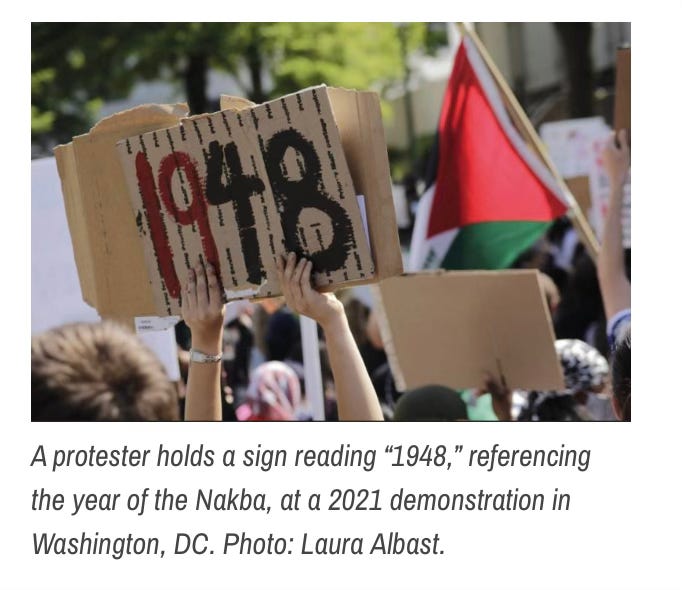
This is not an isolated immigration enforcement action. It is the latest chapter in a long, documented, and deliberate campaign to silence Palestinian voices in the United States, a campaign that predates the War on Terror, predates the Patriot Act, and predates every administration that has recycled its tools. To understand what happened to Salah Sarsour, you must understand what has been happening to Palestinians in America for more than seven decades. The Nakba is not an event; it is a process that continues to unfold and impacts Palestinians across the globe.
On the night of 8 March 2025, plainclothes Immigration and Customs Enforcement agents pushed past Mahmoud Khalil’s eight-months-pregnant wife in a Manhattan apartment building and led the Columbia University graduate and lead negotiator of the Gaza Solidarity Encampment away in handcuffs. He was a lawful permanent resident of the United States. He had been convicted of nothing. Within forty-eight hours, he was in Jena, Louisiana, some 1,300 miles from his attorneys, his family, and the campus where, days earlier, he had been trying to persuade his university to stop investing in the machinery bombing his people.¹ I watched the footage with the peculiar vertigo that only a Palestinian in the diaspora knows: the feeling of watching a very old story arrive in a very new language. I had seen this before, and it is still happening.

The arrest of Mahmoud Khalil, Salah Sarsour, and countless others is not an aberration inside the American story. It is the continuity of another story, one whose first chapter was written in 1917, with the British Occupation, then in 1948, and whose last chapter has never been written because the point of the story is that it will not end. The Nakba travels with Palestinians, and Zionism settler colonial project engages in ethnic cleansing across the globe. Mahmoud Khalil and Salah Sarsour are being ethnically cleansed anew and transferred out of the United States for insisting on narrating Palestine in exile.
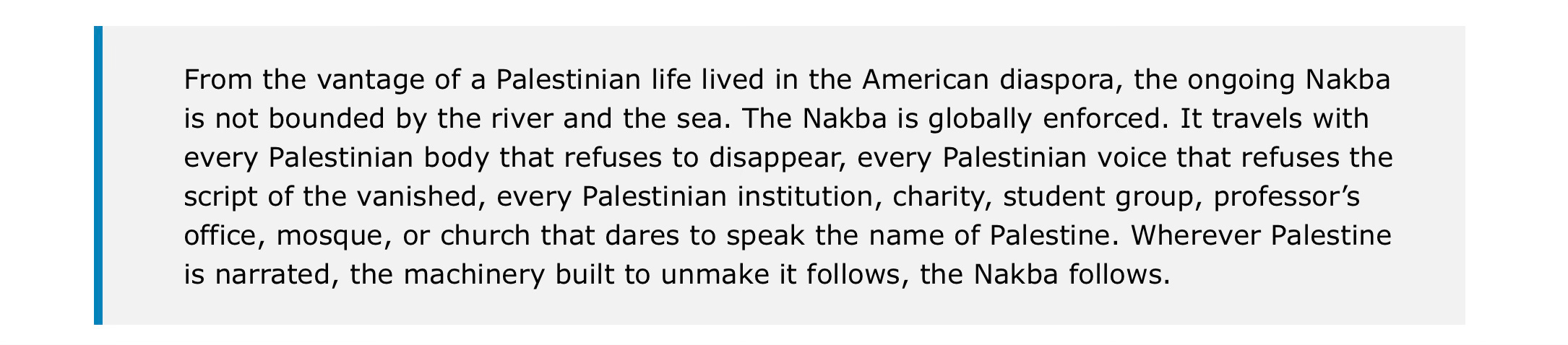
The 1948 Nakba expelled roughly 750,000 Palestinians and destroyed more than 500 towns and villages.² It was, as the Australian historian Patrick Wolfe insisted, not an event but a structure—the founding grammar of a settler-colonial formation whose “logic of elimination” requires the continual unmaking of the native.³ Palestinians have a name for the experience of living inside that structure: al-Nakba al-mustamirra, the continuous or ongoing Nakba, a concept carried into international discourse by Hanan Ashrawi at the 2001 UN World Conference Against Racism and theorized in depth by Joseph Massad and Elias Khoury.⁴ What I want to argue here, from the vantage of a Palestinian life lived in the American diaspora, is that the ongoing Nakba is not bounded by the river and the sea. The Nakba is globally enforced. It travels with every Palestinian body that refuses to disappear, every Palestinian voice that refuses the script of the vanished, every Palestinian institution, a charity, a student group, a professor’s office, a mosque, or a church that dares to speak the name of Palestine. Wherever Palestine is narrated, the machinery built to unmake it follows, the Nakba follows.
Consider whom the machinery has gathered in just the last 36 months. Mahmoud Khalil was finally released on bail in June 2025, after a federal judge found the government’s foreign-policy ground for his detention likely unconstitutional; he had been held 104 days on Secretary of State Marco Rubio’s personal invocation of a dormant 1952 statute empowering the executive to deport a lawful resident whose presence he, the Secretary, deems to have “potentially serious adverse foreign policy consequences.”⁵ Leqaa Kordia, a Palestinian woman from East Jerusalem, was seized in Newark on 13 March 2025, flown to Texas, and held for more than a year on a supposed visa overstay and on the allegation that family remittances to Gaza amounted to “material support” for Hamas, a claim an immigration judge rejected in April 2025 as wholly unsupported. She was finally freed in March 2026.⁶ Salah Sarsour, president of the Islamic Society of Milwaukee, a thirty-two-year lawful resident and father of six United States citizens, was surrounded by nearly a dozen ICE agents on 30 March 2026, accused of lying on a 1993 green-card application and described by the Department of Homeland Security as “a terrorist convicted for throwing Molotov cocktails,” an Israeli military-court conviction obtained when he was fifteen years old, in a system whose rate of conviction of Palestinian minors has been documented at well above 95 percent.⁷ These are not exceptional cases. They are the Nakba genre operating in the diaspora.
The archive is long. In the summer of 1972, weeks after the Munich Olympic attack, the Nixon administration quietly launched Operation Boulder, an interagency program that placed an estimated 150,000 Arab immigrants and Arab-American citizens under FBI and Immigration and Naturalization Service surveillance—officially, to “check records and help establish the identity and immigration status of any Arab or other suspicious person,” but in practice, as scholars at MERIP and in the Arab Studies Quarterly have documented, to drive a wedge between the quiescent and those who insisted on speaking Palestine.⁸ Fifteen years later, in January 1987, federal agents arrested seven Palestinians and the Kenyan wife of one of them, the “LA 8” on charges that they had distributed Palestinian newspapers and raised humanitarian funds. The government invoked the McCarran-Walter Act, a McCarthy-era ideological-deportation statute, and pursued the case through every subsequent administration for the next twenty years, until a judge finally dismissed all charges in 2007, ruling that continued prosecution would constitute “nothing more than persecution.”⁹ Twenty years. Two Palestinian men, teaching, marrying, raising children, building lives under the constant threat of removal for what their attorneys at the Center for Constitutional Rights called lawful First Amendment activity.
The architecture built in the 1970s and tested in the 1980s was industrialized after 11 September 2001. The Holy Land Foundation for Relief and Development, at the time the largest Muslim charity in the United States, was shuttered in December 2001. After a hung jury in 2007, the government retried the case; in November 2008, a Dallas jury returned guilty verdicts on all 108 counts against five men, Ghassan Elashi, Shukri Abu Baker, Mufid Abdulqader, Abdulrahman Odeh, and Mohammad El-Mezain, whose crime was to have sent zakat through local charity committees in the West Bank and Gaza that were never themselves designated as terrorist entities but were alleged to be “controlled by” Hamas. Their sentences ran from fifteen to sixty-five years.¹⁰
Sami Al-Arian, a tenured professor at the University of South Florida and perhaps the most visible Palestinian American Muslim public intellectual, was indicted in February 2003 under the Patriot Act. In 2005, a Tampa jury acquitted him on eight counts and deadlocked on the remaining nine. The government kept him in pre-deportation limbo for another ten years, including a contempt case built around his refusal to testify, before finally deporting him to Turkey in February 2015, twelve years after his arrest, never convicted of an act of violence.¹¹Rasmea Odeh, longtime organizer of the Arab American Action Network in Chicago and a survivor of Israeli torture in the occupied territories, was prosecuted in 2013 for an answer on an immigration form and deported in 2017. The women she served were left without their leader.¹²
The universities, my own place of work, are another front of the same war and the never-ending Nakba. In August 2014, the University of Illinois at Urbana-Champaign revoked the tenured hire of Steven Salaita two weeks before he was to begin teaching, after his tweets protesting the Israeli bombardment of Gaza were declared “uncivil.” He eventually won a settlement, and the chancellor resigned; the chilling effect, however, was the point.¹³ Rabab Abdulhadi, the lone professor of Arab and Muslim Ethnicities and Diasporas program at San Francisco State, has spent nearly two decades in trench warfare with her own administration and with pro-Israel lawfare groups over her right to teach Palestine from a Palestinian standpoint; a federal court dismissed the Lawfare Project’s antisemitism suit against her program, and a faculty grievance panel twice found the administration’s treatment of her unjustified.¹⁴
In April and May of 2024, I watched, along with the world, NYPD officers in riot gear climb a ladder into the second story of Hamilton Hall, which Columbia students had renamed Hind’s Hall for Hind Rajab, the six-year-old child killed in Gaza while begging on the phone for rescue, with weapons drawn. A shot was fired inside the building. More than a hundred arrests were made that night. Columbia’s president resigned by August.¹⁵ These are not separate stories. They are, in Elias Khoury’s words, both “a regime of material violence” and “an ongoing battle of interpretation” whose object is to silence the Palestinian story and relegate it to the past.¹⁶
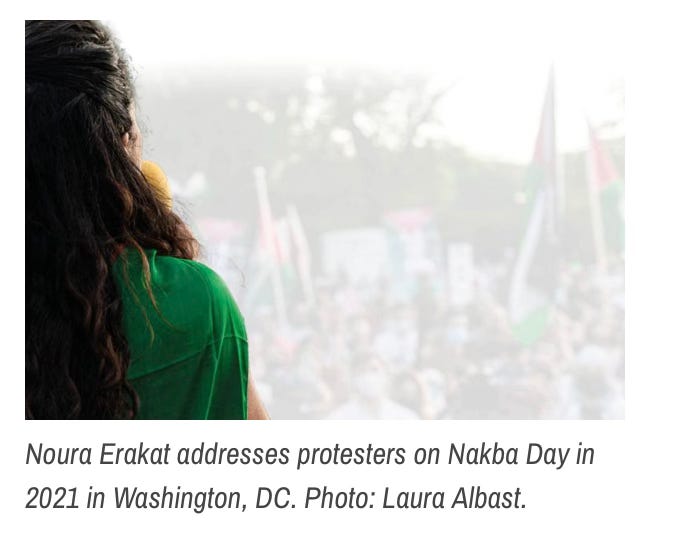
Nor is the apparatus American alone. On 5 July 2025, the British government proscribed Palestine Action, a non-violent direct-action group that had spray-painted military aircraft and locked down weapons-factory doors, as a terrorist organization under the Terrorism Act 2000, bundling it into a single statutory instrument with two neo-Nazi groups.¹⁷ By the end of November 2025, British police had arrested more than 2,500 people, many of them pensioners and priests, for standing peacefully in Parliament Square with cardboard signs bearing the seven-word sentence: “I oppose genocide, I support Palestine Action.” Amnesty International called a single-day tally of nearly 900 arrests in early September “a new low for protest rights” in the United Kingdom, and the UN High Commissioner for Human Rights, Volker Türk, warned that counter-terrorism law was being applied to “conduct that is not terrorist in nature.”¹⁸ The British Charity Commission, simultaneously, has opened a succession of inquiries into Muslim and Palestinian aid charities fundraising for Gaza, even as it has moved only belatedly and reluctantly against British charities funneling money to occupation soldiers and settler militias.¹⁹ Palestinian activists in the United States have long suspected, and independent reporting has confirmed, that the FBI has historically transmitted information to Mossad about Palestinian Americans; more recent investigations have documented the role of Israeli-linked initiatives such as the Psy-Group’s “Project Butterfly” that targeted me directly and the Israel on Campus Coalition in surveilling and smearing US student activists.²⁰ The Mossad’s reach through direct cooperation, through cut-outs, and through ideological allies, extends into our classrooms.
What binds 1972 to 2026, Operation Boulder to Brize Norton, Tampa to Parliament Square, is not coincidence. It is the same logic of elimination in different tactical dress, the Nakba and genocide are always underway. Settler-colonial power is not satisfied with the removal of Palestinian bodies from Palestine. It demands the removal of Palestine from thought. It requires that Palestinian speech, Palestinian memory, Palestinian charity, and Palestinian study itself be recoded as security threats. This is the epistemic violence at the heart of the Nakba. Edward Said warned four decades ago that the Palestinian would never be granted “permission to narrate”; two generations later, the permission has narrowed to a prosecutable offense.²¹
University presidents, social media companies, Home Office ministers, Charity Commissioners, secretaries of state, and immigration judges have become the quiet custodians of a global Nakba whose administrative object is to ensure that 1948, and what followed it, and what follows still, is not said, not seen, not taught, not felt. When it is said, the sayer is held in Louisiana or Texas, in HMP Wandsworth, or in a Manhattan holding cell, until the authorities hope he/she learns to be silent.
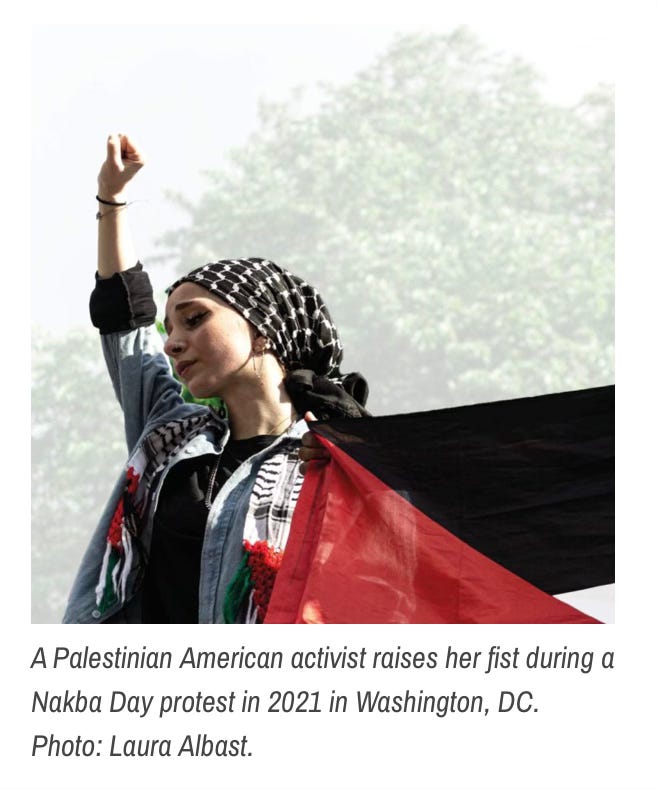
And this is what I want to leave the reader with because we are not, in fact, silent, and we are not, in fact, erased. In the same decade that produced Khalil’s arrest and Sarsour’s detention, I have watched refugee youth in Shatila curate digital archives of their grandmothers’ villages; Palestinian-Chilean writers in Santiago compose manifestos that travel between Spanish, Arabic, and English; mothers in Dearborn, Patterson, and Bay Ridge teach their US-born children to recite the names of the destroyed villages, Dayr Yassin, Lubya, Tantura, Saffuriyya, and Al-Bassa, before those names fall off any available map. Nakba memory is precisely the refusal to accept the genocide of a people as a past tense. It is our focal epistemic node: the point around which a scattered people has reorganized its identity not in nostalgia but as a political form and a center of resistance by recovering and writing the erased history to imagine free-Palestine horizons. Every key passed from grandmother to grandchild, every Nakba Day commemoration in Sydney or Cape Town or Milwaukee, every student who faces expulsion rather than sign the statement demanded of him/her, every scholar who refuses to be fired into silence, is a claim on the Palestine that was, and on the Palestine that awaits actualization.
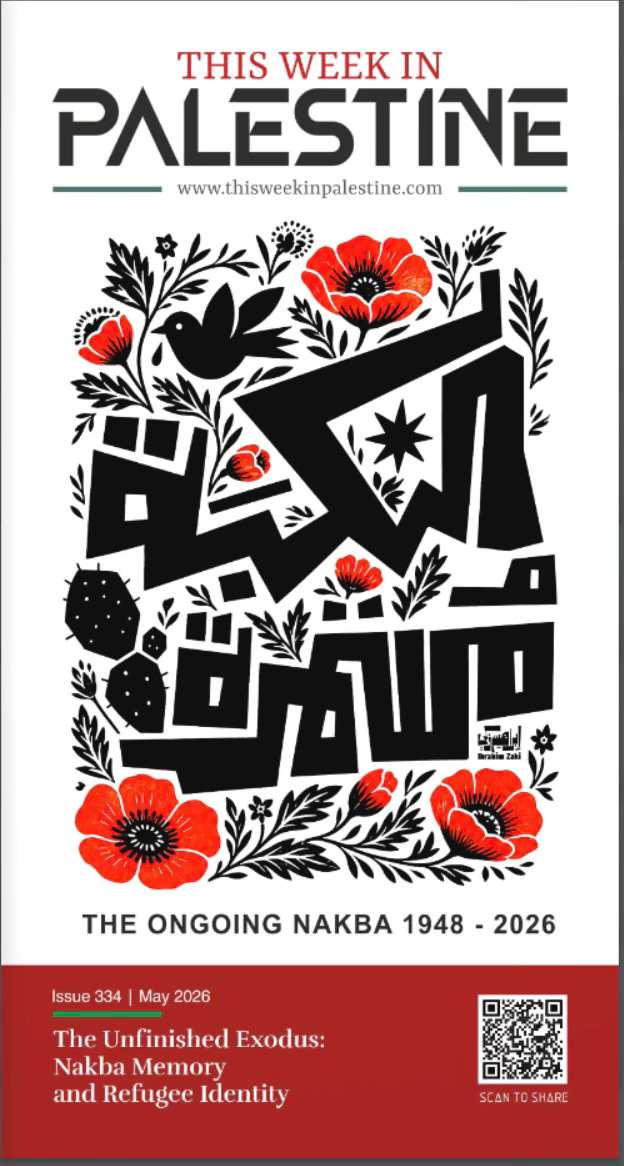
The May 2026 commemoration arrives while 1948 has folded into the genocide of 2023 through 2026 and the globalized machinery that followed it. The point of this issue of This Week in Palestine, as I read it, is not only to remember. The point is to refuse to inherit the category “refugee” as a terminal status, and to insist, as the elders who carried keys across borders insisted, that the right of return is a living demand, not a closed historical claim. The Unfinished Exodus, in this sense, is not only the journey out of Palestine that began in 1948. It is also the journey back into Palestine, from the river to the sea, imagined, dreamed, and increasingly demanded by Palestinians whom the long, global arm of the Nakba has tried, and failed, to silence. That Palestine, the Palestine awaiting actualization, is the Palestine we carry. It is the Palestine, no arrest, no proscription, no raid on a university library, no denial of a grant application, can reach. And it is, in the end, the reason this catastrophe remains unfinished and will be undone in our lifetime.
[1] Islamic Society of Milwaukee official statement, April 2, 2026; NBC News, April 3, 2026; CNN, April 3, 2026; PBS NewsHour, April 3, 2026; ACLU of Wisconsin press release, April 2, 2026; Religion News Service, April 2, 2026.
[2] Spectrum News 1, April 2, 2026; WTMJ Milwaukee, April 3, 2026; ISM official statement confirming Broadview and Clay County jail, Indiana.
[3] Wisconsin Examiner, April 3, 2026; Religion News Service, April 2, 2026; Muslim Legal Fund of America statement, April 2026; DHS press statement confirming ‘foreign policy threat’ and ‘funding terrorist organizations’ designations.
[4] Attorney Munjed Ahmad, quoted verbatim in NBC News, April 3, 2026; CNN, April 3, 2026; PBS NewsHour, April 3, 2026; Wisconsin Watch, April 6, 2026; Washington Examiner, April 3, 2026; Associated Press wire, April 3, 2026.
Endnotes
1. See Eyder Peralta, “Mahmoud Khalil: Green card holders’ rights in spotlight after arrest,” NPR, 11 March 2025, npr.org; “ICE Detains Green Card Holder over Columbia University Gaza Activism,” Democracy Now!, 10 March 2025, democracynow.org; Andrew Raja, “Who is Mahmoud Khalil? A look at the Columbia University protestor detained by ICE,” CNN, 11 March 2025, cnn.com.
2. For foundational figures on 1948 expulsions and village destruction, see the Institute for Palestine Studies, palestine-studies.org; and Rashid Khalidi, Noura Erakat et al., “Toward Nakba as a Legal Concept,” Columbia Law Review 124 (2024), columbialawreview.org.
3. Patrick Wolfe, “Settler Colonialism and the Elimination of the Native,” Journal of Genocide Research 8:4 (2006), 387–409.
4. Elias Khoury, “Rethinking the Nakba,” Journal of Palestine Studies (2012), as cited in Khalidi and Erakat, “Toward Nakba as a Legal Concept,” above, n. 2.
5. On Khalil’s June 2025 release and the constitutional analysis, see “Mahmoud Khalil’s Lawsuit Can Move Forward in Federal Court, Judge Finds,” ACLU, aclu.org; and “Judge orders Columbia University protester Mahmoud Khalil freed from immigration detention center,” PBS NewsHour, pbs.org.
6. Amy Goodman, “Meet Leqaa Kordia: Palestinian Protester Freed After a Year in ‘ICE Dungeon’,” Democracy Now!, 3 April 2026, democracynow.org; “Over a year later, pro-Palestinian protester is released from ICE custody,” NBC News, nbcnews.com; “Who is Leqaa Kordia, the Columbia protester still in ICE detention?” Al Jazeera, 8 February 2026, aljazeera.com.
7. Candice Bernd, “Locked Up by Israel at 15, Palestine Activist Is Now Jailed by ICE,” Truthout, truthout.org; “Palestinian activist, Milwaukee Islamic Society Pres. Salah Sarsour detained by ICE,” Wisconsin Examiner, 3 April 2026, wisconsinexaminer.com. On conviction rates in Israeli military courts for Palestinian minors, see Military Court Watch and Save the Children, “Defenceless: The Impact of Israeli Military Detention on Palestinian Children” (2020).
8. Joseph Nordmann, “From 1967 to Operation Boulder: The Erosion of Arab Americans’ Civil Liberties in the 1970s,” Arab Studies Quarterly 40:1 (2018), 41–56, scienceopen.com; “Covering Surveillance, Struggles and Solidarity in the Arab American Community,” Middle East Report (MERIP), November 2021, merip.org.
9. “Judge Throws Out Charges in 20-Year-Old Palestinian Deportation Case,” ACLU of Southern California, aclusocal.org; “The Case of the L.A. 8,” Democracy Now!, 2 November 2007, democracynow.org; “In the Matter of Hamide and Shehadeh,” Center for Constitutional Rights, ccrjustice.org.
10. “Islamic charity leaders convicted in terror financing case,” CNN (Associated Press), 25 November 2008, cnn.com; “USA v. Holy Land Foundation for Relief and Development,” Charity & Security Network, charityandsecurity.org.
11. Glenn Greenwald and Murtaza Hussain, “Sami Al-Arian, Professor Who Defeated Controversial Terrorism Charges, Is Deported from U.S.,” The Intercept, 5 February 2015, theintercept.com; “Exclusive: Deported Palestinian Scholar Sami Al-Arian on His Chilling Post-9/11 Prosecution,” Democracy Now!, 6 February 2015, democracynow.org; “Ex-USF professor Sami al-Arian deported to Turkey,” Tampa Bay Times, tampabay.com.
12. “US judge orders deportation of Palestinian activist,” Al Jazeera, 17 August 2017, aljazeera.com; Yana Kunichoff, “Rasmea Odeh, deported but not defeated,” The Chicago Reporter, chicagoreporter.com.
13. Cary Nelson and John K. Wilson et al., “Steven Salaita, the Media, and the Struggle for Academic Freedom,” Academe (AAUP), aaup.org; “Settlement Reached in Case of Professor Fired for ‘Uncivil’ Tweets,” Center for Constitutional Rights, ccrjustice.org; Murtaza Hussain, “Professor Hopes to Return After Being Fired for ‘Disrespectful’ Tweets Against Israel,” The Intercept, 20 October 2015, theintercept.com.
14. Colleen Flaherty, “Palestinian scholar accuses SFSU of broken contract promise,” Inside Higher Ed, 21 March 2022, insidehighered.com; “A Victory! Professor Rabab Abdulhadi wins second grievance at SFSU,” Mondoweiss, February 2022, mondoweiss.net.
15. “After police crackdown, what’s next for Columbia’s Gaza protesters?” Al Jazeera, 1 May 2024, aljazeera.com; “How Protesters Occupied a Columbia Building for 21 Hours Before NYPD Stormed In,” Columbia News Service, 1 May 2024, columbianewsservice.com; “Columbia students who occupied Hamilton Hall in pro-Palestinian protest expelled, suspended,” ABC News, abcnews.go.com.
16. Elias Khoury, “Rethinking the Nakba,” Journal of Palestine Studies (2012), cited in Khalidi and Erakat, “Toward Nakba as a Legal Concept,” Columbia Law Review 124 (2024), columbialawreview.org.
17. “UK police arrest almost 900 protesters at pro-Palestine Action rally,” Al Jazeera, 7 September 2025, aljazeera.com; Smriti Mallapaty, “The Shrinking Space for Public Protest: Examining the United Kingdom’s Proscription of Palestine Action,” Georgetown Journal of International Affairs, 10 December 2025, gjia.georgetown.edu.
18. “UK: nearly 900 arrests at Palestine protest shows Government’s disregard for our protest rights,” Amnesty International UK, amnesty.org.uk; “UK: Palestine Action ban ‘disturbing’ misuse of UK counter-terrorism legislation, Türk warns,” OHCHR, 25 July 2025, ohchr.org.
19. Oscar Rickett, “Why Muslim charities face disproportionate scrutiny in the UK,” Middle East Eye, middleeasteye.net; “Charity Commission Still Hasn’t Concluded Investigation Into UK Charity One Year After Revelation It Raised Money for Israeli Soldiers,” Byline Times, 5 February 2025, bylinetimes.com.
20. James Bamford, “Israel’s War on American Student Activists,” The Nation, thenation.com; “Israeli Spies in the US,” Middle East Report 136/137 (January/February 1986), merip.org.
21. Edward W. Said, “Permission to Narrate,” London Review of Books 6:3 (16 February 1984), lrb.co.uk.

