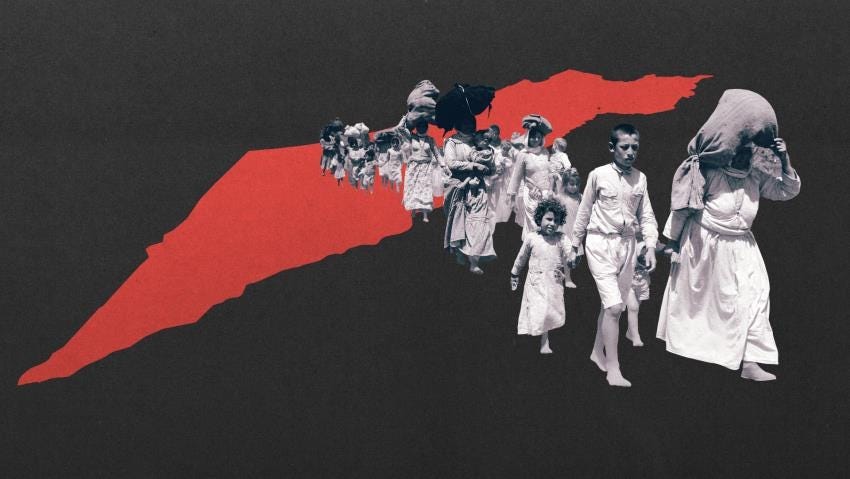
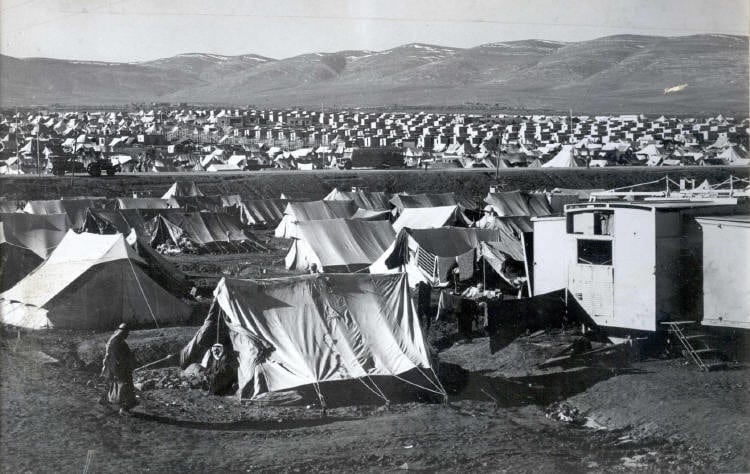
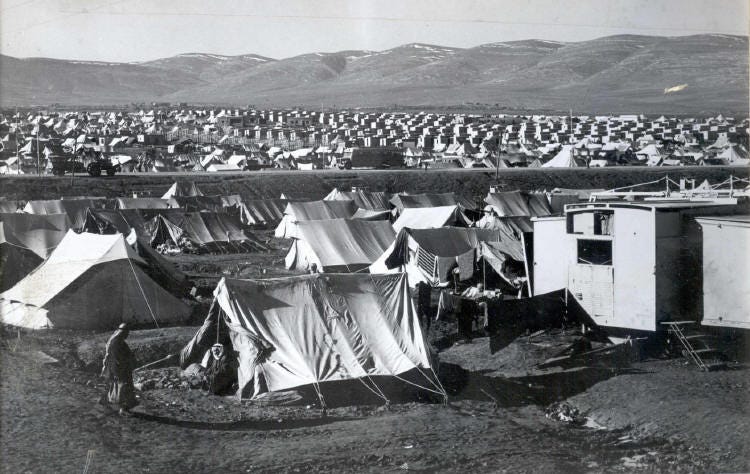
One underreported consequence of the U.S. invasion of Iraq among many others is the impact it had on Palestinians living in the country. A large number of Palestinians moved to Iraq immediately after the 1948 Nakba. As a direct result of the U.S.’s invasion in 2003 and the subsequent intense internal sectarian conflicts large numbers of Palestinians ended up in Al-Hol, Al-Tanaf, Al-Ruweished and Al-Walid refugee camps in the Iraqi desert. It is important to remember that pro-Israel Neo-Conservative in the Bush administration heavily lobbied and influenced the decision making process that led to the invasion of Iraq and anti-Palestinians sentiments were present among those who crafted and implemented the policy. As US forces entered Baghdad the Palestinians living in the country became a target under the pretext of being favored by Saddam during his reign and ended up forced out from various areas around the city. Israel’s pursuit of Palestinians through Neo-Conservative operatives involved in running post-Iraq invasion impacted the already exiled population and forced them out of another safe refuge.
For some Palestinians this was the third or fourth time they have become refugees and it was only when the U.S. began to withdraw its troops from Iraq that it had to take responsibility under international law of almost 34,000 stranded Palestinians on border camps and finally admitted them as refugees starting at the end of 2008. Palestinians were forced out from Jordan in the early1970s, and after the Lebanese civil war and Israel’s invasion of the country in 1982. As a direct result of Israel’s invasion of Lebanon thousands of Palestinians were “relocated” per an American negotiated agreement and moved to distant countries including Yemen, Tunisia, Sudan and Libya. Certainly, those who were relocated faired better than those left behind because the Israeli forces commanded by Ariel Sharon and Rafael Eitan unleashed the Christian Phalangist forces on the Sabra and Shatila refugee camp and in a three-day period somewhere between 762–3500 defenseless civilians were massacred.
Similar circumstances faced Palestinians in Kuwait after Saddam’s invasion of the country in 1991 when the PLO expressed sympathies or neutrality to an Arab-Arab conflict and the end result was many Palestinians were driven out by Kuwait into the Empty Quarter despite some being in the country since 1948. Lastly, the on-going civil war in Syria has produced shocking images of Palestinian in Al-Yarmouk refugee camp and at various periods many were caught in the crossfire and urged to take sides as a pre-condition for providing badly needed food and supplies. More critically, Palestinians living in Western countries experience the long arm of Zionism and Israel’s lobbying effort that influence legislation that impact their ability to speak and organize for Palestine as well as strategies of entrapment into terrorism cases. Post 9/11 in the US and following several terrorism events in Europe, Palestinians were a primary target for security agencies harassment and arrests in bogus cases due to the heavy reliance and training provided by Israeli agencies to their Western counterparts. It would not be an exaggeration to state that the bulk of the post 9/11 terrorism cases in court were either directly or indirectly connected to the Palestine struggle and the success of Israel’s security agencies to hijack the anti-terrorism apparatus in the US and Europe and direct it to silence Palestinians.
The cases mentioned above are listed to illustrate the simple fact that the Nakba for the Palestinians continues and did not end in 1948. Even though the conflicts in each case above has its own specific circumstances; nevertheless the Palestinian appearance in each is directly connected to the 1948 expulsion first and foremost and the lack of a sovereign homeland that can serve as a permanent abode to this constantly problematized and persecuted population. The responsibility for what has befallen the Palestinians since 1948 rests at the hand of an “original Zionist sin” that planned and saw to it the expulsion and dispossession of Palestine’s indigenous inhabitants and forced them into refugee camps and permanent diaspora. “The guilt of the Israeli state”[1] is bringing about the expulsion so as to crate and exclusivist Zionist state is supported by Israeli archival document, eyewitness testimonies and circumstantial evidence. What a paradox for the Zionist to claim Palestine as a colonial project so as to bring an end to the long Jewish persecution, diaspora and suffering. The Zionist ended up creating in the Palestinian refugees a mirror image of their own Jewish history and the continued effort to pursue them non-stop in the region and across the world is a further stark reminder of this similarity.
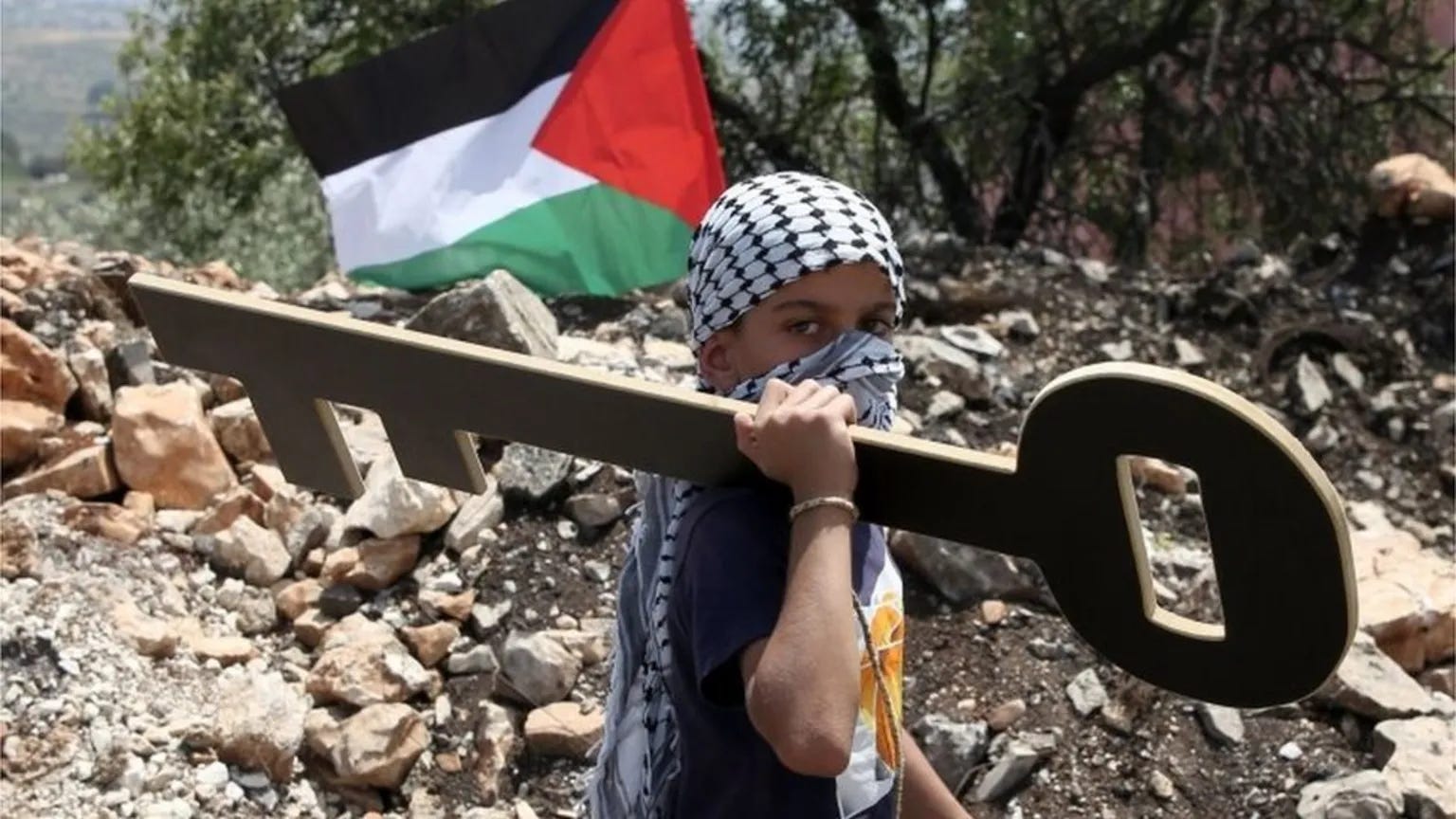
Immediately Zionists will point to the horrible treatment Palestinians receive at the hands of Arab regimes, which is indeed horrible but Zionism and its colonial project brought about the presence of Palestinians in each of these countries in the first place. Almost 75 years removed from the 1948 Nakba, Israel and the Zionist spokespeople continue to refuse taking responsibility for what their hands had wrought on the Palestinians. More criminally is the fact that Israeli and Zionist leaders continue to blame the refugees for their predicament by insisting that they left on their own accord and not because of coordinated and deliberate use of violence and massacres. Zionism being a colonial project modeled on its European counterparts did not recognize the existence of indigenous population and even when it was well documented it only rationalized the need to remove them for modernity and progress to emerge. Thus, past and present Israeli leaders at the highest levels are responsible for the expulsion and dispossession of the Palestinians for they were standing in the way of the march of Jewish modernity and nationalism. Professor Abdel Jawad observes, “Zionism shared the belief in the existence of “empty land” with the ideology of colonialism.” Furthermore, it was easy and self serving for “Zionist leaders quickly adopted Lord Shaftesbury’s famous slogan: “a land without people for a people without land” despite the fact that internal documents, especially a speech entitled ‘The Hidden Question,’ illustrate that they were troubled by the presence of the Palestinians.”[2]
No movement forward on the addressing the issue of Palestine without the Israeli government and Israeli society coming to terms with the collective responsibility they bore for the ethnic cleaning and the benefits that the society collectively draw upon from removing the Palestinians from their homes, lands and towns. Ethnic cleansing and expulsion is not a matter of public relations or a Hasbara strategy session, rather it is a moral and ethical issues that must be addressed for any solution to emerge. Many Palestinians and I are as firm as can be on the question of holding Israel and the Zionist project responsible for what has befallen Palestine and its people. Zionism worked to create the new modern and powerful Jew and to redeem the land so as to bring body and land together but the Palestinians were the impediment to be removed for the birth of a distorted Zionist modernity.
The Nakba is the price of birthing Zionist modernity and Palestinians are living its consequences. For diehard Zionists, the price was worth it and the expulsion of the Palestinians within Zionism’s colonial racial structure is further rationalized. To better understand the impacts of what has befallen the Palestinians, I will highlight certain aspects that made the Nakba possible and in the process dispense with the standing Zionist propaganda that continues to engage in willful and sophisticated acts of denial as well as in cases outright justification for ethnic cleansing. Taking stock of what happened to the Palestinians during the 1948 war is more critical and constitutes the first step in beginning to address the ongoing crisis effecting Palestine and the constant efforts to address the issue without digging deeper on how we got to where we are at today.
The title of the chapter speaks directly to Benny Morris’ foolish defense of deliberate and systematic acts of ethnic cleansing undertaken by Ben-Gurion and the Zionist leadership during the 1947–49 war and its immediate aftermath. In a 9 January 2004 Haaretz interview, Morris defended the atrocities committed by Israeli leaders with the following statement:
“Ben-Gurion was right. If he had not done what he did, a state would not have come into being. That has to be clear. It is impossible to evade it. Without the uprooting of the Palestinians, a Jewish state would not have arisen here.… But in certain conditions, expulsion is not a war crime. I don’t think that the expulsions of 1948 were war crimes. You can’t make an omelet without breaking eggs. You have to dirty your hands…. I don’t think they felt any pangs of conscience, and in their place I wouldn’t have felt pangs of conscience. Without that act, they would not have won the war and the state would not have come into being….There are circumstances in history that justify ethnic cleansing. I know that this term is completely negative in the discourse of the 21stcentury, but when the choice is between ethnic cleansing and genocide … I prefer ethnic cleansing…. A Jewish state would not have come into being without the uprooting of 700,000 Palestinians. Therefore it was necessary to uproot them. There was no choice but to expel that population.”[3]
Who determines the historical circumstances that would “justify ethnic cleansing” and should it be left to the perpetrator of the crime to determine it? Wouldn’t this type of argument become the standard defense for every act of genocide and ethnic cleansing? In the quote Morris is clear about Ben-Gurion’s responsibility for the expulsion but in other parts of the interview and earlier writings he maintains that the Zionist leadership did not have a plan for the expulsion and only acted in self-defense and in many cases against hostile population. Admitting the expulsion in the course of a war is different, at least this what Morris and other Zionist argue, than having a deliberate, methodical and systematic plans. Precisely, the question of plans and how the Nakba was brought about deserves utmost attention and not because the Palestinian victims did not know what happened to them rather to continue to understand, contextualize and expose the Zionist colonial project.
Indeed, the Palestinian Nakba is an unfinished project both in attempting to narrate and recognize what actually happened and the basic fact that those expelled are awaiting the fulfillment of the right of return and a measure of justice. As to what happened, the core arguments maybe reduced to two: forced and pre-planned expulsion and ethnic cleansing or voluntary evacuation and circumstantial movement due to war and hostilities.
Each of the conceptualization as to what happened has a set of rationale, cluster of scholars, writings associated with it and if taken as the basis of the 1948 events then implications on how the Palestine Nakba is approached. At the heart of the debate on what happened in the Nakba rests the question of accountability, responsibility, and measured steps to achieve justice for the victims. On the one hand, Israel’s advocates insist on innocence on the primary question and whether the Haganah and the Zionist leadership had had a pre-planned, coordinated and organized ethnic cleansing strategy that they put into effect during the war. At best, Israel’s advocate and protectors, like Morris above, accept the fact that ‘some’ massacres occurred during the 1948 war but all supposedly took place in the ‘heat of battle’ and based on the development on the ground and not on any centralized directives from Ben-Gurion or his cabinet. Furthermore, the massacres that then were followed by Palestinian ‘flight’ or ‘voluntary movement’ were on the whole unplanned and if by force, according to established Zionist narrative, was to remove a hostile Arab population intent on fighting and undermining the security of the would be new Zionist state. The Palestinians in the constructed Israeli propaganda were a hostile population that if left in the country would constitute a fifth column and would not reconcile itself with Zionism and was in reality awaiting the unified Arab response and armies who are coming to the rescue.
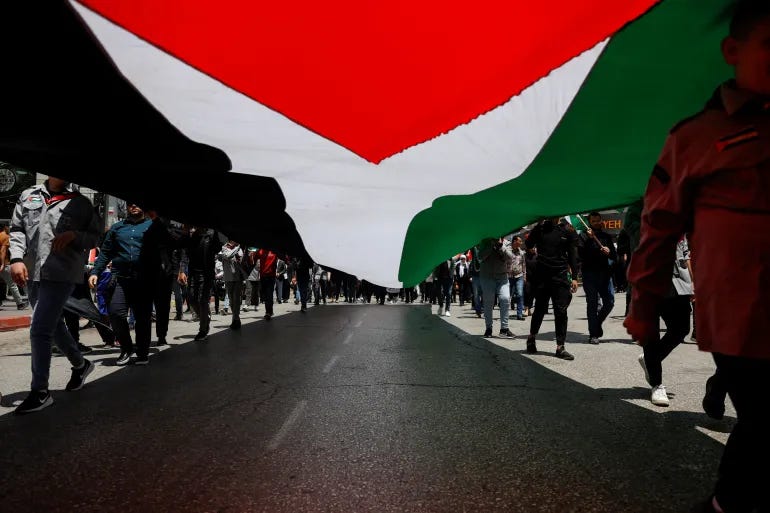
In the Israeli authorized narrative, the Palestinians are an aggressor population that brought about its own dispossession and as such Zionism and the Jewish leaders in the newly established state are not responsible or owe anything to address the injustice that has befallen the population. We are reminded constantly that Israel and the Jewish population in Palestine were fighting a war of survival and facing an existential threat from the Palestinians and the combined forces of five Arab armies that ‘invaded the country’ in an attempt to ‘throw the Jews to the sea’ and commit another genocide. More critically, the authorized narrative maintains that the early Zionist were in favor of having a bi-national state and had no intention whatsoever to expel or transfer the Palestinians out of the UN defined territory or the state that emerged during the war. Indeed, the Palestinians are cast as the historical Refuseniks in the struggle for a bi-national or diverse political order and the Zionist were brought to the idea of transfer only through the Peel Commission and the involvement of the British.
Consequently, the debate on the 1948 war and Nakba is more intense than say the post 1967 period occupation and settlements building because it goes to the core of the Palestinian cause i.e. the expulsion, dispossession and building a new state on top of their ruins. Palestinian’s narrative that is based both on documentary and circumstantial evidence maintains that the Nakba was not an accidental occurrence and it was a well-planned and executed strategy to empty the land of its indigenous inhabitants. The location, and strategy of the actual massacres that occurred during the war were well thought out, deliberate, methodical and carried with precision to bring about a decisively Jewish majority state in the areas designated for the Zionist state. The goal is to have a Zionist majority state by any means necessary, which meant massacres, expulsion and dispossession.
The narrative of Israel as a modern day David facing the Goliath of 5 Arab armies has to be set aside and understood as being part of a sophisticated post Nakba Zionist propaganda and a Hasbara narrative that succeeded in rallying western public opinion in its favor and in the process blaming the victims for their predicament. Critically, one has to grasp that the Zionist narrative was introduced into a western public opinion that was dealing with the effects of WWII on the one hand and the existence of a deep orientalist reservoir informed by scholarship rooted in an imagined east and an attempt, at least in the fields of archeology and biblical studies, to locate the Holy Land and ‘authenticate’ the Bible as ‘real’ history. As a matter of fact the selling point for the Zionist narrative was not as hard since western public opinion and the political leadership was already behind the project as early as WWI and the UN process demonstrated in more than one way that Zionism and western interests in the region were fused at a much earlier stage than 1948 Nakba itself. In reality, the Palestinians were the little David that was part of a colonized third world, indigenous, pre-industrial, pre-capitalist, agrarian and shared cropping agricultural based society with highly distorted, colonially appointed and dysfunctional leadership facing the Zionist Goliath that was supported initially by a British colonial Goliath, then adopted by an American imperial Goliath, to be funded and nurtured into hegemonic power by the combined wealth and strength of multiple Goliaths including those in the Arab and Muslim world, who worked to strike their own deals to secure their seats of power at the expense of the Palestinians. If honesty on the global stage could be entertained for a brief moment, then the real surprise and shock for many is that the little Palestinian David is still hanging around, standing and making noise after facing such over-whelming odds.
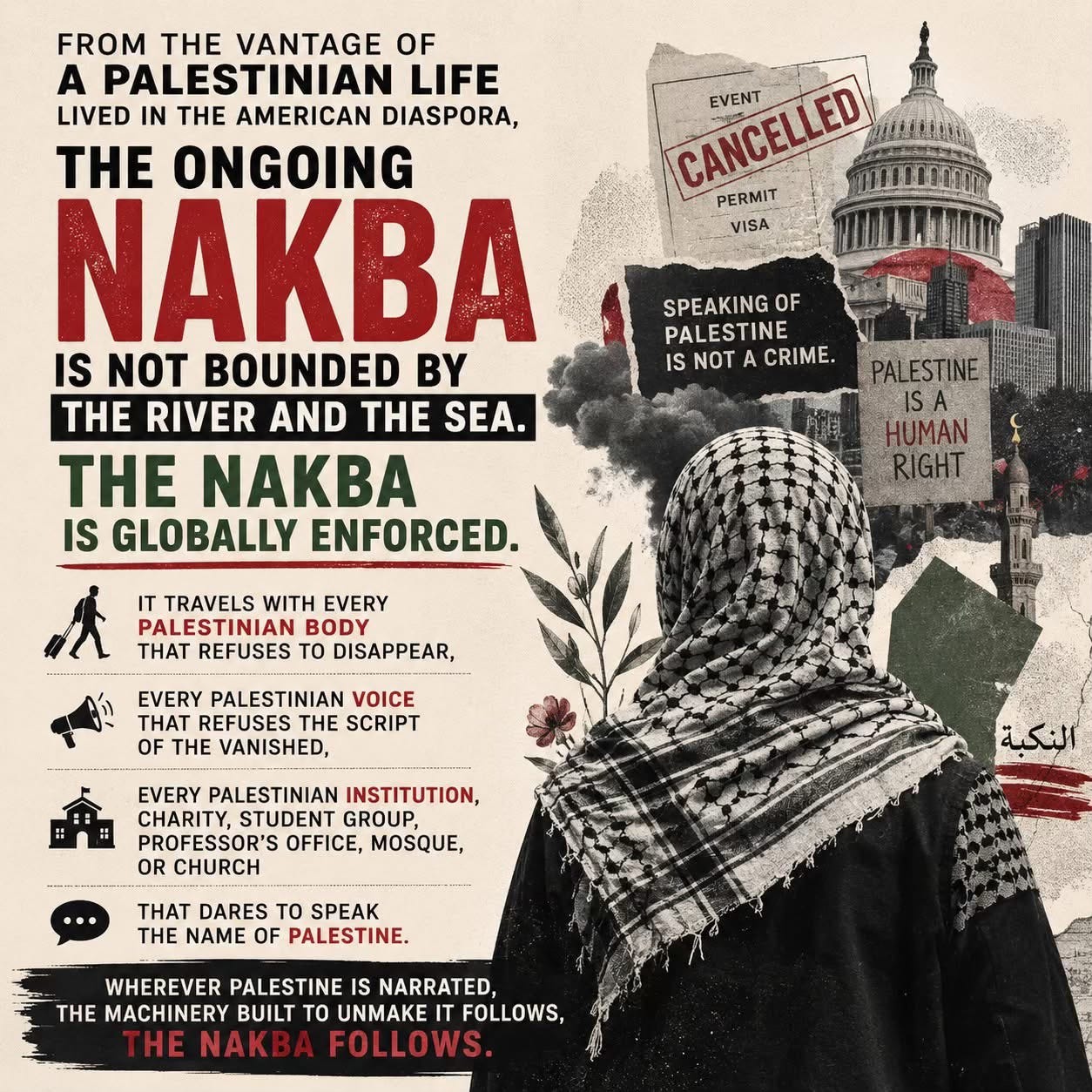
Every piece of information related to Zionism and the establishment of the State of Israel that points toward a pre-planned ethnic cleansing is debated and argued beyond recognition so as to maintain the authorized propaganda narrative intact and absolve Israel of responsibility. Nur Masalha in his book, The Palestine Nakba: Decolonizing History, Narrating the Subaltern, Reclaiming Memory, maintain that “the Nakba is the turning point in the modern history of Palestine — that year over 500 villages and towns and a whole country and its people disappeared from international maps and dictionaries.”[4] Critical at this juncture to remember that the on-going debate is not whether Palestine has been erased and depopulated, rather who is responsible and what forces came together to cause 780,000 civilians to abandon their homes, lands, villages and towns in the span of 6 months and never allowed to return afterward. The extent of obfuscation and outright deception when it comes to 1948 Nakba with the insistence of Israel and its many defenders to maintain a national and global state of denial for what was done to the Palestinians is the real issue at hand.
Palestinian scholar Omar Dajani situates the meaning of the Nakba for Palestinians and its centrality in identity formation in the following way:
“The nakba is the experience that has perhaps most defined Palestinian history. For the Palestinian, it is not merely a political event — the establishment of the state of Israel on 78 percent of the territory of the Palestine Mandate, or even, primarily a humanitarian one — the creation of the modern world’s most enduring refugee problem. The nakba is of existential significance to Palestinians, representing both the shattering of the Palestinian community in Palestine and the consolidation of a shared national consciousness. In the words of Baruch Kimmerling and Joel Migdal, ‘Between the last month of 1947 and the four and a half months of 1948, the Palestinian Arab community would cease to exist as a social and political entity.’ Hundreds of villages would be destroyed, urban life in Palestine’s most populous Arab communities would disappear, and almost a million Palestinians would be rendered homeless and/or stateless.
At the same time, ‘the shared events of 1948… brought the Palestinians closer together in terms of their collective consciousness, even as they were physically dispersed all over the Middle East and beyond…
Although it bears emphasizing that Palestinian political consciousness predated the nakba by several decades and many Palestinians’ sense of connection to their towns and lands extends back many generations further, it seem clear that noting forged Palestinian identify surely as the loss of Palestine.”[5]
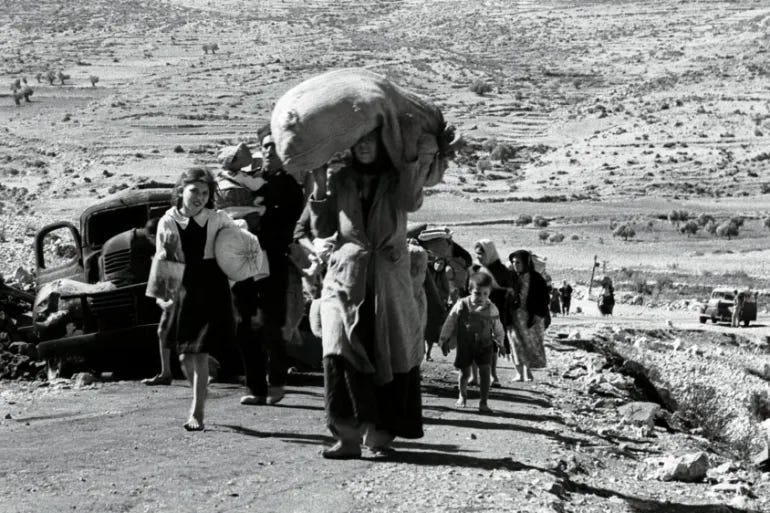
Important to recognize at the outset that the Nakba is not a singular event that occurred in the past and as such disconnected from contemporary unfolding developments impacting Palestinians inside and outside of Palestine. In reality, the Nakba, as a multilayered and cross-generational occurrence, has not ended and it continues to unfold daily in Palestine itself as well as across the globe wherever Palestinians are living in the Diaspora. On a personal level, my own mother lost her brother during the Nakba as he never returned to the family home in Jerusalem and up to this day no one knows what happened to him. How to measure this loss and the inability to know on the one hand what happened and to assess the emptiness felt at the time and then for all the family members who have been denied the ability to experience and share the life with him. The stories of loss, separation, death and flight are related by every Palestinian family either directly impacted or having to respond to the massive influx of refugees streaming to cities and towns in what became known as the West Bank or the Gaza Strip.
My own father could not return to Palestine since he left and could not make it back to attend the funeral for the passing of his father first and then after a period the passing of his mother as well. On both occasions, my father received people at home to offer condolences and up to the day of his passing he never was able to make it back to Nablus to visit the graves of his own parents and to spend time in the city of his birth, where he spent his early childhood, worked, got married and had kids.
One can make a direct connection between the Nakba and Palestinian circumstances inside and outside Palestine in such a way to illustrate how the 1948 catastrophe unfolds daily in small and large ways. Consider that some Palestinians had to endure multiple dispossessions and expulsion as a result of the initial removal from their homelands and properties in 1948. A person expelled in 1948 Nakba and forced out from the West Bank in 1967, Jordan 1970, Lebanon 1982, Kuwait 1992, Iraq 2003, Syria 2011 with no end in sight. While the specific events that caused each of the above episodes might be seen and considered as separate and distinct; nevertheless the key and fundamental issue is that Palestinians were made into a stateless people by Zionism’s creation of the State of Israel and the expulsion of the Palestinians. What the Nakba means for the Palestinians and how to view it correctly according to Dr. Adel Samara is important and emphasizes this point in commenting on the on-going ethnic cleansing that has not stopped since 1948.
“ethnic cleansing takes place against a nation mainly once and for a certain period of time, but in the case of Palestinian ethnic cleansing it has been carried out till the present time. What they did and still do against us is different. They have never been satisfied with the 1948 occupation and they have been committing ethnic cleansing since then: on a daily basis in Jerusalem, confiscating land in the WB [West Bank], and making Gaza the largest jail in history. What they did and still do is a total destruction of our geography, social fabric, class structure, demography, economy, and even their culture they did not hesitate to steal.”[6]
Zionism, as a settler colonial project, achieved its stated aims and established a state but at the same time caused the eraser of Palestine from the maps and worked since to frustrate and prevent the emergence of a Palestinian state or even to permit the presence of a sustainable and independent Palestinian political and social order. Herzl’s vision of a state was “something colonial” from its inception and involved the ‘spiriting’ of the indigenous population across the border, which occurred through the deployment of systemic, methodical and deliberate violence. Colonial projects are structured around violence and are sustained by it.
“Spirit the penniless population across the border” is the epistemic violent stamp that informs Zionism and provides the logic for expelling the Palestinians. For sure Zionist leaders in the 1920s and 30s debated and attempted to make a distinction between expulsion and transfer but it was an attempt to ‘humanize’ the dispossession process and a semantic difference pointing to the same outcome. “The Hidden Question”[7] for Zionism then was and is today the presence of the Palestinians and their continued collective attachment to their homeland. As long as Palestinians remained in Palestine the possibility of achieving a decisive Jewish majority state was elusive and the remedy from the beginning was ‘the transfer’, a euphemism for dispossession and expulsion. The concept of transfer central to Zionist thought was discussed in the previous chapter and it is important to re-call the village files developed in late 1930s and all the way up to the creation of the state because they serve the intended purpose during the 1948 Nakba:
“We had to study the structure of the Arab village. This means the structure and how best to attack it. In the military schools, I had been taught how to attack a modern European city, not a primitive village in the Near East. We could not compare it [an Arab village] to a Polish, or an Austrian one. The Arab village, unlike the European ones, was built topographically on hills. That meant we had to find out how best to approach the village from above or enter it from below. We had to train our “Arabists” [the Orientalists who operated a network of collaborators] how best to work with informants.”[8]
The village files’ importance can’t be overemphasized since the documents provided the geographical and demographical blueprint for the Palestinian society at a critical juncture in the history of the conflict. As a matter of fact, the Palestinians themselves did not have such survey for villages or town and for sure had no such extensive and detailed materials on Jewish settlement prior to the 1948 war. More than anything, the ability to survey and record the country reflects the power and institutional differential between the Palestinian Arabs and the Zionist toward the end of the Mandate period. As discussed earlier, the Mandate Authority made it possible to create a Zionist state in the wings, which was illustrated first in the military preparedness and the ability to systematically document Palestine for the colonization purposes and not for the benefit of the Palestinians. The village files harbor back to Napoleon’s Egypt campaign, which had a scientific project to record the country for the benefit of the French colonial program and it was reflective of power relations. Colonialism is about creating new “facts on the ground” that erase the indigenous footprints while writing the colonizers narrative, modernity and conquest all over it.
Knowledge production is reflective of power and in the case of the village files it was the power to document Palestine and the Palestinians in ways and manners they themselves could not imagine nor contemplate or had the institutional capacity to undertake or resources to do it. Another relevant issue related to the village files is the relationship established early on in the Zionist project between academic and scholarly pursuits and colonization. In Israel’s case they are inseparable, co-dependent, colonially constitutive and structurally infused. The Israeli university is an embedded institution within the framework of the Zionist colonial project and continues to operate within this framework up to the present period. The village files of the pre-state period are today’s demographic research units and university departments focused on counting how many Palestinians there are in the neighborhood, the security threat they pose and what would it take to make them leave/exchange with the PA/find jobs for them abroad/ and possibly transfer to Jordan. A racist epistemic informs every aspect of the Zionist colonial project and all knowledge produced by it is vested in power to define and negate the indigenous Palestinians. Furthermore, Israeli universities are founded upon a “Doctrine of Discovery” epistemic with the land and space being taken from the indigenous Palestinians.
Zionism humane racism is so visible and encompassing that you have to be mentally blind not to see through it but alas Israel defenders insist on defending the un-defensible. Just as important is Israeli universities’ role in the theft of Palestinian intellectual, literary and cultural heritage that is contained in thousands of books and whole libraries that were confiscated, robbed and transformed into academic archives overseen by faculties and researchers wedded into Zionism’s colonial project. How many books are held at Israeli universities and the state national archives that were taken from a Palestinian home, school, mosque and research center in 1948, 1967, 1982 in Lebanon and during the 1st and 2nduprisings. What can be said of an academic enterprise that collectively benefited from ethnic cleansing and not only the land that was taken but also the actual books belonging to the forcefully expelled and dispossessed Palestinians? Zionism defenders and “scholars” speak of Israel’s contribution in the scientific and academic fields but fail to honestly acknowledge the massive intellectual crime committed against the Palestinians by stealing the books they own and have kept for generations. The pillaging of Palestinian sources and cultural heritage did not stop and continues to the present day as the last massive stealing of archival materials occurred at the start of the al-Aqsa Inifada as the Israeli military confiscated all documents from the Palestinian Orient House in Jerusalem and up to this day refuses to return any of the materials taken.[9]
Coming back to the Nakba and the central Zionist idea of transferring the Palestinians so as to achieve a decisive Jewish majority state. Certainly, Ben-Gurion embraced the Peel Commission’s transfer plan and pressed other Zionist leaders to accept the recommendations despite the majority viewing the small area allotted for the Jewish state as being in violation, as far Zionist opinion at the time, of the Balfour Declaration that encompassed all of Palestine and parts of Jordan. In a letter addressed to his son, Ben-Gurion speaks openly of the forceful transfer of the Palestinian from the Negev:
“Let us assume that the Negev will not be allotted to the Jewish state. In such event, the Negev will remain barren because the Arabs have neither the competence nor the need to develop it or make it prosper. They already have an abundance of deserts but not of manpower, financial resources, or creative initiative. It is very probable that they will agree that we undertake the development of the Negev and make it prosper in return for our financial, military, organizational, and scientific assistance. It is also possible that they will not agree. People don’t always behave according to logic, common sense, or their own practical advantage. Just as you yourself are sometimes split conflicted between your mind and your emotions, it is possible that the Arabs will follow the dictates of sterile nationalist emotions and tell us: “We want neither your honey nor your sting. We’d rather that the Negev remain barren than that Jews should inhabit it.” If this occurs, we will have to talk to them in a different language — and we will have a different language — but such a language will not be ours without a state. This is so because we can no longer tolerate that vast territories capable of absorbing tens of thousands of Jews should remain vacant, and that Jews cannot return to their homeland because the Arabs prefer that the place [the Negev] remains neither ours nor theirs. We must expel Arabs and take their place. Up to now, all our aspirations have been based on an assumption — one that has been vindicated throughout our activities in the country — that there is enough room in the land for the Arabs and ourselves. But if we are compelled to use force — not in order to dispossess the Arabs of the Negev or Transjordan, but in order to guarantee our right to settle there — our force will enable us to do so.” (Ben-Gurion letter to his son, 5 October 1937)[10]
A raging debate is still underway and an attempt to challenge Ben-Gurion’s endorsement of expulsion in the letter written to his son, which includes Benny Morris’ citation in his book, The Birth of the Palestinian Refugee Problem, 1947–1949, and later on the full translation of the letter published by Institute of Palestine Studies.[11] In a response published in Commentary Magazine, Morris argues that the important sentence in the letter, “We must expel Arabs and take their place,” had a correction made in the text. More importantly, Morris argued, “Ben-Gurion rarely made corrections to anything he had written, and this passage was not consonant with the spirit of the paragraph in which it was embedded. It was suggested that the crossing out was done by some other hand, later — and that the sentence, when the words that were crossed out were restored, was meant by Ben-Gurion to say and said exactly the opposite (“We must not expel the Arabs … ”).” While arguing for a far fetched reading of the sentence, Morris does conclude that Ben-Gurion “at this time repeatedly endorsed the idea of “transferring” (or expelling) Arabs, or the Arabs, out of the area of the Jewish state-to-be, either “voluntarily” or by compulsion.”[12]
The debate once again is a fictitious one and intended as many other similar efforts to distract from the central issue, which is the actual adoption by Zionism of the policy of removing the Palestinians form their lands and dispossessing them of their properties. If the claim that the Zionists and Israel did not want the Palestinians removed then it is simple allow them back and open the gates for people to return to their homes and lands including those that are internally displaced who likewise were kept away from their towns and villages. More broadly, if the Zionist did not have a plan for the expulsion why would there be a transfer committee set-up and specific discussions about what needs to be done. Josef Weitz, the 1st director of the Jewish National Fund Land Settlement Department statement is indicative of Zionist thinking on the need to expel the Arabs and is direct to the point: “It must be clear that there is no room in the country for both peoples…. If the Arabs leave it, the country will become wide and spacious for us…. The only solution is a Land of Israel… without the Arabs…There is no way but to transfer the Arabs from here to the neighboring countries, to transfer all of them, perhaps with the exception of Bethlehem, Nazareth and the old Jerusalem. Not one village must be left, not one tribe.”[13] Again, apologist for Zionism like Benny Morris will point that Josef Weitz was an exception rather than the norm, which is an easy way to assert a bad apple defense for someone that was executing government an already adopted government policy that called for transferring the Palestinians.
Josef Weitz was operating within an existing Zionism framework that already included recording and studying Palestine and to put it into effect once needed. As the village files quoted above illustrates, the files had colonial epistemic violence and racism written all over it. The village files were put into effect during the 1947–48 war and thereafter until the newly established state was able to control 78% of historical Palestine and expel some 780,000 Palestinian Arab inhabitants. Ben-Gurion, the Haganah, Stern and Lehi Zionist terrorist gangs were ready to bounce on the opportunity to claim the territory identified as a Jewish state. In addition, the Zionist leadership made sure on the one hand to capture much more than what the UN provided and at the same time bring about the forceful transfer of the Palestinians so as to arrive at an exclusive and decisive Jewish majority state. The village files, and survey of the country coupled with existing military advantage that the Zionist had prior to the war made for the results that we are still currently living with and attempting to address.
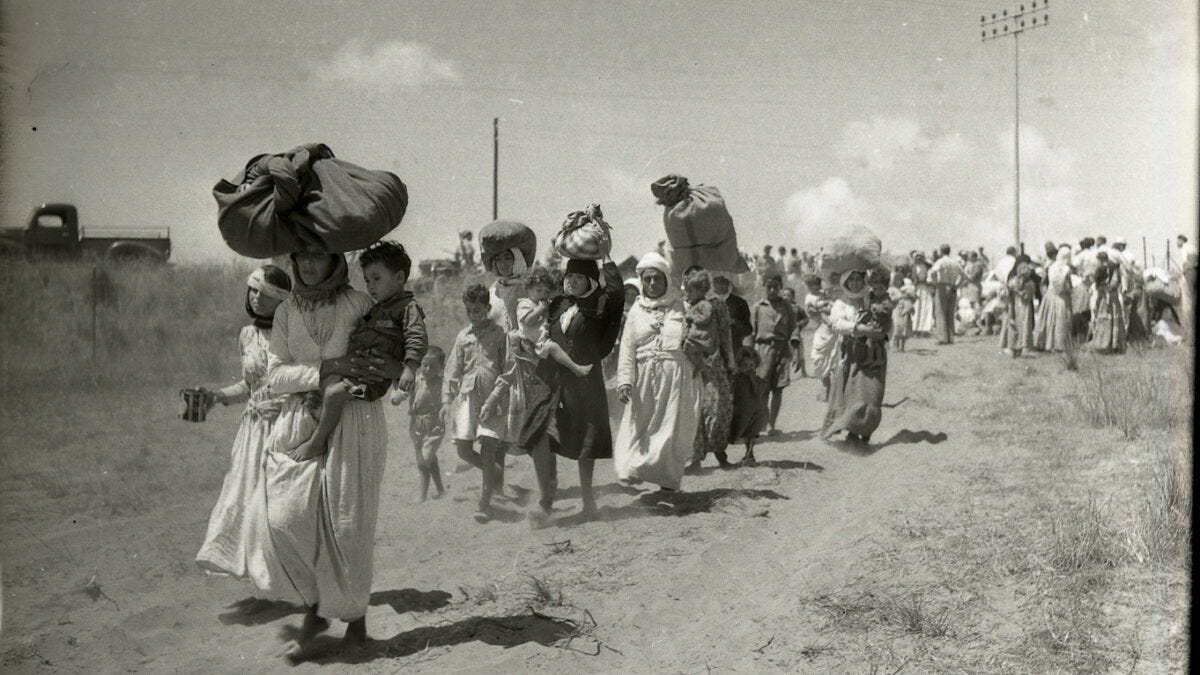
One of the most pernicious claims made by the Zionists about the expulsion of the Palestinians is that they left on their own, a propaganda campaign unleashed by the Transfer Committee that was setup by Ben Gurion to accomplish misinformation. Zionist propaganda constructed a fictitious claim that the Palestinians left because the Arab leaders urged them to move so as to make it easy for Arab armies to drive the ‘Jews to the sea’. This actual lie and outright propaganda piece of information still has currency in books and materials published about the conflict and are used to rationalize opposition to Palestinians Right of Return. While the evidence demonstrates a lack of an Arab call for the Palestinians to leave their land then the important question is what really caused the massive flight of 780,000 Palestinians in a short span of time. Planned transfer, unrestrained and coordinated violence based on village files and survey was the primary cause for the flight of the Palestinians during the 1948–49 period. An answer to the question of how was partly provided by Nathan Chofshi, a Jewish immigrant from Russia who arrived in Palestine in 1908 and witnessed what happened and gave his answer as to the real cause of flight. Chofshi in responding to a statement regarding the refugees made by an American Rabbi named Kaplan stated:
“If Rabbi Kaplan really wanted to know what happened, we old Jewish settlers in Palestine witnessed the flight could tell him how and in what manner we, Jews, forced the Arabs to leave cities and villages….
Here was a people who lived on its own land for 1,300 years. We came and tuned the native Arabs into tragic refugees. And still we dare to slander and malign them, to besmirch their name.”[14]
What Chofshi, an old settler in Palestine, expresses is that the Palestinians were “forced” out of their homes and villages, but the how and why this took place is yet another critical question that must be answered. A clear articulation of the methods to be deployed can be gleaned from Theodor Herzl’s own diaries when consideration is given on how to bring about the exodus or “transfer” and more accurately ethnic cleansing of the native Palestinians. Herzl diary entry for June 12, 1895 reads in part:
“When we occupy the land, we shall bring immediate benefits to the state that receive us. We must expropriate gently the private property on the estates assigned to us. We should try to spirit the penniless Arab population across the borders by procuring employment for it in the transit countries, while denying it any employment in our own country. The property owners will come over to our side. Both the process of expropriation and the removal of the poor must be carried out discreetly and circumspectly.”[15]
At the face of it, Herzl’s statement might seem bland and none threatening but what is important is the establishment of the expulsion principle and the need to remove the Palestinian population for a state for the Jews to emerge. This idea was expressed in almost exact words by the Zionist movement most liberal thinkers Le Motzkin stating in 1917:
“Our though is that the colonization of Palestine has to go in two directions: Jewish settlement in Eretz Israel and the resettlement of the Arabs of Eretz Israel in areas outside the country. The transfer of so many Arabs may seem at first unacceptable economically, but is nonetheless practical. It does not require too much money to resettle a Palestinians village on another land.”[16]
One can’t get any clearer language on the basic thinking of the Zionist movement prior to any conflict or violence during war. The transfer was central to the success of Zionism and for giving birth to a new modern and powerful Jewish person. Zionism is a settler colonial movement that needed to expel the indigenous population for the hoped for reunification with the land to occur. In contrast to colonialism with a motherland that needs the labor of the colonized populations, settler colonialism has no need for the indigenous population altogether and Zionism being such a movement at the inception formulated ideological positions on how best to remove the Palestinians with transfer plans discussed above. While at present and in post state formation, the Palestinian labor force was utilized by the Zionists; nevertheless this was an unplanned outcome since Jewish National Fund and the Jewish Agency had restrictions on employment of Palestinians on their owned and managed enterprises. This prohibition was not always successful and Ilan Pappe correctly points to this fact in his book on the history of Palestine but it is the over-all principle that constantly created this gulf between the communities. Also, as the state of Israel came into existence the Palestinian population served as a source of cheap labor thus capitalist interest in here trumped ideological consideration.
The case in the West Bank and Gaza post 1967 occupation are a little different, as they constituted a captive market for Israeli products and a source of constant cheap manual labor that can be utilized to suppress Israeli wages and reduce costs in a competitive capitalist economy. Also, the economic access provided to Palestinians in the Occupied Territories served a security purpose as well by allowing Israel to manage the work permit privileges and constituting a network of local collaborators that helped in achieving the needed control and information gathering system. Thus, access to the Israeli economy for the Palestinians was connected to the security structure and instrumentalized to compel the population to consent to the occupation and stop resisting. The access to jobs and to the Israeli labor market by the populations in the West Bank and Gaza is often used to point out that Palestinians standard of living is evidence that Israel is not a settler colonial or an Apartheid state rather it is the “shinning democratic” city upon a hill! A golden cage is nevertheless a cage regardless how comfortable it is maybe appear to look from the outside.
Coming back to the discussion on the 1948 expulsion and the constant efforts at shifting the blame and responsibility away from Israel and Zionism to the expelled Palestinian themselves. In an attempt to shed some light on the issue while at the same time implying a lack of coordinated plan, Benny Morris argued in an article published in Tikkun March/April 1998 issue that “during the last decade of the Mandate the idea [of transfer of the Palestinians] became increasingly attractive and realistic” for the Zionists. Morris further points out that the July 1937 Royal Peel Commission proposal to divide Palestine included a recommendation to transfer “225,000–300,000 Arabs living in the area allocated to the Jewish state” to be formed at a future date. Again, Benny Morris sophisticatedly is constructing an apologetic Zionist narrative by diverting direct responsibility away from Zionism core ideas and plans to one that situate them as being drawn into it and placing the responsibility on the Peel Commission for making the transfer recommendation. Indeed, the plan to remove the Palestinians and to confiscate their properties was an understood and needed policy, if an exclusivist state for the Jews is to be created in Palestine. In the Tikkun article Morris includes another relevant quote by Ben Gurion taken from a speech he made to the 20th Zionist Congress, held in Zurich on the 7th August 1937:
“In many parts of the country new Jewish settlements will not be possible unless there is a transfer of the Arad peasantry. The [Peel] Commission dealt with this matter seriously, and it is important that [the transfer] plan come from them and not from us… The transfer of the population is what makes possible a comprehensive [Jewish] settlement plan. Thankfully, the Arab people have large, empty areas [outside Palestine]. Jewish power in the country, which is continuously growing, will also increase our possibilities to carry out the transfer on a large scale. You must remember, that this method contains an important humane and Zionist idea, to shift parts of a people [i.e., the Palestine Arabs] to their own country and to settle empty lands [in Syria, Transjordan and Iraq].”[17]
Both Herzl and Ben Gurion were committed to the transfer plan and looked to the right conditions to bring it into fruition but the arrangement of the evidence by Morris makes it sound as if they fell upon the idea and not being constitutive element within Zionism. The transfer also had the added dimension of confiscating Palestinians lands and properties thus making for a total dispossession. The process of expropriating the property of the Palestinians was carried out systematically during and in the aftermath of the 1947–48 war, which was accompanied by a large number of massacres. These massacres were the main instrument for forcing the Palestinians to leave fearing the real possibility of death at the hands of Zionist terrorist gangs. The fear was also stoked by the Zionist so as to maximize Palestinian flight.
The Israeli newspaper Ha’ir had an article titled, “Massacres of Palestinians in 1947–49: During the War: Many Arabs Were Massacred Not Only in Deir Yassin,” which was published on Friday May 6th, 1992, then at the eve of Israel’s independence day and included first time details of previously unreported massacres. In the article, the Israeli history researcher Ariyeh Yitzhaki, who worked as the Israeli army historian, concluded from the newly released records, “at least 20 large massacres of Arabs took place during the War of Independence (defined as over 50 murdered in each massacre) and about 100 small massacres (defined as of individuals or small groups).”[18] Yitzhaki further concludes, “these massacres had a profound effect on the fleeing of Arabs from the country.” Yitzhaki points out that “for many Israelis it was easy to cling to the safe claim that the Arabs left the country because that was what their leaders ordered. That is a total lie.”[19]
What is most impressive about Yitzhaki’s reference in the article is the immediate link he makes between the massacres and the flight of the Palestinians. In Yitzhaki’s view, “the fundamental cause for the flight of the Arabs was their fear of Israeli violence and that fear had a basis in reality. From almost every report which appears in the army’s (Israeli army) archives about the occupation of Arab villages during the May-July 1948, the height of confrontation with the Arab villagers, there comes the smell of a massacre.”[20] Another prominent Israeli historian quoted in the same article, Uri Milstein, named dispeller of myths in Israel agrees with Yitzhaki and goes further to say that “if Yitzhaki claims that there were murders in every village, then I say that up to the inception of Israel, every event of fighting ended in a massacre of Arabs. There were massacres of Arabs in all of Israel’s wars, but I have no doubt that the War of Independence was the dirtiest.”[21]
In an interview given to the Israeli newspaper Haaretz on 9 January 2004 and on the occasion of publishing his two books in English, Benny Morris was more emphatic in supporting the ethnic cleansing while considering a necessity for the birth of a Jewish State. Excerpts from the interview are illustrative and also provide further details on the 1948 period:
“To my surprise, there were also many cases of rape. In the months of April-May 1948, units of the Haganah [the pre-state defense force that was the precursor of the IDF] were given operational orders that stated explicitly that they were to uproot the villagers, expel them and destroy the villages themselves.”
“About a dozen. In Acre four soldiers raped a girl and murdered her and her father. In Jaffa, soldiers of the Kiryati Brigade raped one girl and tried to rape several more. At Hunin, which is in the Galilee, two girls were raped and then murdered. There were one or two cases of rape at Tantura, south of Haifa. There was one case of rape at Qula, in the center of the country. At the village of Abu Shusha, near Kibbutz Gezer [in the Ramle area] there were four female prisoners, one of whom was raped a number of times. And there were other cases. Usually more than one soldier was involved. Usually there were one or two Palestinian girls. In a large proportion of the cases the event ended with murder. Because neither the victims nor the rapists liked to report these events, we have to assume that the dozen cases of rape that were reported, which I found, are not the whole story. They are just the tip of the iceberg.”
“Twenty-four. In some cases four or five people were executed, in others the numbers were 70, 80, 100. There was also a great deal of arbitrary killing. Two old men are spotted walking in a field — they are shot. A woman is found in an abandoned village — she is shot. There are cases such as the village of Dawayima [in the Hebron region], in which a column entered the village with all guns blazing and killed anything that moved.
“The worst cases were Saliha (70–80 killed), Deir Yassin (100–110), Lod (250), Dawayima (hundreds) and perhaps Abu Shusha (70). There is no unequivocal proof of a large-scale massacre at Tantura, but war crimes were perpetrated there. At Jaffa there was a massacre about which nothing had been known until now. The same at Arab al Muwassi, in the north. About half of the acts of massacre were part of Operation Hiram [in the north, in October 1948]: at Safsaf, Saliha, Jish, Eilaboun, Arab al Muwasi, Deir al Asad, Majdal Krum, Sasa. In Operation Hiram there was a unusually high concentration of executions of people against a wall or next to a well in an orderly fashion.”[22]
Morris’ comments in the article give a strong indication that the expulsion “can’t be chance”[23] and the complicity of Ben-Gurion of not only ordering the Palestinian transfer but also in covering “up for the officers who committed the massacres.”[24] According to Morris’ research: “on October 31, 1948, the commander of the Northern Front, Moshe Carmel, issued an order in writing to his units to expedite the removal of the Arab population. Carmel took this action immediately after a visit by Ben-Gurion to the Northern Command in Nazareth. There is no doubt in my mind that this order originated with Ben-Gurion. Just as the expulsion order for the city of Lod, which was signed by Yitzhak Rabin, was issued immediately after Ben-Gurion visited the headquarters of Operation Dani [July 1948].”[25]
It has been the case that up to this point we don’t have a written order signed by Ben-Gurion explicitly directing the IDF to expel and transfer the Palestinians, which Morris correctly points out that: “From April 1948, Ben-Gurion is projecting a message of transfer. There is no explicit order of his in writing, there is no orderly comprehensive policy, but there is an atmosphere of [population] transfer. The transfer idea is in the air. The entire leadership understands that this is the idea. The officer corps understands what is required of them. Under Ben-Gurion, a consensus of transfer is created.” Furthermore, declaring “of course” and affirming the already understood perspective that “Ben-Gurion was a transferist. He understood that there could be no Jewish state with a large and hostile Arab minority in its midst. There would be no such state. It would not be able to exist.”[26]
Yet, and after all the evidence that Morris presents in the article and in his books about massacres he turns back and embraces Zionism and Ben Gurion’s expulsion decision. Morris concludes, “Ben-Gurion was right. If he had not done what he did, a state would not have come into being. That has to be clear. It is impossible to evade it. Without the uprooting of the Palestinians, a Jewish state would not have arisen here.”[27] The interview provides a window into the warped worldview of Morris who prides himself as an Israeli leftist but ends up embracing every right wing and neo-conservative position including “clash of civilization” and a very racist view of Islam and Palestinians. A selection from the long interview is needed to shed more light on this pervasive point of view among Zionist and Benny Morris is the leftist type, which we can infer from it the even more extremist perspective held by the right wing on the matter:
“That is correct. Even the great American democracy could not have been created without the annihilation of the Indians. There are cases in which the overall, final good justifies harsh and cruel acts that are committed in the course of history…
If he was already engaged in expulsion, maybe he should have done a complete job. I know that this stuns the Arabs and the liberals and the politically correct types. But my feeling is that this place would be quieter and know less suffering if the matter had been resolved once and for all. If Ben-Gurion had carried out a large expulsion and cleansed the whole country — the whole Land of Israel, as far as the Jordan River. It may yet turn out that this was his fatal mistake. If he had carried out a full expulsion — rather than a partial one — he would have stabilized the State of Israel for generations.
If the end of the story turns out to be a gloomy one for the Jews, it will be because Ben-Gurion did not complete the transfer in 1948. Because he left a large and volatile demographic reserve in the West Bank and Gaza and within Israel itself.
But I am not a statesman. I do not put myself in his place. But as an historian, I assert that a mistake was made here. Yes. The non-completion of the transfer was a mistake.”
… There is a deep problem in Islam. It’s a world whose values are different. A world in which human life doesn’t have the same value as it does in the West, in which freedom, democracy, openness and creativity are alien. A world that makes those who are not part of the camp of Islam fair game. Revenge is also important here. Revenge plays a central part in the Arab tribal culture. Therefore, the people we are fighting and the society that sends them have no moral inhibitions. If it obtains chemical or biological or atomic weapons, it will use them. If it is able, it will also commit genocide.”[28]
Not only Morris endorses the expulsion of Palestinians, but goes to the extreme by rationalizing the “annihilation of the Indians” since, as far as the context of his statement, it was done to bring about a final good. Genocidal annihilation is acceptable or to be sanctioned, in Morris’ view, if it leads to a final good for the colonizer. The point of view advanced by Morris is precisely emerges from a colonial epistemic which must rationalize its criminal and genocidal actions against indigenous population with the only criteria being if it leads to good outcome for the colonizer. If moral and ethical questions are set aside by Benny and his kind then no rules should apply to examining the past and the present since power and the ability to annihilate the other is the operative standard. We can list a long list of genocides that have to be set aside and past and current attempts at holding anyone responsible would have to be rejected according to the extension of Morris’ argument. “A justifiable ethnic cleansing” the defense of every criminal and genocidal regime past and present and Morris would have to join the honor role of such logically deprived individuals. In today’s America no one of any standing would consider or offer a defense of the annihilation of the Native Americans and to come from a “Jewish” historian is nothing but a total abandonment of Judaism highest ideals.
Morris’ defense of ethnic cleansing has meaning only when one looks at the world through a distorted Zionist lens and the goal of bringing forth the new modern and powerful Jewish person that writes a new history. The land needed to be cleansed so as to bring the birth of this new person that embraces expulsion and dispossession on the premise that it is for a final good. Consequently, the matrimony between land and people is not possible without first removing the obstacles that live and exist on the land, the Palestinians, and for a final good to emerge, a militaristic state founded on a violent epistemic. Morris is on the side of dispossession and putting forth the necessity to annihilate for the good to emerge and defending Zionist actions on the basis of others done it argument. Not content with only supporting annihilation of Native Americans, and ethnic cleansing in 1948 period, Morris jumps head first into racism and Islamophobia. Morris in distinct Islamophobic manner problematizes the problem of the Palestinians refusal to concede to their colonizer. The problem is something inherent in the make-up of the colonized people and for the Palestinians and the Arab world it is to be located in Islam according to Morris. Indeed, Morris joins the “clash of civilization” crowed of neo-conservatives and others that find comfort in a racist and unscientific explanation for that can be readily researched through colonial and anti-colonial discourses.
In the same interview, Benny Morris believes that Ben-Gurion is at fault for not completing the ethnic cleansing job. “If he had carried out a full expulsion — rather than a partial one — he would have stabilized the State of Israel for generations” which in Morris mind leaves the door open for a possible future undertaking to complete the job of ethnic cleansing. The flimsy argument for a possible future ethnic cleansing in Palestine is that the Arabs had a large number of countries and lands thus one country for the Zionist is defensible and Palestinians should be accommodated by these states. Not wanting to decipher the multiple problems with Benny’s argument but suffice to say that the region and its people are not situate it as changeable parts and are not a sideshow to service the emergence of the modern, colonial and empowered Zionist Jew.
Coming back to the expulsion and the 1948 undertaking that made it possible to expel the Palestinians and the existence of a plan for it. Morris’ work is firmly situated in absolving Zionism and Zionist leaders of pre-mediated planning for the expulsion process, which makes the subsequent events and massacres contingent on unfolding events. Morris reduces the argument to the following framing: “A society that aims to kill you forces you to destroy it. When the choice is between destroying or being destroyed, it’s better to destroy.” Absent any understanding and context to what was underway in 1948 Morris is stretching for the conclusion that Zionist and Israel acted in self-defense and an attempt to prevent a possible genocide. As such and in Morris’ logic, in order to prevent genocide of the Jews in Palestine the Zionists ‘were forced’ to commit ethnic cleansing, massacres and forced transfer. Through this sophisticated obfuscation Morris and other Zionist apologists end up placing the blame on the Palestinians on the basis of an unsubstantiated genocide that required an ethnic cleansing and expulsion before it can be allowed to materialize. If this sounds failure, it should because the basic thesis of preemptive war or for the Zionist a preemptive ethnic cleansing, expulsion and massacres has always rationalized the action to solve the immediate problem but not the foundation.
Benny Morris is too colonially smitten by power to realize that in his defense of Zionism he ends-up rationalizing every atrocity committed under the rubric of self-defense. What makes other criminal and genocidal undertaking less defensible than Zionism or does Morris believe in exceptionalism and accords it a privileged dispensation to undertake ethnic cleansing in Palestine and in the process mount a defense of the annihilation of Native Americans. In here we are witness to the effect of colonialism on the mind of the colonial citizen him and herself for they are incapable of thinking outside their own constructed power pardigem that produces a nagging dumped down discourse that fails to account for what is unfolding within the colony and among the colonized. The violence of the colonized is a mere reproduction of the colonial violence that has been set to produce the levers of control and not independent of it. What Morris misses in his preoccupation with thinking of his own narrow Zionist view is the Palestinians are reproducing the same logic and epistemic that colonialism has introduced in the relationship since power and violence becomes the measure of all meaning then the colonized has internalized the constitutive relationship. Zionism dehumanization of the Palestinians, the expulsion and massacres results in the intensification of response to the conditions set by the colonial power among the colonized and end-up appearing at various times in the form of uncontrolled violence. Benny fails to see Palestinians in this relationship and can only contemplate the fact that Ben-Gurion did not finish the job and left current Zionist with this nagging problem. In this way, Morris like other Zionists wish that the Palestinians were taken out the state in 1948 or at present wishes like Netanyahu and others in Israel that the conditions can become ripe to throw them out of Palestine so we can have an ever lasting piece. One can see in this the delusional logic that if they only can leave or be made to leave then the problem is solved because as long as they are around the problem continues and Zionist will not have peace. The same dimwitted logic operative at every turn by every racist, colonial and fascist enterprise since it never assumes for a minute that the problem is in the project itself and not in the external subject that is to be neutralized.
Coming back to the actual expulsion and Nakba and the central question of the existence of an approved plan that then gets executed during the war is a key factor that we turn to next. We already had the public and well established record of statements from Zionist leaders desiring and wanting to remove the Palestinians from the land and constantly maneuvering to find the appropriate conditions to do, which included in the pre-war period all types of economic measures to cause the population to leave. The war was expected and immediately after the end of WWII it was only a matter of time that the hostilities will intensify and the Zionist began to import the needed weapons and develop the defensive and offensive capacities to force a state into existence. It is with force and fire that the state is to be born and the new modern and powerful Zionist Jew that will bring it into existence. Are we to assume that the Zionist movement, which began to plan for Palestine some 70 years before the war would leave itself without a plan or a strategy of how to get rid of the Palestinians whom already been described years earlier as a threat to the possibility of forming state. It would insult the intelligence of people of sound mind to think that an important a task as the removal of a population so as to birth the state is to be left to circumstances and lack of planning. In reality, the Zionist rhetoric from the earliest periods, the policy debates, the village files, the stockpiling of weapons and the nature of attacks leave nothing to chance and point to the existence and execution of it over the period of the war.
As mentioned earlier, Zionist in Palestine had already used terrorism against both Palestinians and British troops throughout the 1930s and immediately after the end of WWII they went back to the tactic in full force. Attacking soft targets, the Zionist unleashed a reign of terror focusing on Café, markets, cinema and theater houses, hotels, trains and public transportation, which resulted in death and destruction all over the country. Every major Zionist figure of the period was implicated in one way or another in fomenting and carrying out the terror campaign and culminated in the bombing of the King David Hotel in Jerusalem, used as the British headquarters in the city at the time. The Zionist terror campaign was intended to make Palestine ungovernable for the British and frighten the Palestine into flight and early surrender. Bringing the “Iron Wall” concept into reality required unrestrained violence and an early Zionist conceptualization of shock and awe strategy to compel the Palestine to surrender and better yet if they flee individually and collectively, which was the desired outcome for the success of building a Zionist state. One can understand Benny’s blame of Ben-Gurion if the goal is to remove “the demographic” problem once and for all-a past and present Zionist dream.
The expulsion was all along strategized for since the first Zionist settlement was built and Ben-Gurion did leave things to change and had a plan to bring about the removal of the Palestinians which was adopted as early as 14 February 1948 and put into effect across the country. The Dalet Plan that became effective on the 10 March 1948 provides an evidence of the existence of a strategic plan developed at the highest levels of government that included targeting villages and inhabited areas with specific instructions that “in the event of resistance, the armed force must be destroyed and the population must be expelled outside the borders of the state.”[29] The Dalet Plan had two separate goals one focused on securing facilities emptied by the British while the second and far more important was to “cleanse” the future Jewish state of as many Palestinians as possible. Once again, Zionist apologist discount and dismiss the existence of such a plan and firmly maintain the façade that all were these measures were undertaken in the heat of the battle and in few cases (bad apples defense i.e. the exception) the local commanders acted on their own to expel the population. Benny Morris makes this point in the interview quoted above by pointing out that when it comes to the expulsion in the Northern Front: “One of the revelations in the book is that on October 31, 1948, the commander of the Northern Front, Moshe Carmel, issued an order in writing to his units to expedite the removal of the Arab population. Carmel took this action immediately after a visit by Ben-Gurion to the Northern Command in Nazareth. There is no doubt in my mind that this order originated with Ben-Gurion. Just as the expulsion order for the city of Lod, which was signed by Yitzhak Rabin, was issued immediately after Ben-Gurion visited the headquarters of Operation Dani [July 1948]”[30] While Benny provides the circumstantial evidence and Ben-Gurion’s active encouragement in the expulsion in the Northern Front, nevertheless he stops short from taking the existence of Dalet Plan into account and moves to dismiss it altogether. Here we have a Zionist project that has been actively pursued since at least 1870, founded upon a colonial racist epistemic with founding documents from Herzl and others speak and contemplate various ways to remove the population and at every turn restricts or resist alternatives to a different outcome, yet Morris and apologist for Zionism make it appear as if they accidently fallen upon ethnic cleansing and massacres of the indigenous Palestinian population. How do you accidently come upon an ethnic cleansing that covers over 541 villages and all the Palestinian urban centers and moves methodically like clock work?
Assuming for the moment that it was in the heat of battle that this took place then how do we explain the consistency and duplicate approach across all sectors of fighting with few exceptions. More importantly, when external pressure to save and prevent expulsion of sections of the Christian population we find an ability to intervene and putting a stop to it before it can begin. If the ability to stop it was present then the divergent meaning would have to be possible that is the presence of a strategy and structure to bring about the expulsion. The particular mechanics of the expulsion is normative of acts of genocide and ethnic cleansing, which is the deployment of a reign of terror that causes the flight of civilian populations. Palestinians were terrorized into flight by a Zionist reign of terror that continues to the present day. Massacres were used as a strategic tool to force as many Palestinians as possible to flee their villages and cities or face death, which made it possible for the Jewish state to emerge with a decisive Jewish majority. Researching the 1948 massacres through interviews and oral history project Professor Abdel Jawad states:“my research, the emerging information convinced me that there was a central guiding brain, which unified all the individual massacres into a coherent policy of ethnic cleansing. Our interviews revealed in a highly visible way that the massacres were disciplined and the chain of command was clear. The killings were also carried out more to create an environment of terror and result in the flight of the population, than to maximize the number of casualties.”[31] Precisely because the United Nations partition plan dealt with geographic boundaries for the state and not demography this rationalized in the minds of the Zionist the need to cleanse the areas designated for the Jewish State of its Palestinian population. The Zionist wanted a purely Jewish state with a decisive Jewish majority thus the forceful transfer already discussed in earlier years by both Herzl and Ben-Gurion would brought into actualization through planned massacres and violence. Another important factor to consider is that “the choice of a certain village was also not at random”[32] and was part of the over-all plan to empty the areas designated as a Jewish State by the U.N. from its Palestinian population.
This coordinated plan was brought out by Sir John Bagot Glubb who relates in his book, A Solider With the Arabs, an encounter between a British officer and a Zionist office before the war in December 1947. This officer when asked about the U.N. partition plan and the fact that the Jewish state would have internal problems from a large Arab population responded, “that will be fixed. A few calculated massacres will get rid of them!”[33] The officer’s statement is not strange or falls outside what was already a common strategy felt and known to the Palestinian victims of this forced expulsion. “The Arabs should go!” was what Ben-Gurion wrote in a letter to his son in 1937. “The Arabs should go!” needed “an opportune moment for making it happen such as a war.”[34] The opportune time was contemplated and planned for by Ben-Gurion and the Zionist, which is contrary to the constructed narrative that it was in the heat of the battle and out of necessity. The expulsion of the Palestinians was a deliberate, methodical and premeditated undertaking on the part of the Zionist and part of a state policy post May 15, 1948.
The late William Zukerman, editor of the Jewish Newsletter, maintained that the “flight of the Palestine Arabs, which created the Arab refugee problem, was not a spontaneous act. … It was a coldly calculated plan executed by the Irgun but with the knowledge of the Haganah and the Jewish Agency of the time.”[35] Zukerman’s view could be further contextualized by Menachem Begin’s own words in his book, The Revolt, maintaining that the “Arabs throughout the country induced to believe wild tales of Irgun butchery, were sized with limitless panic and started to flee for their lives.” The induced panic was strategically deployed and the “mass flight” according to Begin “soon developed into maddened, uncontrollable stampede.” Begin goes further on to say that “the political and economic significance of this development can hardly be overestimated.” “Massacres”, according to Abdel Jawad, “should be viewed as a common phenomenon in nearly every Palestinian village and Bedouin settlement from which people involuntarily fled.”[36]
What is missing from the above is Begin’s own role in bringing about the mass flight of the Palestinians through the utilization of massacres and none as important as the one committed on April 9th, 1948 in Deir Yassin village resulting in 254 reported civilians murdered at the time. Begin defended his participation stating “the massacre was not only justified, but there would not have been a state of Israel without the victory at Deir Yassin.”[37] Arthur Koestler wrote sometime later that the “bloodbath” carried out by the Zionists at Deir Yassin was “the psychologically decisive factor in the spectacular exodus of the Arabs from the Holy Land and the creation of the Palestinian refugee problem.” According to Mordechai Nisan of the Truman Research Center of the Hebrew University in Jerusalem, “without terror it is unlikely that Jewish independence would have been achieved when it was.”[38]
Begin’s “victory” at Deir Yassin is nothing other than a war crime committed against an unarmed civilian population. In his book, Bitter Harvest, Sami Hadawi quotes Dov Joseph, “a one-time Governor of the Israeli sector of Jerusalem and later an Israeli Minister of Justice,” describing the Deir Yassin massacre as a “deliberate and unprovoked attack.”[39] Jon Kimche, the editor of the London Jewish Observer, described the massacre in his book, Seven Fallen Pillars, in the following manner:
“On Friday, April 9th, 1948, a commando force composed of Irgun and Stern soldiers raided the village. There was no obvious occasion for them to do so. What happened afterwards has been the subject of conflicting versions, explanations and excuses by the terrorists; but nothing they have said has explained or can explain away, the murder of some 250 innocent Arabs, among them more than a hundred women and children. No less disgusting was the subsequent publicity parade by the Irgun of a number of poor Arab prisoners through the streets of Jerusalem.”[40]
What emerges in Deir Yassin is that the murder of the civilians in the village was not done during military operations or the heat of battle as propagandist claim, on the contrary, the village was already under control of the Irgun soldiers and Arab fighters in the region were on the run. It was deliberate act by the Irgun soldiers with the specific intent of causing as much fear and disarray among the Arab civilian population which might persuade them and others to leave, and many did flee after hearing of the massacre.
Journalist Elias Zananiri collected testimonies and narratives from a number of Deir Yassin’s survivors and published it in the Gulf News on September 4th, 1997.[41] One of the published accounts of the massacre comes from Umm Mahmud, who at the time was 15 years old but managed to escape the killing fields in Deir Yassin. She recalls the following details:
“We were inside the house. We heard shooting outside. My mother woke us up. We knew the Jews had attacked us. My cousin and his sister came running and said the Jews were already in our garden. In the meantime, fighting became heavier and we heard lots of gunshots outside. A bomb was thrown at us and it exploded close to where we were in the yard … My sister-in-law did not want to leave. She was frightened. The girl was two months old and the boy about three. I took the two and my mother said we should go to my uncle’s house.
I saw how Hilweh Zeidan was killed, along with her husband, her son, her borther and Khumayyes. Hilweh Zeidan went out to collect the body of her husband. They shot her and she fell over his body… I also saw Hayat Bilbeissi, a nurse from Jerusalem serving in the village, as she was shot before the house door of Musa Hassan. The daughter of Abu El Abed was shot dead as she held her niece, a baby. The baby was shot too… Whomsoever tried to run away was shot dead.”[42]
Another survival testimony is that of Abu Yousef, who at the time of publication was 70 years old and living in the Am’ari refugee camp near Ramallah. Abu Yousef account of the massacre gives more details of the events afterward:
“… after the battle, the Jews took elderly men and women and youths, including of 4 my cousins and nephew. They took them all. Women, who had on them gold and money, were stripped of their gold. After the Jews removed their dead and wounded, they took the men to the quarry and sprayed them all with bullets.
One woman had her son taken some 40 to 60 meters away from where she and the rest of the women stood by, and shot him dead. Then they brought Jewish kids to throw stones at his body. They later poured kerosene on his body and set it ablaze while the women watched from a distance. We later collected ourselves and checked who was missing. At Jaffa Gata in Jerusalem, we were gathered by the Arab Supreme Committee. Each of us was looking for a son, a daughter, a sister or a mother.”[43]
Fahimi Zidan, a Palestinian child at the time of the massacre but survived by hiding under his parents’ bodies, reported that: “The Jews ordered [us] … to line up against the wall … started shooting … all … were killed: my father … mother … grandfather and grandmother … uncles and aunts and some of their children … Halim Eid saw a man shoot a bullet into the neck of my sister … who was … pregnant. Then he cut her stomach open with a butcher’s knife … In another house, Naaneh Khalil … saw a man take a … sword and slash my neighbor.”[44] (David Hirst, The Gun and the Olive Branch, p. 249–50)
A British officer still present in Palestine, Richard Catling, reported on the massacre:
“There is … no doubt that many sexual atrocities were committed by the attacking Jews. Many young school girls were raped and later slaughtered … Many infants were also butchered and killed. I also saw one old woman … who had been severely beaten about the head with rifle butts.”[45]
More importantly is the testimony and the official report submitted by Jacques de Reynier of the International Committee of the Red Cross, who met the “cleaning up” team upon arrival at the village immediately after the massacre:
“The gang … were young … men and women, armed to the teeth … and [had] also cutlasses in their hands, most of them still blood-stained. A beautiful young girl, with criminal eyes, showed me hers still dripping with blood; she displayed it like a trophy. This was the ‘cleaning up’ team, that was obviously performing its task very conscientiously.”[46]
Dr. Reynier further described the scene he encountered on entering the homes to check on bodies left behind:
“… amid disemboweled furniture … I found some bodies … the ‘cleaning up’ had been done with machine-guns … hand grenades … finished off with knives … I … turned over … the bodies, and … found … a little girl … mutilated by a hand grenade … everywhere it was the same horrible sight … this gang was admirably disciplined and only acted under orders.”[47]
A letter to the New York Times dated December 4th, 1948, and signed by Albert Einstein, Hannah Atendt, and others protesting the occasion of Begin’s visit to the US and pointing out the atrocities committed in Deir Yassin, which reads in part:
“A shocking example was their behavior in the Arab village of Deir Yassin. This village, off the main roads and surrounded by Jewish lands, had taken no part in the war, and had even fought off Arab bands who wanted to use the village as their base. On April 9 (THE NEW YORK TIMES), terrorist bands attacked this peaceful village, which was not a military objective in the fighting, killed most of its inhabitants (240 men, women, and children) and kept a few of them alive to parade as captives through the streets of Jerusalem. Most of the Jewish community was horrified at the deed, and the Jewish Agency sent a telegram of apology to King Abdullah of Trans-Jordan. But the terrorists, far from being ashamed of their act, were proud of this massacre, publicized it widely, and invited all the foreign correspondents present in the country to view the heaped corpses and the general havoc at Deir Yassin.”[48]
An Israeli first hand account of the massacre did finally come out corroborating what the Palestinian victims have said all along about Deir Yassin. On April 29th, 1972, the Israeli daily newspaper Yediot Aharonot published an eyewitness report from Col. Meir Pa’el, an Israeli solider who decided to give account of his participation in the massacre but doing so after retiring from the army. His account of the Deir Yassin:
“In the exchange that followed four men were killed and a dozen were wounded… by noon time the battle was over and the shooting had ceased. Although there was calm, the village had not yet surrendered. The Irgun and Lehi, men came out from hiding and began to ‘clean’ the houses.
They shot whoever they saw, women and children included, the commanders did not try to stop the massacre….
I pleaded with the commander to order his men to cease fire, but to no avail. In the meantime, 25 Arabs had been loaded on a truck and driven through Mahne-Yehuda and Zichron Yosef.
At the end of the drive, they were taken to the quarry between Deir Yassin and Givat-Shaul, and murdered in cold blood… The commanders also declined when asked to take their men and bury the 254 Arab bodies.
This unpleasant task was performed by two Gadna units brought to the village from Jerusalem.”[49]
Emphasis on Deir Yassin is warranted due to the size and the real panic it produced immediately after resulting in massive flight of Palestinians fearing a similar fate. Yet, Deir Yassin was not the only massacre, rather it is a very well known one and even today it is still subject to disputes from Zionist propagandist. Certainly, recent research placed the numbers murdered closer to 102; nevertheless the reports of 254 murdered by Zionists terrorists had, at the time, such a great impact and contributed to the mass flight. Not surprising Begin view that “there would not have been a state of Israel without the victory at Deir Yassin”[50] since the massacre and news about it spread wide and far inducing a panic and a massive Palestinian flight.
A number of other less known massacres during the 1948 period took place in villages and towns across Palestine and after Israel’s declaration of independence on May 15th, 1948. The list of massacres include: Dawyimeh, Elaboun, Majd Al-Krum, A-Ba’na, Deir Al-Assad, 94 people blown up with their houses in Slikha, Nasser Al-Din and Sheikh, Abu Zurik, Umm al-Sha’of, Safsaf, Jiz, Sa’asa, Knisas, Wadi Shubash, Balad Al-Sheikh, Kafer, Kofrin, Zebuba, Kufr Hula, Ain Zeitun, and Nuris. The research on massacres and organized violence against Palestinian communities in 1948 still needs further work and as more researchers engage this subject matter the list will for sure continue to expand. Furthermore, the research on massacring Egyptian prisoners of war during the 1948 war is a sensitive subject that has been suppressed by successive Egyptian governments but the files will come to light sooner than latter and a more accurate picture will emerge about the structured violence deployed during the 1948 period.
Deir Yassin and the rest of the massacres are paradigmatic of settler colonial enterprises and are deliberate and systematic attempts at changing the demographics in favor of the colonizing power or group. Settler colonialism has no need for the indigenous population and if left alone will always constitute a demographic challenge and under appropriate framing will be made to pose political and security challenge. The expulsion, transfer and/or genocide are normative; thus Zionists and their methods are atrocious but at the same time normative.
The intent of Zionist massacres in 1948 was to inflict upon the civilian population a major blow that would result in a psychological edge to be gained by Zionist forces. This psychological weapon coupled with a massive propaganda campaign directed at the Palestinian population made fleeing the only logical option and fulfilled a strategic goal articulated years before the actual war: “a land without a people for a people without a land.” Again Professor Abdel Jawad research provides the broad context of the massacres and the unleashed strategy that brought about the flight of the Palestinians and commenting: “Villagers experienced subversion, sabotage, rumor mongering, and propaganda designed to create panic. There was also the meticulous planning of the expulsions, reflected in Ben-Gurion’s diaries, which was accompanied by an equally meticulously planned cover-up. The cover-up consisted of deliberate fabrication of myths by a Foreign Ministry, which was finely attuned to world opinion and wholly dedicated to the displacement of Palestinians. Finally, the Palestinians were — just as the machine wanted them to be — dust trampled under the heel of the powerful.”[51]
By resorting to the massacres, the Haganah was able to embark on a systematic, deliberate and well-planned ethnic cleansing campaign to evacuate a number of coastal cities and villages. The population in city of Haifa “were subjected to a campaign of terror jointly instigated by the Irgun and the Hagana,”[52] with the goal of forcing them to flee the city. Professor Ilan Pappe in his book, The Ethnic Cleansing of Palestine describes the methods that were used in Haifa causing the flight of Palestinians:
“The Jewish troops rolled barrels full of explosives, and huge steel balls, down into Arab residential areas, and poured oil mixed with fuel down the roads, which they then ignited. The moment panic-stricken Palestinian residents came running out of their homes to try to extinguish these rivers of fire, they were sprayed by machine-gun fire. In areas where the two communities still interacted, the Hagana brought cars to Palestinian garages to be repaired, loaded with explosives and detonating devices, and so wreaked death and chaos. A special unit of the Hagana, Hashahar (‘Dawn’), made up of mistarvim-literally Hebrew for ‘becoming Arab’, that is Jews who disguised themselves as Palestinians — was behind this kind of assault.”[53]
The use of terror was not an isolated incident or some solider acting illegally. On the contrary, the process was coordinated, planned and executed on all fronts. Again Professor Abdel Jawad views the “massacres as a tool, probably the primary tool, of a total war through which Zionists and later Israelis sought to expel the Arabs from their lands by means of ethnic cleansing.”[54] A strategic goal for arriving at a Jewish majority in the state had to be accomplished at all costs including acts of ethnic cleansing. “Such action was designed to produce an exclusively Jewish state in the place of the Arab-dominated, multi-ethnic society which once flourished there.”[55] Furthermore, the use of violence was constitutive for the new Zionist Jew to emerge into a reformed and distorted modernity. What is more remarkable than the ethnic cleansing itself is the ability of the Israeli state and society to collectively participate in a successful worldwide campaign of disinformation and obfuscation of the facts leading up to the expulsion of the Palestinians.
Michael Bar-Zohar in David Ben-Gurion’s biography describes his first visit to Nazareth after the 1948 war: “Ben Gurion looked around in astonishment and said; why are there so many Arabs, why didn’t you drive them out.”[56] Ben-Gurion, the first Israeli Prime Minister, Begin and other Zionist leaders shared a common goal, the need to empty the new state of its Arab Palestinian inhabitants. The cause of Ben-Gurion’s “astonishment” was the fact that not all the Arabs were driven out, which was the preferred outcome at the moment of the inception of the state of Israel. In the context of demographics, Ben-Gurion spoke of the need to have at least 80% Jewish majority for his hoped for state to be viable and said that much in a speech to Mapai Party on 3rd of December, 1947:
“There are 40% non-Jews in the areas allocated to the Jewish state. This composition is not a solid basis for a Jewish state. And we have to face this new reality with all its severity and distinctness. Such a demographic balance questions our ability to maintain Jewish sovereignty… Only a state with at least 80% Jews in viable and stable state.”[57]
In focusing on the Nekba, the Palestinians are asserting their rights, the justness of claims accrued from planned acts of ethnic cleansing and wholesale thievery that made it possible to build the Israeli state. All along Zionist propagandist were not content of stealing the land and dispossessing the Palestinians but continue blaming the victims while wearing an fabricated ethical and moral cloak. The right of return is the first act toward making the Palestinians whole once again, restoring their collective bodies to their land but it can’t occur in a vacuum and the first step is a accounting and recognition of the ethnic cleansing. The issue is not one of empty slogans of peace, but it has to be rooted in an approach of restorative justice that can give birth to a peaceful existence. The time for the Right of Return is today and justice is on the horizon.
To give an idea of the extent of violence perpetrated by Zionist in Palestine, below is a partial list of massacres committed against the Palestinians around the country during the Nakba period and based on oral history, Israeli and British sources, which were primary factor in the flight of the over 780,000 Palestinians. The list are cited directly from Nur Masalha’s book, The Palestine Nakba, and I am totally indebted to his extensive primary work on the subject and recommend it and all his writings on Palestine:
· Balad al-Shaykh, 11 December 1947 and 31 December-1 January 1948: 14 civilians, of whom 10 were women and children were killed in the second attack by the Haganah.
· Jaffa Municipality and Welfare Centre, 4 January 1947: 17 Arab civilians were killed by attack by Lehi.
· Semiramis Hotel, Jerusalem, 5 January 1948: the Haganah below up the hotel; 12 Arab civilians were killed, among them 4 women and 5 children.
· Nasr al-Din, 12 April 1948: a widely documented massacre by the Haganah.
· Ramle, 20 February 1948: an attack by the Irgun, killing 6 Arab civilians and wounding 31. Among the killed were 4 children.
· Qisarya (Caesarea), February 1948: the 4th battalion of the Palmah forces, under the command of Yosef Tabenkin, conquered Qisarya. According to historian Uri Milstein, all those who did not escape from the village were murdered.
· Al-Husayniyya, 12 March and 16–17 March 1948: the Palmah 3rd battalion twice attacked the village in upper Galilee. In the first attack, 15 Arabs were killed, including 10 women and children and 20 seriously wounded. In the second raid more than 30 Arab civilians were killed.
· Safad, 4 May 1948: a few days before the conquest of Safad, some 37 young men were among the 70 Arab detainees massacred by two Palmah 3rd Battalion soldiers.
· Abu Shusha, 14 May 1948: evidence of a large-scale massacre.
· Acre, 18 May 1948: according to a United Nations Observer fro France, Lieutenant Petite, at least 100 Palestinians were murdred (Palumbo 1987: 119).
· Kabri, 20 May 1948: the Carmeli Brigade conquered the village of Kabri. One of the Israeli soldiers, Yehuda Rashef, got hold of a few youngsters, ordered them to fill up some ditches and then lined them up and fired at them with a machine gun. A few died but some of the wounded managed to escape.
· Al-Tantura, 22–23 May 1948: between 70 and 200 Palestinian civilians were killed (Fearn 2006: 424), in a large scale, well-planned massacre; the atrocities were perpetrated by the 33rd Battalion of the Alexandroni Brigade of the IDF.
· Lydda, 11–12 July 1948: one of the bloodiest atrocities of 1948. According to Israeli historian Yoav Gelber, Dayr Yasin ‘was not the worst of the war’s atrocities… the massacre of approximately 250 Arabs in Lydda … took place following capitulation and not in the midst of combat’ (Gelber 2001: 116, 162). Dozens of unarmed civilians who were detained in the Dahmash Mosque and church premises of the town were gunned down and murdered. One official Israeli source put the casuality figures at 250 dead and many injured. It is likely, however, that somewhere between 250 and 400 Arabs were killed in this IDF massacre; and an estimated 350 more died in the subsequent expulsion and forced march of the townspeople. On 6 May 1992, Hebrew daily published new revelations about the atrocities committed by the Palmah soldiers at Lydda. After Lydda gave up the fight, a group of stubborn Arab fighters barricaded themselves in the small mosque; the Israeli army gave an order to fire a number of shells at the mosque. The soldiers who forced their way into the mosque were surprised to find no resistance. Under the destroyed walls of the mosque they found the remains of the Arab fighters. A group between twenty and fifty Arab civilians was brought to clean up the mosque and bury the remains. After they have finished their work, they were shot into the graves they had dug.
· Asdud, end August 1948: the Israeli army murdered 10 Arab fellahin in cold blood.
· Suqrir, 29 August 1948: 10 Arabs were killed by the Giva Brigade of the IDF (Morris 2004: 215)
· Sfsaf, 29 October 1948: 50–70 were killed by the IDF.
· Al-Dawayma, 29 October 1948: 80–100 were killed by the IDF.
· Saliha, 30 October 1948: 70–80 were killed by the IDF.
· Majd El-Krum, 30 October 1948: 9 people, including 2 women, were murdered bu the IDF (Palumbo: 171).
· ‘Eilabun, 30 October 1948: 13 were murdered by the Golani Brigade of the IDF (Palumbo 1987: 164; also Morris 1987: 229)
· Hula, October 1948: 35–58 were killed by the Cameli Brigade of the IDF.
· ‘Arab al-Mawasi (eastern Galilee), 2 November 1948: 14 Bedouin tribesmen were massacred by the IDF (Morris 2001:57)[58]
The exact number of Zionist massacres remains subject to debate and historians provide a divergent range from a low of 10 to a high of 68 such massacres committed against the Palestinians during the 1947–49 period. Research on the Nakba and Israeli massacres remains an open field but considerably hampered by extending a longer period of restrictions on materials from the Israeli archives covering the 1948 period. Also and just as important, is the closed archives of the UN from that period that continues to prevent a full accounting of the 1948 Nakba that had befallen the Palestinians and the ability to reconstruct what happened based on primary documents.
An important area of research on the 1948 Nakba and the massacres committed as part of the over-all strategy for ethnic cleansing has been collecting and documenting the oral history from the survivors. Oral history and eyewitness accounts of the Nakba were delayed for a number of reasons including the continuation of the dispossession over a long period time up to the present circumstances, the lack of attention paid by the Palestinian leadership to the need to document and record the atrocities committed during the period, a pre-occupation in the Arab and Muslim world of finding an accommodation with Israel and increased attention to the 1948 past would complicate these efforts and more critically the dis-interest among international human rights and non-governmental organization to systematically expose Zionist crimes and ethnic cleansing because the difficulties it generates in the West and possible curtailment of funding for such groups. Often, it is taken for granted that the Palestinians have been subject to forced movement multiple time beginning with the 1948 expulsion and continues up to the present day. At minimum and even if the interest to document the 1948 crimes the fact of this constant forced movement and having to fetch a living in new settings impacted the ability to work on documenting the massacres systematically.
The work on the Nakba’s oral history quoted earlier by Prof. Saleh Abdel Jawad, Zionist Massacres: the Creation of the Palestinian Refugee Problem in the 1948 War, has been a much needed and critical contribution in the process of documenting Israeli massacres during the period. The critical work documenting the Nakba, according to Abdel Jawad started with conducting some 300 interviews focusing on a list of 10 destroyed villages. From the initial study, Abdel Jawad quickly concluded that “the number of documented massacres perpetrated by Zionists and Israeli forces against the Palestinians during the 1948 War is much larger and more important than previously thought.”[59] Abdel Jawad’s collected interviews illustrated that “the massacres were disciplined and the chain of command was clear.”[60] After documenting few of the massacres Abdel Jawad observed that the “pattern of massacres suggested a central Zionist policy of ethnic cleansing.”[61] In addition, “the killings were also carried out more to create an environment of terror and result in the flight of the population, than to maximize the number of casualties.”[62] The collected evidence point to “villages” being “encircled, bombarded,” while in many cases “residents were sent through openings in the line of attack toward Arab areas.”[63] More critically, the selection of what village to attack and the region likewise was subject to a well-coordinated plan and not at all random. What became clear to Abdel Jawad from documenting the massacres is that “there was a clear relationship between the timing of a brutal massacre in an outlying village and the assault on a major nearby town or city.”[64] In this context, the Deir Yassin massacre “must be understood within the struggle for Jerusalem”[65] and the attempt to cause a flight of the population by the means of huge massacres. Another example of a massacre to illustrate this strategy is “the one in the village of Al-Dawayima where between 100 and 200 people were killed and raped with exceptional brutality, were part of Ben-Gurion’s strategy to control the whole Hebron area.”[66] Similarly, Abdel Jawad maintain that “the intensity of massacres in Central Galilee on 29 and 30 October in the year 1948, during Operation Hiram, was a clear solution to Ben-Gurion’s worries a month earlier concerning a pocket of civilian population in this area. This population was problematic for Ben-Gurion because it attracted forcibly removed refugees who were attempting to return to Lebanon.”[67]
Abdel Jawad’s research is methodical beginning with developing a working definition of what constitute a massacre and then embarks on collecting oral testimonies from 1948 refugees while all along engaging Palestinian and Israeli historians work and existing archival materials. Often, the discussions and debates concerning massacres is not connected to a specific definition which leaves it open to a wide range of incident specific interpretations and highly susceptible to political manipulations by powerful actors not to mention the difficulty of documenting such events in the first place during intense conflicts and ongoing wars. A massacre, in the view of Abdel Jawad, is the killing of unarmed civilians or combatants who have surrendered and who have come under the authority of the conquering force, by an armed military or para-military force. Massacres also involve the use of lethal force in a variety of forms (terror attacks, aerial bombardment, “reprisals” etc.) against civilians, unrelated to military necessity, but nevertheless occur- ring in the context of a total war and with the aim of producing ethnic cleansing.”[68] Importantly, Abdel Jawad definition points to three distinctive elements that must be present to constitute a massacre: (1) the perpetrators are state agents or quasi-state agents; (2) the victims are individuals who, according to the international rules of war, are not to be killed even if hostilities exist; and (3) the killings are not the result of any military necessity or threat posed by the victims, but, instead, are part of another greater strategy.”[69] Thus, massacres, as far as the Nakba and other similar events, are tethered by a specific set of requirements that can be identified and researched with possible access to eyewitness testimonies, archival records and news reports of the events. Precisely, the introduction of a definition for what constitute a massacre makes it possible to begin to document and organize the collection of evidence from various sources including Palestinian oral history.
According to Abdel Jawad, the research “involved cross-checking the information we gathered, adding a significant number of new interviews, and matching eyewitness accounts with written sources, especially Israeli archival material and secondary sources.”[70] The existence of massacres is agreed upon in the literature pertaining to the 1948 Nakba. However, up to Abdel Jawad’s research, the scope was limited to few instances and for sure lacking extensive eyewitness testimonies from the expelled Palestinians and developing the documentary evidence for the existence of pre-planned blue print behind these atrocities.[71] Discussions of the Nakba often focus only on a single type of massacres and the number of those killed, rather than the broader campaign directed at emptying Palestine of its inhabitant by utilizing a variety of violent strategies to achieve this Zionism foundational epistemic. Again Abdel Jawad is unique is identifying seven different types of actions under taken by the Zionist during the Nakba that constitute the actual campaign that resulted in the successful expulsion of a large segment of the Palestinians from 78% of historical Palestine. The seven types documented by Abdel Jawad are:
1. “Type I: Selective Killing
After the occupation of a village, the invading forces selected a few individuals, mostly men described by Israeli documents as being “of the age of fighting” (from 15 to 55 years old). They were lined up against a wall and shot.
2. Type II: Prisoner Massacres
All massacres of prisoners are in some sense selective, insofar as they target particular populations, either captured combatants or men of fighting age. Nevertheless, it is worth distinguishing them from the selective killings mentioned above, which all have an eerie similarity to one another.
3. Type III: Indiscriminate Killing
Indiscriminate killing as a type of massacre has two distinguishing features. First, no distinction is made between men and women, or be- tween adults, children and the elderly. Second, the objective is the ex- termination of either a large number of people or a high percentage of the people remaining in an area. Such killings — involving many people killed, women raped, as well as pregnant women and children being among the murdered — typically created a climate of terror and fear be- yond the borders of the village where the crime occurred. The impact created a regional exodus.
4. Type IV: “Reprisal” Raids
“Reprisal” raids were carried out in villages, which had not yet been occupied. Therefore, almost all such attacks occurred at the beginning of the war, before the departure of the British armed forces from Palestine in May 1948.
5. Type V: Terror Operations
Explosives are the main instrument utilized in terror operations. Bombs were placed in urban areas, public buildings, and transport services. Small undercover groups committed such action. The people of such groups familiarized themselves with target locations prior to their at- tack. They were also fluent in Arabic and knew how to disguise them- selves, either in Arab dress or as British soldiers.
6. Type VI: Aerial Bombardment of Civilians
The Israelis had almost no air force in the beginning of the war. Until April 1948, there were only a few air attacks reported. That unfortunately changed during the first truce (June/July 1948) when the IDF was able to acquire fighter planes and bombers (including B-17s) on the European and American black markets. Aerial and land bombardment created great loss of civilian life and widespread demoralization due to its indiscriminate character and because Palestinians, who had never experienced aerial bombardment before, had no defenses against it. Air raids brought the “industrialization of massacres” (mass killings on a wide and speedy basis and from a distance) to the Middle East.
7. Type VII: Deaths Resulting from Expulsions and the Execution of Old People
The Israelis used a variety of methods to accelerate the flow of refugees and to empty the Palestinian land of its population. The expulsions went far beyond a mere transfer of populations and were often fatal for the people who were subjected to the forced relocations. For instance, my interviews contained stories of Palestinian women who were so terrified, that they grabbed pillows, but left their children in the midst of forced evacuations.”[72]
In this manner, massacres become part of an over all strategy intended to conduct total war against the indigenous Palestinians so as to cause them to flee and abandon their homes and lands due to fear. The emptying of Palestine was undertaken in a systematic, methodical and well coordinated approach so as to bring about the demographically desired Jewish majority in the new state. In village after village and town after town the oral testimonies speak of the violence and attacks directed at civilian populations that had no involvement in the fighting or the ongoing war. A number of villages had already reached understanding with the Haganah prior to the war that they will not resist the Zionist army and in some cases the mayor and elders of the town collaborated and provided information about residents who might engage in fighting. Abdel Jawad’s conclusion based on his systematic and empirical research is very important:
“I strongly argue that the massacres, along with the other techniques used to acquire Palestinian land, were so consistent, comprehensive, and effective that the existence of a central guiding intelligence can be inferred. Perhaps most chilling is that the leaders of the massacres, such as Dayan, Kilman, Shaham, Lahis, and Sharon, not only went unpunished, but were promoted to the highest positions in Israeli public life.
I find the lack of a “smoking gun,” which documents a policy of ethnic cleansing, irrelevant for the purposes of my research. By any reasonable standard of intellectual inference, moral reckoning, and international law, the array of facts allows us to assign responsibility for massacres to the Israeli state. The guilt of the Israeli state is apparent, even without documented proof of their plans to produce such a series of events.
I do not seek to enter a debate concerning Israeli intentions, but instead I aim to demonstrate empirically the pervasiveness of the massacres. I argue that massacres were the principal instrument of ethnic cleansing, which, in turn, was part of a total war against the Palestinians. Ethnic cleansing continues to this day, by other means. My objective in this chapter is to illustrate the importance of the massacres of 1948 in producing the refugee problem, which we continue to face today. I seek to achieve this aim through typology and a (still evolving) systematic census of massacres.”[73]
Documenting the Zionist massacres during the war period, according to Abdel Jawad, faces a number of challenges and limitations including the following:
1. “It does not cover the entire period of the war.
2. There are locations for which I have no data at all, like the Bedouin settlements in the Negev.
3. There are other areas for which I have little information.
4. I have not listed the hundreds of war crimes involving only one or two fatalities.
5. There are archives that I have not yet been able to visit, archives that have not yet yielded all their information (for example “sensitive” documents in the UN and Israeli archives), and Arab archives that have not been made accessible as of yet.
6. Arab societies often failed to collect or, when collected, failed to protect documents that would attest to massacres even after all the eyewitnesses had died.
7. Some massacres are still under investigation, and they, too, are omitted from my list.
8. For purposes of this paper, I have also eliminated most terror attacks which, while part of the 1948 dirty war, were not often aimed at populations that had already surrendered, as one of the conditions of my definition of a massacre.”[74]
The voices to be recorded and given amplification at this point in time is that of the Palestinians survivors of the 1948 Nakba, who witnessed firsthand Zionist brutality and then endured a prolong period of eraser and silencing. Israeli leaders all along insist that the expulsion was not pre-planned and the massacres that were committed against the Palestinians were an exception and contrary to existing orders. Furthermore, the Palestinians who ended being expelled are a small number that was hostile and engaged in the fighting while the rest left on their own accords without the Israeli army or other Zionist armed groups having anything to do with it. At present Israeli researchers on the 1948 Nakba and the expulsion are clustered into three groups: 1. “The old school and its contemporary adherents continue to deny the reality of massacres. 2. The second group consists of a small number of Israeli scholars who are actually willing to confront the implications of the massacres. 3. The third and most influential group is made up of Israeli apologists who accept massacres as fact, but tend to minimize their significance.”[75] Responding and debunking the apologists, according to Abdel Jawad, should be the primary focus since their deployed narrative is utilized to normalize and rationalize the Zionist propaganda in global discourses.
The testimonies from Deir Yassin are available and can be read but what Abdel Jawad documented are new and never before published narratives of what actually happened. Chilling details emerge from each type of massacres committed against the Palestinians during the Nekba and the collected documentary evidence for the most part has remained outside of circulation due to lack of a translation effort and resources directed to it. If anything can be taken from this chapter concerning the Nakba is a call for individual researchers, academic centers and community based groups to dedicate the needed time and resources to bring the stories to life and make it available for future generations outside the Arab World. In addition, a more intense effort should be focused toward documenting more of the massacres and structured violence that has been committed against the Palestinians. A further call to progressive allies within and outside of occupied Palestine to direct their attention to unearthing the hidden documentary evidence pointing to the decision making and directives that made the Nakba what it is and the systematic nature of the whole program. For Jewish allies inside and outside of historical Palestine, this one area of work and uncovering the evidence can go a long way toward beginning to reconstruct and remedy the effects of Zionism and the injury it caused to Palestine. Finally, I leave the last words in the chapter to the eyewitnesses from the Nakba documented by Abdel Jawad for their stories should be central to speaking and narrating Palestine.
“The soldiers were laughing and joking loudly as they marched in. The Sheikhs and Daraweish began to plead with the soldiers for mercy. One of the soldiers said “Arabs you have to die so that you go to God.” I heard the shooting and simultaneously the calling of “There is but One God” by the Sheikhs, giving their religious wit- ness as they died. The voice of the Mosque’s Imam, Sheikh Mu-hammad Mutlak Al-Ghawanme, calling with pain “God” and then I heard a shot and the voice was extinguished. And I heard one of the Daraweish saying “Oh God, Oh great one” and a soldier shouted “die because you are great.” After that a frightening silence engulfed the Mosque.”[76]
“We began to hear the sound of shooting approaching the cave. Everybody flattened themselves against the walls and floor of the cave, and they thought that their hour had come. A terrible silence reigned. Each woman began to hug their children to their breasts, kissing them with deep compassion, but without crying. Fear dried their tears. When the soldiers came to the entrance, one of them shouted, ordering people to come out. At this moment, children burst out crying. They grabbed their mothers’ jalabiyyas. There is nothing warmer than a mother in the moment of death. One of the men took his white headdress in his hands and the people in the cave came out, one after the other, men, women, and children in a night- mare scene. Their eyes, now, were full of tears, not knowing if they will die. Two men fled. The soldiers turned shot at them, but they escaped. Then the soldiers led us to the nearby well and we were asked to stand in two lines, one of men and one for women and children. One soldier came from the troop carrier with a long weapon, but he was wearing shorts … Everybody was standing ab- solutely motionless. I was on the far side. I was very young and I was saying to myself silently ‘Hey, Khalil Allah [Abraham of God] hey, Khalil Allah’ but I didn’t say it out loud. I had my baby boy in my arms. This man, he went up to a woman, Fatmeh el-Maqdisyeh who was an old woman with children. They approached her and they took the three girls, Mariam, and the daughter of Moustafa al- Haj and another girl from the village of al-Qubaybah [a nearby vil- lage], — they took the three girls to the troop-carrier. The daughter of Ibrahim Joudeh was carrying her brother in her arms. They took him and threw him to the people standing around. And the woman said ‘Hey, Khawajah, my daughter — where are you going to go with her?’ She just said that and one bullet hit her heart. We heard their voices. She said ‘Ah’ and she fell to the ground as if she were kneel- ing for prayer. In her arms were her grandson (the son of Mariam Moustafa) and granddaughter. And then they got an order from the man in the tank and began to shoot first the men’s line. Oh my god! Bang, bang, bang. It was like seeing a flock of pigeons being shot by hunters. The boy was in my arms and all I kept saying was ‘Oh, Khalil Allah.’ And they continued to shoot. I fell to the ground, not even daring to look around. Only hearing the shooting. Then they left. My husband Salim said ‘I’m thirsty.’ From where should I bring him water? I took the shoes from his feet and I covered him with my shawl. He was only a small distance from me. And there was a man with a little girl. She remained between his knees, her head turned toward the ground … with her father’s leg over her. The girl was unconscious. I came and pushed his leg aside. The girl was not breathing.”[77]
This story is told unapologetically from facts, which include the voices of the Palestinian exiles. Israeli expulsions, viewed from the Palestinian side, are recalled in stories like the one below of Haj As’ad Hassouneh, a survivor of the death march that followed the expulsion of Palestinians from Lod, in July 1948. In my interview with him, Hassouneh re- called:
“The Jews came and they called among the people: “You must go.” “Where shall we go?” “Go to Barfilia.” At first they let people walk on the asphalt road that led east, but later they corralled people forcing them off the paved roads and onto, stony, hard to walk in areas. The taking of cars was prohibited. The riding of an animal or cart was permitted, although not a single step could be taken westwards. In other words, the spot you were standing on determined what if any family or possession you could get; any to the west of you could not be retrieved. You had to immediately begin walking and it had to be to the east. The people began to depart — among them the sick, paraplegic, handicapped, children, pregnant women who may have given birth at any time, and even those who were heavy and old. They all had to begin walking. Most people of Lod were peas- ants and did not have money. Very few of them were traders or shopkeepers. It was very rare that one of them owned ten pounds. Many were in debt and it was the beginning of summer. No one had collected the produce off of their land or sold it. The Jews were taking the jewelry and any money from the women. Only a few women could escape their searches and seizures.
I heard a story, although I did not see it with my own eyes, of an area where people left a water generator, which provided water for the town. It was a western generator. The Jews let the water flow out onto the road, producing mud on which people began to slip. The people were fatigued even before they began their journey or could attempt to reach any destination. No one knew where Barfilia was located or its distance from Jordan. Perhaps one or two individuals had heard of it. The people walked and among them some carried a daughter, a son, or some food. Some did not know what to carry. After a little while, they reached the stones and rock. Those who were riding animals let them go and the animals fled back to Lod, because the farm animals always know their way back home. The people were also fasting due to Ramadan because they were people of serious belief. There was no water. People began to die of thirst. Some women died and their babies nursed from their dead bodies. Many of the elderly died on the way. The distance to Barfilia can be travelled in four hours, but it took the people three days. They were very thirsty and many died of thirst. Many buried their dead in the leaves of the corn.”[78]
Father Odeh Al-Rantisi recalled:
“That morning the Jews knocked on the doors of the houses, one by one, and my mother went to the door. I was standing behind her. There were three soldiers with blond hair and blue eyes and their facial type appeared European and they spoke English fluently. My mother used to know English and German and so she understood them when they demanded that we leave all the doors open and de- part. During the six month general strike of 1936 the British asked the people of the town to leave their houses and leave the doors open and we returned at the end of the day. We thought that things would be similar. We decided to go to the church of Mar Giryes (Saint George) in Lod to take refuge there until the end of the search. And then we thought we would go back home. However, this time things were different. The Jews prevented us from returning and forced us to join a flood of people towards the eastern exit. We walked with the people until the end of the town and there the Jews prevented us from walking on the automobile road and directed us to the mountains. We had nothing with us, because we believed that we could return. But it was an exodus without a return. People heard what had happened in the Mosque and thus people thought that the Jews would kill them in the mountains and thus the morale of the people was awful. We walked in the mountains until we reached a large vegetable farm. In front of the farm was a big gate, which had a cement pediment, and on this there sat three Israeli soldiers. They began to shoot over our heads. And this in- creased the fear in the hearts of people. When we turned to the gate there were hundreds there, wanting to enter. I was holding my grandfather’s hand who was holding in his pocket a box of sugar. In his other hand he had some milk, because my cousin, who was only two years old, had typhoid and I remember it as a sight which is impossible to forget. There was, in front of us, a woman holding her small baby and a cart with large wheels pulled by a horse. From the greatness of crowding and anxiety and fear, the child fell from his mother’s arms to the ground and the wheel went over his neck. It was the first of this type of scene which passed before my eyes. When we entered this gate, we saw Jewish soldiers spreading sheets on the ground and each who passed there had to place whatever they had that was valuable on the ground or be killed. I remember that there was a man whom I knew from the Hanhan family from Lod who had just been married barely six weeks and there was with him a basket which contained money. When they asked him to place the basket on the sheets he refused — so they shot him dead before my eyes. Others were killed in front of me too, but I remember this person well because I used to know him. We continued walking after this and we had no food or drink. In the farm the people had taken to walking quickly to pick fruits and eat them raw. We filled what we could with water, and rejoined the march. In the evening, we reached the district Jimzo and there, in the mountains, we gathered wood and lit a fire so we could warm ourselves. And a bit later we heard airplanes approaching us and the people yelled “Put out the fires.” Whoever had a bit of water used it to throw on the fire but then we had not a drop of water left to drink. In the morning we woke to the sound of shooting in our direction. There came a group of armed Jews, approaching on horseback and firing in our direction. The people scattered and fled in all directions and, in this way, families were divided. And because we were on the mountain, we began to run to the valley. Suddenly I looked around me and found myself alone. I could not find my father and brothers or relatives. Each person had run in a different direction. I took to asking people if they saw my relatives, but none had. All of them were suffering from the same problem and all were searching for their family. Suddenly a bullet scraped me and ended up in a donkey standing behind me and killed him. So I ran away as fast as I could. I continued to walk and to inquire and, to my great luck, I found my uncle and his family. My oldest sister was with them. I asked about my mother and father and brothers. They indicated that they had not seen them, but that they would probably follow us and catch up with us in time. I stayed with them and we walked all day until we went a long distance. Nightfall came and we found a place among the rocks to lie down and protect ourselves from the cold. I could not accept the idea that our parents would catch up with us and thus I left my uncle’s family and I marched the other way in the dark. From a distance I heard my father’s voice and it was a deeply affecting moment when I actually met up with them and I took them to where my uncle and his family were, and there we spent the night. We continued walking on the third day and the things I saw that third day had a big effect on my life. Hundreds lost their lives due to fatigue and thirst. It was very hot during the day and there was no water. I remember that when we reached an abandoned house, they tied a rope around my cousin’s child and sent him down into the water. They were so thirsty that they started to suck the water from his clothes … The road to Ramallah had become an open cemetery.”[79]
[1] Abdel Jawad, Saleh, ‘Zionist Massacres: The Creation of the Palestinians Refugee Problem in the 1948 War’, in Eyal Benvenisti, Chaim Gans and Sari Hanafi (eds), Israel and the Palestinian Refugees (Berlin, Heidelberg and New York) 2007. P. 127
[2] Ibid. p. 77
[3] Ari Shavit, ‘Survival of the Fittest? An Interview with Benny Morris’, Haaretz magazine, 9 January 2004. http://www.logosjournal.com/morris.htm
[4] Nur Masalah, The Palestine Nakba: Decolonizing History, Narrating the Subaltern, Reclaiming Memory. Zed Books, London and New York, 2012. P. 3
[5] Ibid. pp. 12–13
[6] Ibid. p. 14
[7] See A. Shapira, Land and Power, The Zionist Resort to Force, 1881- 1948, 1992.
[8] Ilan Pappé, The Ethnic Cleansing of Palestine. Oneworld, Oxford, 2006. p. 19
[9] See http://www.palestine-studies.org/jq/fulltext/78054 http://www.theguardian.com/world/2001/aug/12/israel, http://www.poica.org/preview.php?Article=106
[10] See the full translation of the letter as was published by the Institute of Palestine Studies: http://www.palestineremembered.com/download/B-G%20LetterTranslation.pdf
[11] See the article regarding IPS translation: http://mondoweiss.net/2012/03/we-must-expel-arabs-and-take-their-place-institute-for-palestine-studies-publishes-1937-ben-gurion-letter-advocating-the-expulsion-of-palestinians
[12] See the response in Commentary Magazine: https://www.commentarymagazine.com/2011/12/07/ben-gurion-herzl-quotes-morris-rubin/
[13] Nur Masalah, The Palestine Nakba: Decolonizing History, Narrating the Subaltern, Reclaiming Memory. p. 6
[14] Sami Hadawi, Bitter Harvest: Palestine Between 1914–1967. New World Press, New York, 1967. pp. 94–95
[15] Entry for June 12, 1895
[16] Ilan Pappé, The Ethnic Cleansing of Palestine. pp. 7–8
[17] Benny Morris, Righteous Victims: A History of the Zionist-Arab Conflict, 1881–1999. John Murray, London, 2000. p. 143
[18] See the full article http://www.deiryassin.org/op0010.html
[19] Ibid.
[20] Ibid.
[21] Ibid.
[22] The full article is reproduced on this site: http://www.logosjournal.com/morris.htm
[23] Ibid.
[24] Ibid.
[25] Ibid.
[26] Ibid.
[27] Ibid.
[28] Ibid.
[29] Translated by Walid Khalidi — as it appeared in Journal of Palestine Studies. V XVIII Number 1, 1988. A.I
[30] The full article is reproduced on this site: http://www.logosjournal.com/morris.htm
[31] Abdel Jawad, Saleh, ‘Zionist Massacres: The Creation of the Palestinians Refugee Problem in the 1948 War’, in Eyal Benvenisti, Chaim Gans and Sari Hanafi (eds), Israel and the Palestinian Refugees (Berlin, Heidelberg and New York) 2007. pp. 66–67
[32] Ibid. p. 67
[33] John Bagot, A Soldier with the Arabs. Hodder and Stoughton, London, 1957. P. 81
[34] Ilan Pappé, The Ethnic Cleansing of Palestine. p. 23
[35] Sami Hadawi, Bitter Harvest, p. 86
[36] Abdel Jawad, Saleh, ‘Zionist Massacres: The Creation of the Palestinians Refugee Problem in the 1948 War’, in Eyal Benvenisti, Chaim Gans and Sari Hanafi (eds), Israel and the Palestinian Refugees (Berlin, Heidelberg and New York) 2007. p. 69
[37] Sami Hadawi, Bitter Harvest. p. 85
[38] See http://www.thepeoplesvoice.org/TPV3/Voices.php/2013/04/15/israeli-massacre-of-deir-yassin
[39] Ibid. p. 85
[40] Jon Kimche, Seven Fallen Pillars: The Middle East, 1915–1950. Secker and Warburg, 1950. P. 217.
[41] http://www.deiryassin.org/survivors.html
[42] Ibid.
[43] Ibid.
[44] David Hirst, The Gun and the Olive Branch, p. 249–50
[45] Ibid. p. 250
[46] Ibid. p. 252
[47] Ibid. p. 252
[48] New York Times, December 4th, 1948
[49] Yediot Aharonot, April 29th, 1972
[50] Sami Hadawi, Bitter Harvest, p. 85–86
[51] Abdel Jawad, Saleh, ‘Zionist Massacres: The Creation of the Palestinians Refugee Problem in the 1948 War’, in Eyal Benvenisti, Chaim Gans and Sari Hanafi (eds), Israel and the Palestinian Refugees (Berlin, Heidelberg and New York) 2007. p. 70
[52] Ilan Pappe, The Ethnic Cleansing of Palestine, p. 58
[53] Ibid. p. 58
[54] Abdel Jawad, Saleh, ‘Zionist Massacres: The Creation of the Palestinians Refugee Problem in the 1948 War’, in Eyal Benvenisti, Chaim Gans and Sari Hanafi (eds), Israel and the Palestinian Refugees (Berlin, Heidelberg and New York) 2007. p. 70
[55] Ibid. p. 70
[56] Nur Masalha, The Bible and Zionism, Zed Books, 2007. P. 61. Nur quoted from Bar-Zohar’s biography of David Ben-Gurion published in 1977, page 776.
[57] Ilan Pappe, The Ethnic Cleansing of Palestine, p. 58
[58] Nur Masalah, The Palestine Nakba: Decolonizing History, Narrating the Subaltern, Reclaiming Memory. pp. 84–86
[59] Abdel Jawad, Saleh, ‘Zionist Massacres: The Creation of the Palestinians Refugee Problem in the 1948 War’, in Eyal Benvenisti, Chaim Gans and Sari Hanafi (eds), Israel and the Palestinian Refugees (Berlin, Heidelberg and New York) 2007. P. 60
[60] Ibid. p. 67
[61] Ibid. p. 64
[62] Ibid. p. 67
[63] Ibid. p. 67
[64] Ibid. p. 67
[65] Ibid. p. 67
[66] Ibid. p. 67
[67] Ibid. p. 67
[68] Ibid. p.75
[69] Ibid. pp. 75–76
[70] Abdel Jawad, Saleh, ‘Zionist Massacres: The Creation of the Palestinians Refugee Problem in the 1948 War. P. 63
[71] Professor Abdel Jawad includes a long footnote (#9) in his chapter that is important to reproduce in full here: “The existence of central plan or intent of ethnic cleansing is, of course, a matter of intense controversy, with the Israelis arguing, despite their recognition of archival censorship, that no documentary evidence of such a plan has ever been produced. However in personal correspondence to the author, Harvard historian John Womack writes: “reading of the missing ‘black box’ or ‘smoking gun,’ I thought of Hitler’s missing orders for extermination of European Jewry, the lack of which has not yet stopped historians from arguing that the orders we know he did give certainly warrant the argument that he intended to wipe out Jews and others in the way of German rule westward and German demographic expansion eastward — and that his intention in these orders was perfectly clear to his subordinates all the way down to the lowliest German policeman assigned to military duty. Likewise, I think of the current uproar over torture in U.S. prison camps. We (historians) have a pitifully narrow and childish idea of how ‘statesmen’ proceed, as if we did not want to know. Not even General Pinochet said, ‘Kill him’, or ‘kill them.’ The real political order to kill is always a euphemism. Only in stories and plays do we have to say it, as children say it in their play.” The self-same logic — that mass killings can be organized without centralized written orders — applies to other instances of mass killing in the Russian gulag, the Chinese “Great Leap Forward,” the killing fields of Cambodia, the Bosnian and Rwandan genocides.”
[72] Ibid. pp. 83–99
[73] Ibid. p. 127
[74] Ibid. pp. 60–61
[75] Ibid. p. 124
[76] Ibid. p. 91
[77] Ibid. pp. 91–92
[78] Ibid. pp. 70–71
[79] Ibid. pp. 100–102

