On October 24, 2023, Florida Governor Ron DeSantis ordered the shutting down of Students for Justice in Palestine chapters at universities across the state using support of terrorism claims. Florida’s action was followed on November 10th, 2023, by the Columbia University president’s suspension of Students for Justice in Palestine and Jewish Voice for Peace chapters on campus for violating campus student policy. Since the events of October 7th and Israel’s war on Gaza, Students for Justice in Palestine has faced a steady stream of articles, negative media coverage, and constant political attacks directed at the group and their successful campus activism for Palestine.
The ongoing Israeli national and international Islamophobic assault on SJP is precisely because of its success in forging a multi-ethnic, multi-faith, and intersectional coalition across college campuses. Sinisterly, the Israeli Government, pro-Israel advocates in the US (ADL, AJC, ZOA, AIPAC, Stand With US, and others), and media talking heads have utilized a combination of Islamophobic tropes and outright fabrication to demand the shutdown of the organization across the country. Israel’s malicious, bullying and McCarthyism-style strategy centers on demonizing SJP, JVP, AMP, and others because, to be frank about it, they no longer can defend the records of Zionism, Apartheid Israel, settler daily violence, Netanyahu, and his cast of religious extremists.
If you can’t argue the facts, then create a distraction or an alternative Islamophobic narrative and lie in the hope that something might stick.
It is clear that Islamophobia is Israel’s public relations go-to strategy and the attempts to create 99 degrees of connection between Palestine advocates in the US and Hamas is the preferred PR strategy. The media and US politicians who have a deeply formed Islamophobic worldview are spoon-fed this narrative, and every outlandish Israeli lie and claim is taken as a fact to be acted upon. Islamophobia is deadly and has been deployed before to push for war and intervention. Israel is deploying Islamophobia in support of the Gaza Genocide.
The Founding of Students for Justice in Palestine
Students for Justice in Palestine (SJP) was founded in 1993 by a group of graduate and undergraduate students at the UC Berkeley campus led at the time by Osama Qasem. Palestine organizing on campus was going through a transition period at the end of the 1987 Uprising, the US Desert Storm invasion of Iraq, the successful defeat of Apartheid in South Africa, and the commencing of the Oslo agreement. Just before the development of SJP, in the 70s and 80s, the General Union of Palestine Students on US college campuses was the key mobilizer and center of activism for Palestine, but this came to a screeching halt as the chapter in the country was frozen due to internal conflicts between Palestinians factions.
For those of us involved at UC Berkeley in 1993, Students for Justice in Palestine was an effort to organize for Palestine outside the old patterns and structures of the Palestinian factional organizing that dominated the work up to that point. From its inception, SJP was to be independent, open to every student, not only Palestinian students, secular in its orientation, and guided by a set of general principles. Witnessing the successful model of the South African Anti-Apartheid movement and the key role of the National People of Color Student Coalition of the United States Student Association, which I chaired in 1990. The intersectional and coalition-building work was foundational from the first days, so much so that SJP and Arab students were invited to attend Nelson Mandela’s speech at the Oakland Coliseum and volunteered as ushers for the event.
Contrary to the erroneous and malicious framing of SJP, the formation was in response to all the developments in the US and worldwide that made an open and inclusive student organization the natural step forward.
What Was the Seen Back in 1993?
The early 1990s campus organizing was intersectional and witnessed the massive mobilization around Apartheid South Africa, opposition to the Iraq War, the Central American Solidarity Movement, the quincentennial of resistance to Columbus’s arrival in the new world mobilization led by the American Indian Movement, post-anti-immigration proposition 187, and the destructive impacts of trickle-down economics. Palestinian students took a leading role in all of the mobilizations, and by 1993, the logical step was to create an open platform for Palestine organizing at UC Berkeley, one of the key hubs for student activism in the country. It is important to remember that pro-Israel groups and organizations stood on the opposite end of progressive causes and supported destructive US policies in Latin America, supported Israel-South African relations, and favored the war on Iraq.
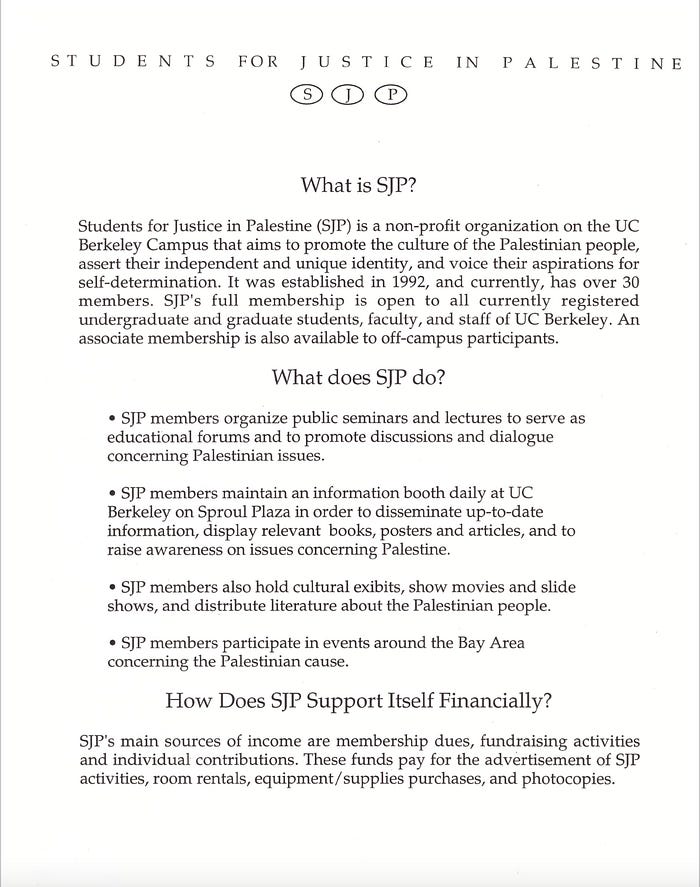
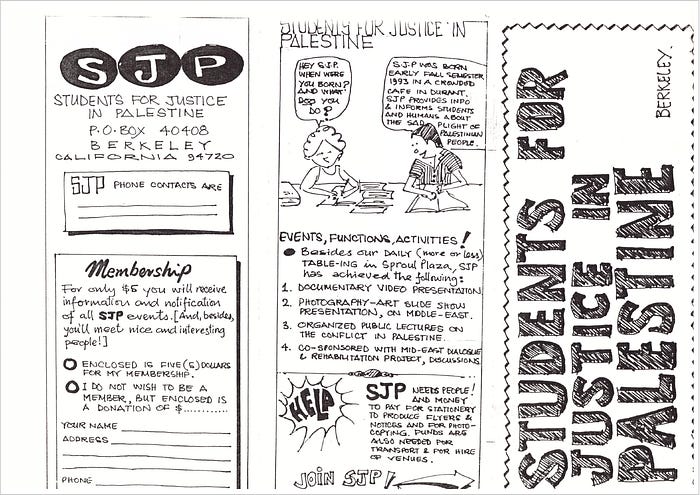
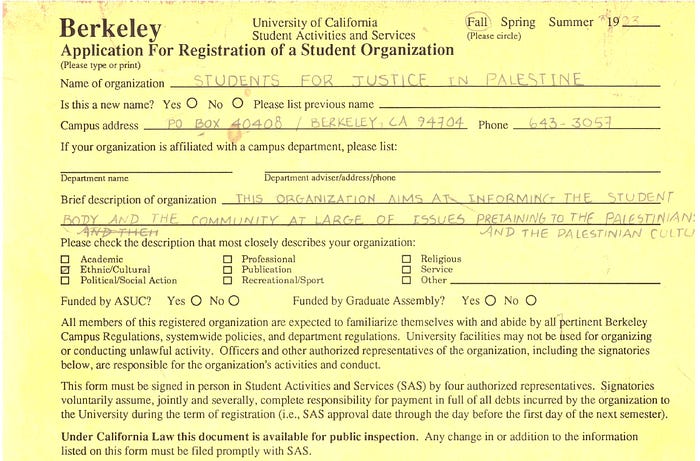
A flyer used on campus to promote SJP in 1993 and the date in here states 1992 but the actual campus registration was completed in August 1993.
Just before the founding of SJP, the Arab Student Union on campus participated in the International House Annual Cultural Festival with a display table with a Palestinian flag on it. The International House staff overseeing the event came to the table demanding the flag’s removal from Osama Qasem because the Hillel students next to the ASU table complained that the flag was threatening and should be taken down. The Arab Student Union members at the table refused to take the flag down, and this incident was one factor among others that contributed to forming SJP as a voice for Palestine on campus.
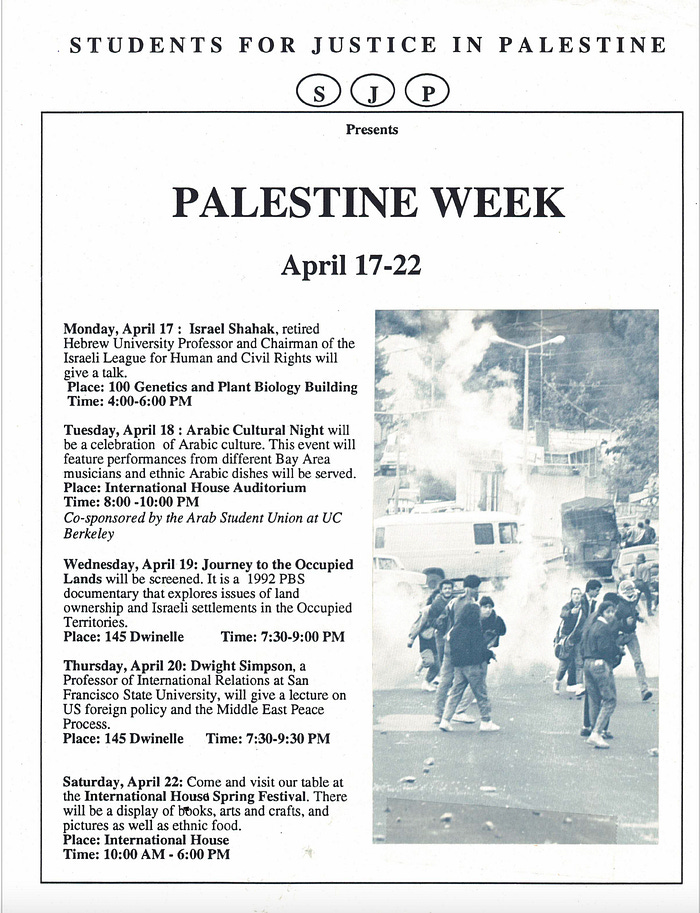
Palestine Week, April 1994.
Returning to forming the organization, the momentum from various struggles mentioned above brought thousands of people onto the streets, and Sproul Plaza at UC Berkeley played a role in the birth of SJP. The initial name was Students for Peace and Justice in Palestine, but after a discussion with a few members, the name was shortened to SJP since peace is an outcome of justice and a prerequisite for it. The initial group was tiny and diverse since the number of Palestinian students on campus was tiny, to begin with, and an open and inclusive organization is the best way to remedy this weakness.
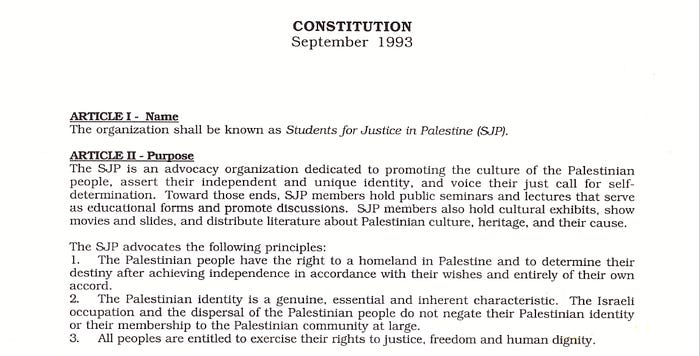
The UC Berkeley submitted SJP Constitution adopted in 1993
In the early period, faculty and community members on and off campus wanted to know if we were connected to any of the PLO factions or who was behind this new effort. Just as today’s nonsense is coming out from Israel and all its ill-intentioned mouthpieces, those with established credentials in Palestine organizing viewed SJP with suspicion, including the possibility of it being a way to weaken Palestinian organizing. If necessity is the mother of invention, then SJP is the outcome of both internal development within the Palestinian organizing landscape and external large intersectional grouping that is ready to express solidarity with Palestine on a sustained basis.
SJP and Post-Oslo Organizing
The signing of the Oslo agreement was a watershed moment for Palestine’s organizing in the US and on college campuses. Immediately after the signing of Oslo, the space for Palestine’s organizing shrunk, and a normalization pattern among segments of Palestinians and Arabs in the US took shape with all types of jointly hosted events and efforts to silence critical voices. Even among Palestinians who were thought to have a critical discourse, the approach was to lay low and not take on the Oslo Agreement since it was a massive wave that would drown everything in its way.
SJP was engaged in critical analysis of the Oslo Agreement and did not take into the celebratory mode witnessed in the community and embraced by campus leadership. A series of events focused on de-constructing the Oslo Agreement and documenting its inherent faults of denying Palestinian sovereignty and the no immediate end of the occupation. Here, one has to state the fact that the University Administration worked hand in hand with local Zionist organizations to forge “dialogue” between Arab and Zionist students while trying to keep SJP at bay so that the critique of the Oslo framework does not get into the discussion. The University Administration always acted at the behest of Zionist concerns and demands while all along viewing and treating Palestinians and pro-Palestine students with distrust, hostility, structured control, and checkpoints within academia.
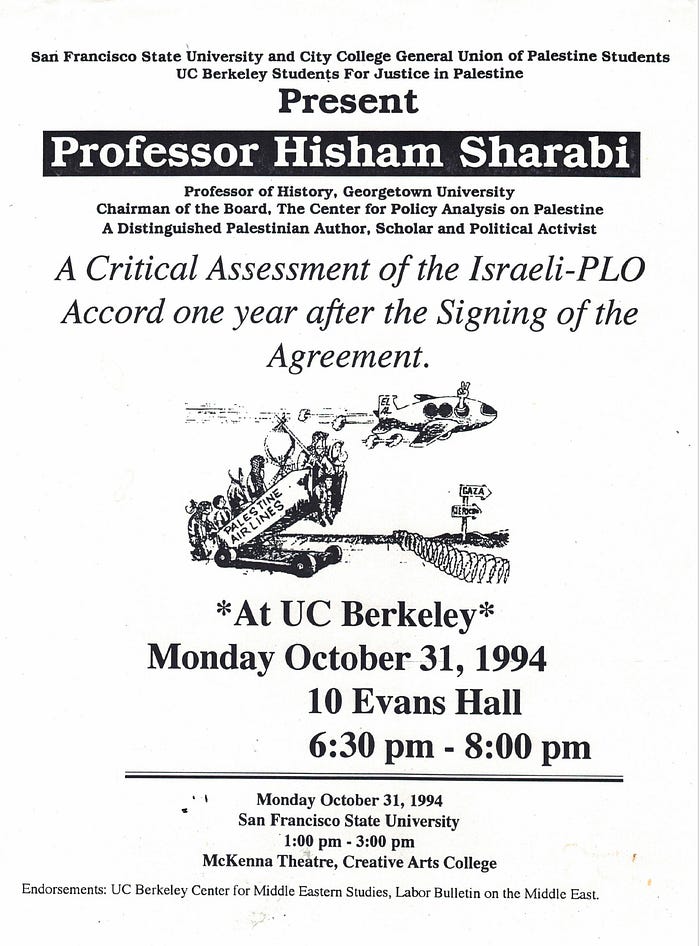
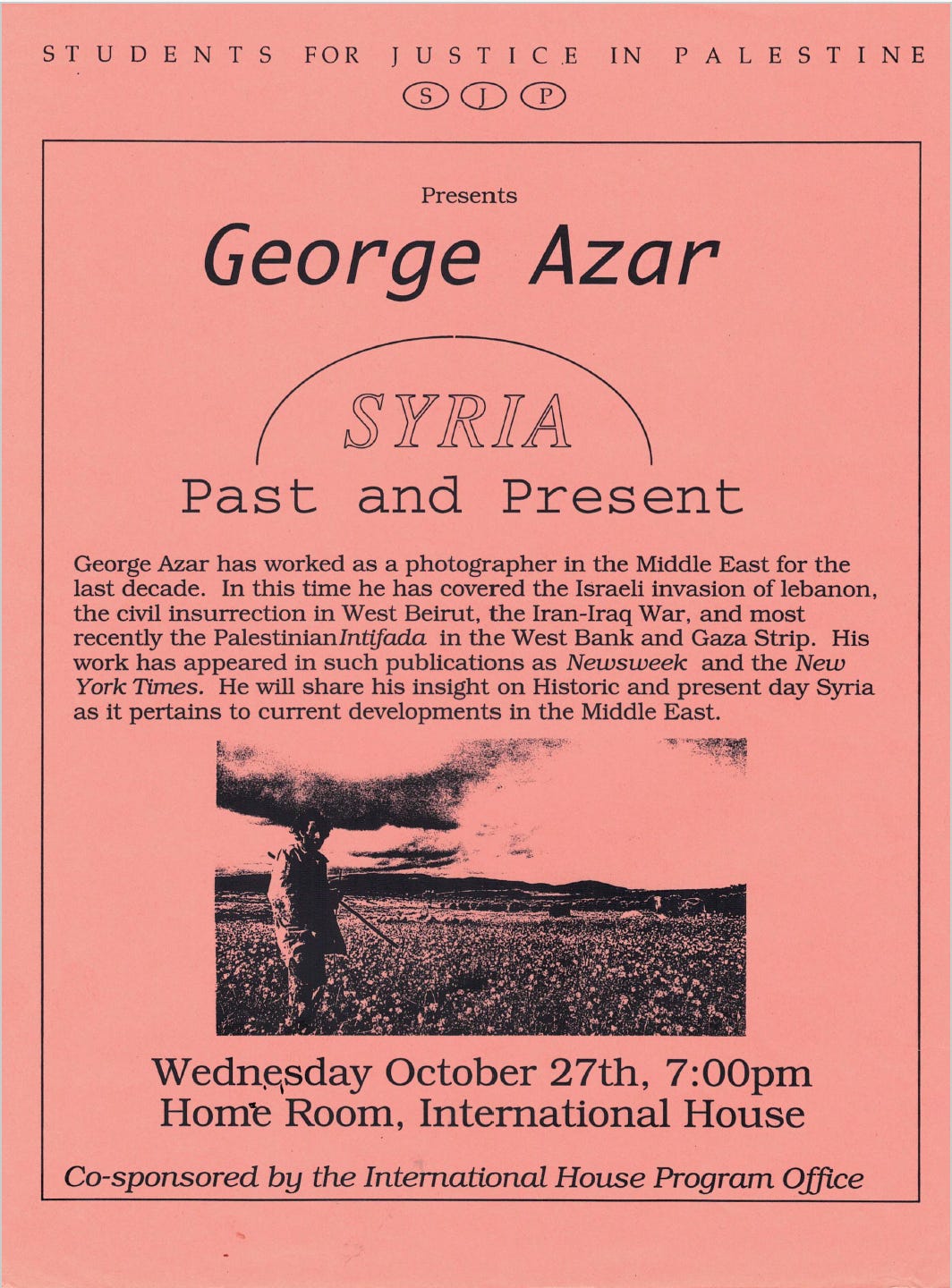
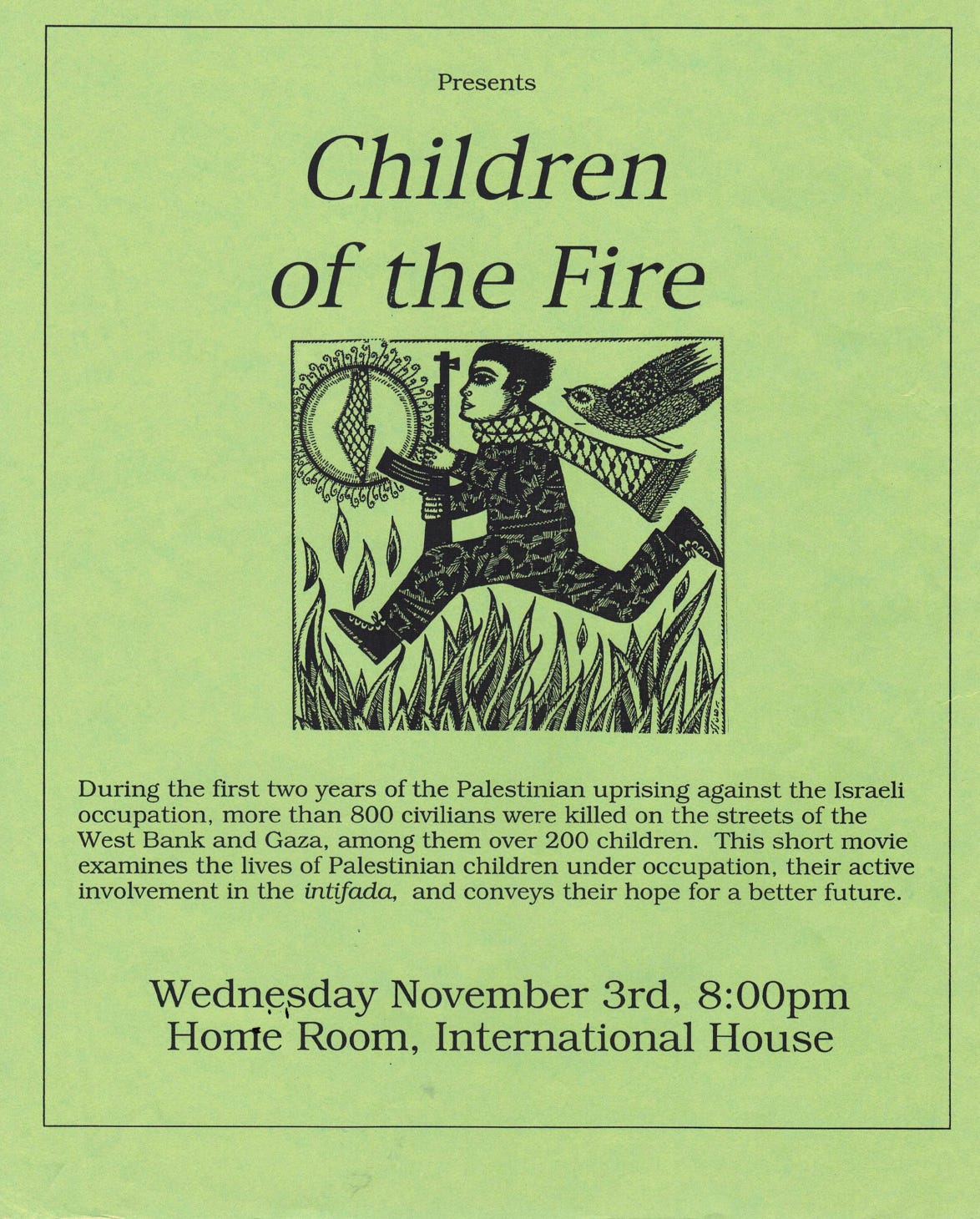
An event was also held at UC Berkeley International House
The post-Oslo period took a sharp, violent turn when Baruch Goldstein, an American-Israeli Zionist physician from the Kach Movement, opened fire on worshipers at the Ibrahimi Mosque during the holy days of Ramadan and early morning prayers. On the morning of the 25th of February 1994, Baruch used an assault rifle and killed 29 Palestinians; the youngest were 12 years old and wounded another 125, which came to be known as the Ibrahimi Mosque Massacre. The Ibrahimi massacre was a very important moment and galvanized campus organizing, not only at Berkeley but on all campuses and in the community. The Ibrahimi Massacre was the beginning of the end of the Oslo Agreement framework on the Israeli and the rise of the extreme right, which culminated in Yitzhak Rabin’s murder on November 4, 1995, by Yigal Amir, an extremist Zionist Jew, who was opposed to the Oslo Accords.At the time, current Prime Minister Netanyahu was stoking, inciting, and agitating against the Oslo Agreement and campaigning on anti-Rabin peace-making efforts with the Palestinians, no matter how limited it was in real terms.
Baruch’s Murder of 29 Palestinians in the middle of the fasting month of Ramadan, the assassination of Rabin, and subsequent violent attacks by Palestinian groups led President Clinton to issue a state of emergency in the US and the passage of the 1996 Anti-Terrorism and Effective Death Penalty Act. The collapse of the Soviet Union and the signing of the Oslo Agreement brought about a shift in Israel and Hasbara propaganda operations in the US and across Europe, with the singular focus on stoking fear of Islam and speaking of the common threat of “Islamic” violence. With Oslo and the birth of the Palestinian Authority, the PLO threat receded into the background, and Bernard Lewis’ framing of the Clash of Civilizations around the threat of Islam popularized by Huntington’s article in Foreign Affairs Journal first then a book dominated discussions and discourses up to this day.
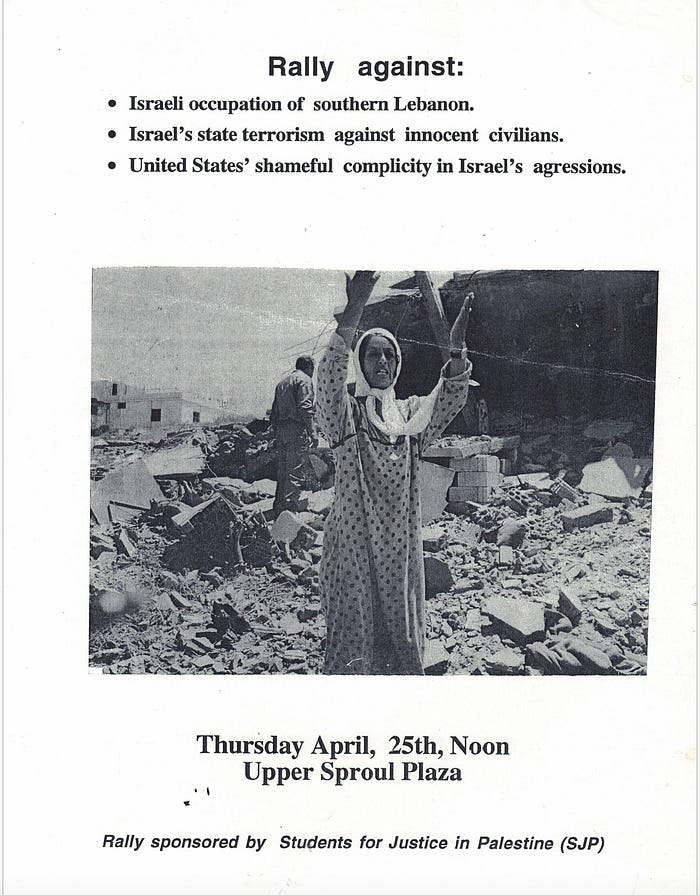
SJP Rally on Sproul Plaza in 1996
Post Oslo witnessed Zionist propaganda and attacks on Palestine activism, and SJP, in particular, took to using Islamophobia and promoting the singular narrative of the global threat of Islam. Contextually, the Islamic threat framing made it possible for Israel and its Hasbara network to position themselves as the go-to experts in confronting this threat with all types of “scholars” to speak on the topic, security conferences, joint training programs with US police and military personal, paid visits by politicians and media practitioners and students. The full-court press to construct the Islamophobic imagination and infuse it into political circles and policy debates was the outcome of this period. Oslo made it possible for Israel to move from confronting the PLO and Communist threat with the West into projecting itself as the key ally in challenging and providing the expertise on the rising Islamic threat, with Hamas serving as the soundboard to achieve this strategic goal.
Indeed, SJP plays a pivotal role on campuses in advocating for the Palestinian cause, raising awareness about the Israeli Apartheid, and challenging existing mainstream and dominant academic narratives-all- had nothing to do with or remotely connected to Hamas, but propaganda is not built on facts but structured disinformation. SJP was founded at a critical transition period in the history of the Palestine rights movement in the US and critical shifts emerging globally post the end of the Cold War, Apartheid, and the signing of the Oslo Agreement. SJP organizers at UC Berkeley led by Osama Qasem and others did not contemplate at the time the crucial role the organization would play for Palestine advocacy in the US and how over a thirty-year period, they managed to change the landscape around longstanding and deeply entrenched geopolitical and ideological framings.
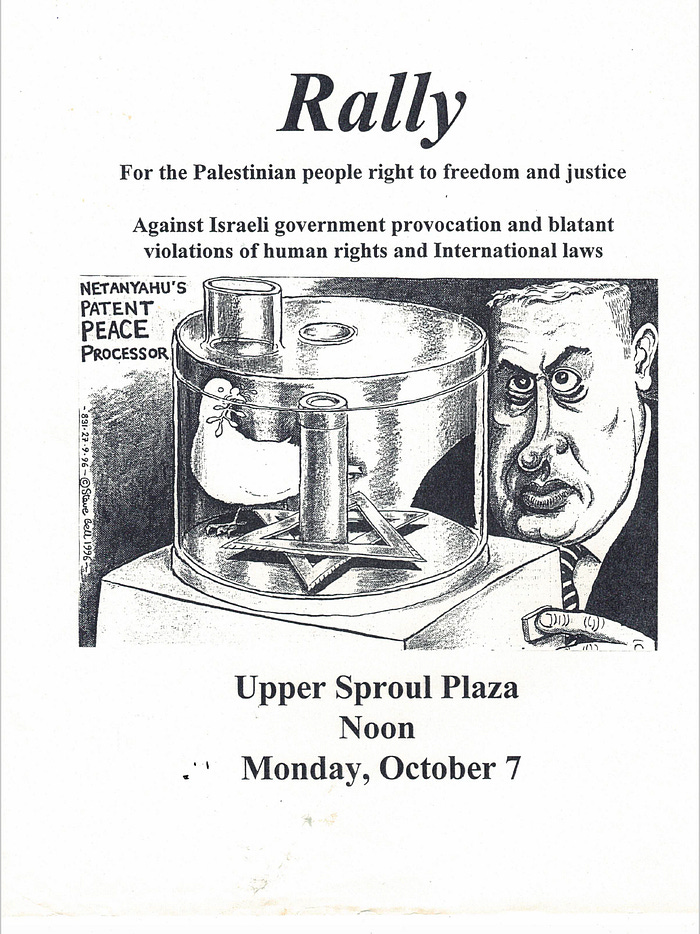
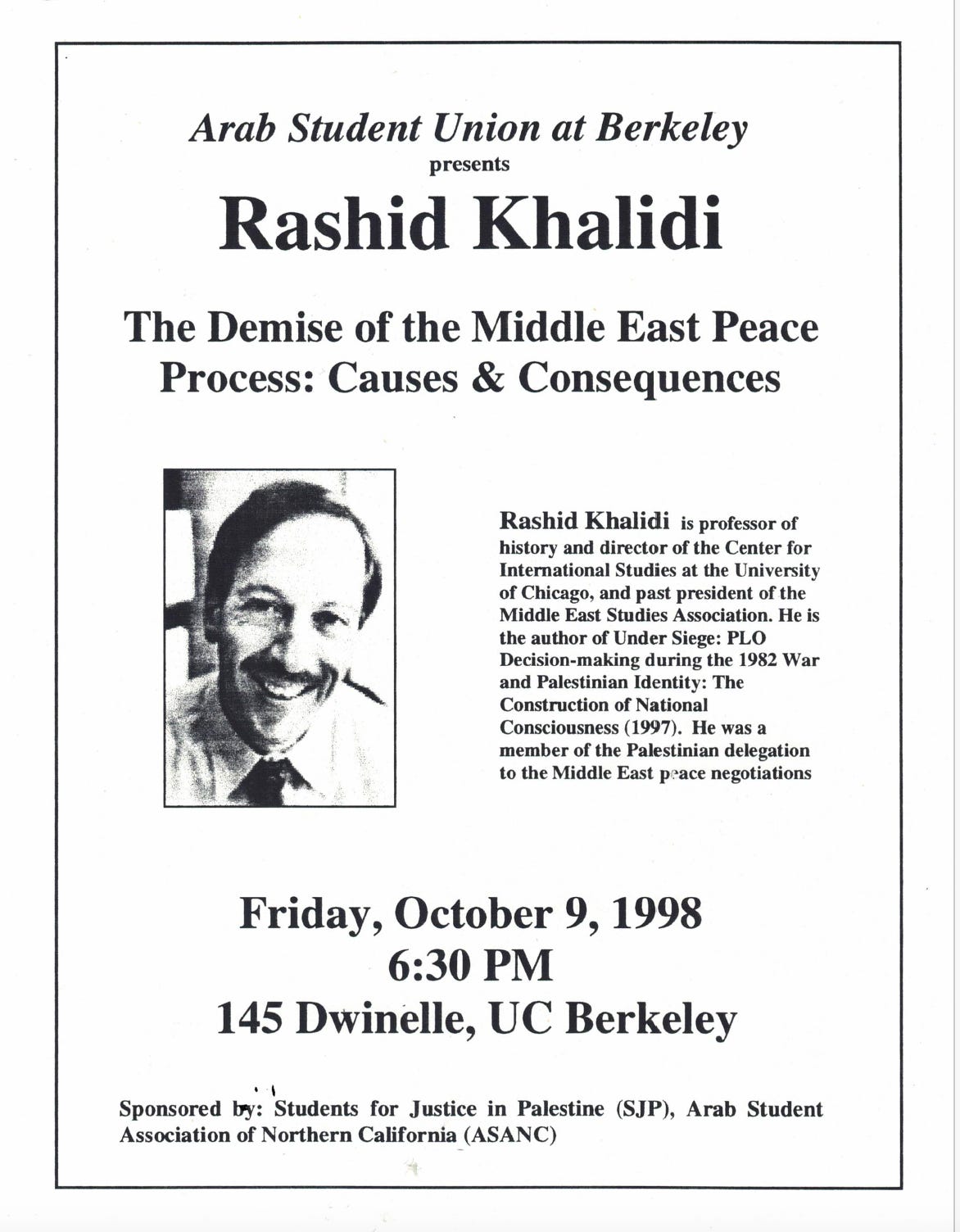
SJP Rally in 1998
SJP is the organizational, non-sectarian, and open bridge that allowed diverse campus communities, including a sizable segment of young anti-Zionist Jewish activists, to emerge into Palestine advocacy. The post-9/11 and Israel’s constant attacks on Gaza provided the stimulus for campus organizing, which only accelerated after the Ferguson and George Floyed Protests, the bombastic Trump embrace of Netanyahu, and the assault on worshippers in al-Aqsa Mosque during the 2021 Ramadan fasting. SJP success is a direct outcome of long hours of discussion among activists, developing further points of unity, and contemplating nuanced perspectives on the complex issues at the heart of campus organizing.
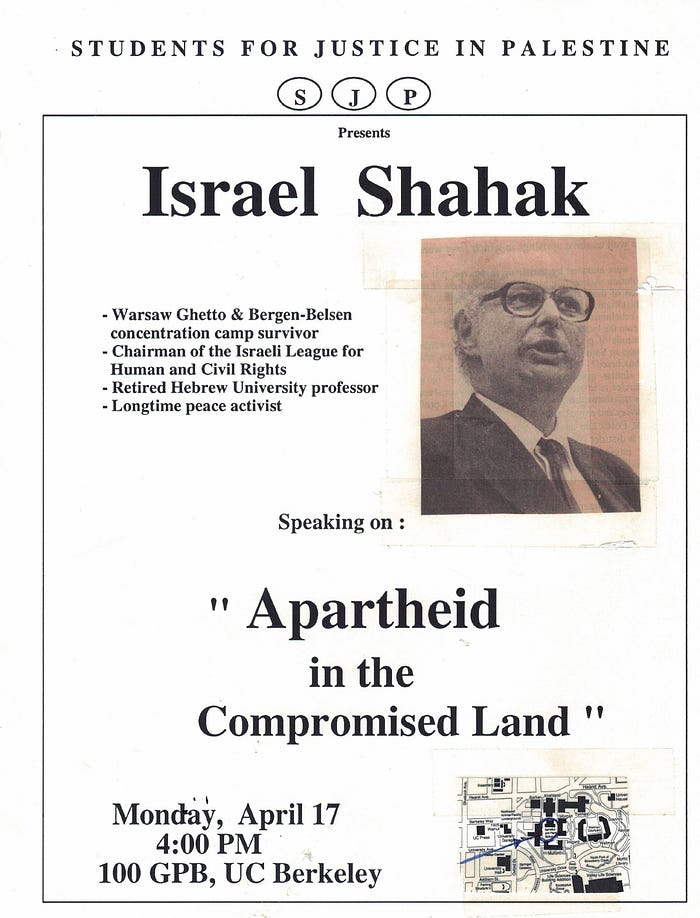
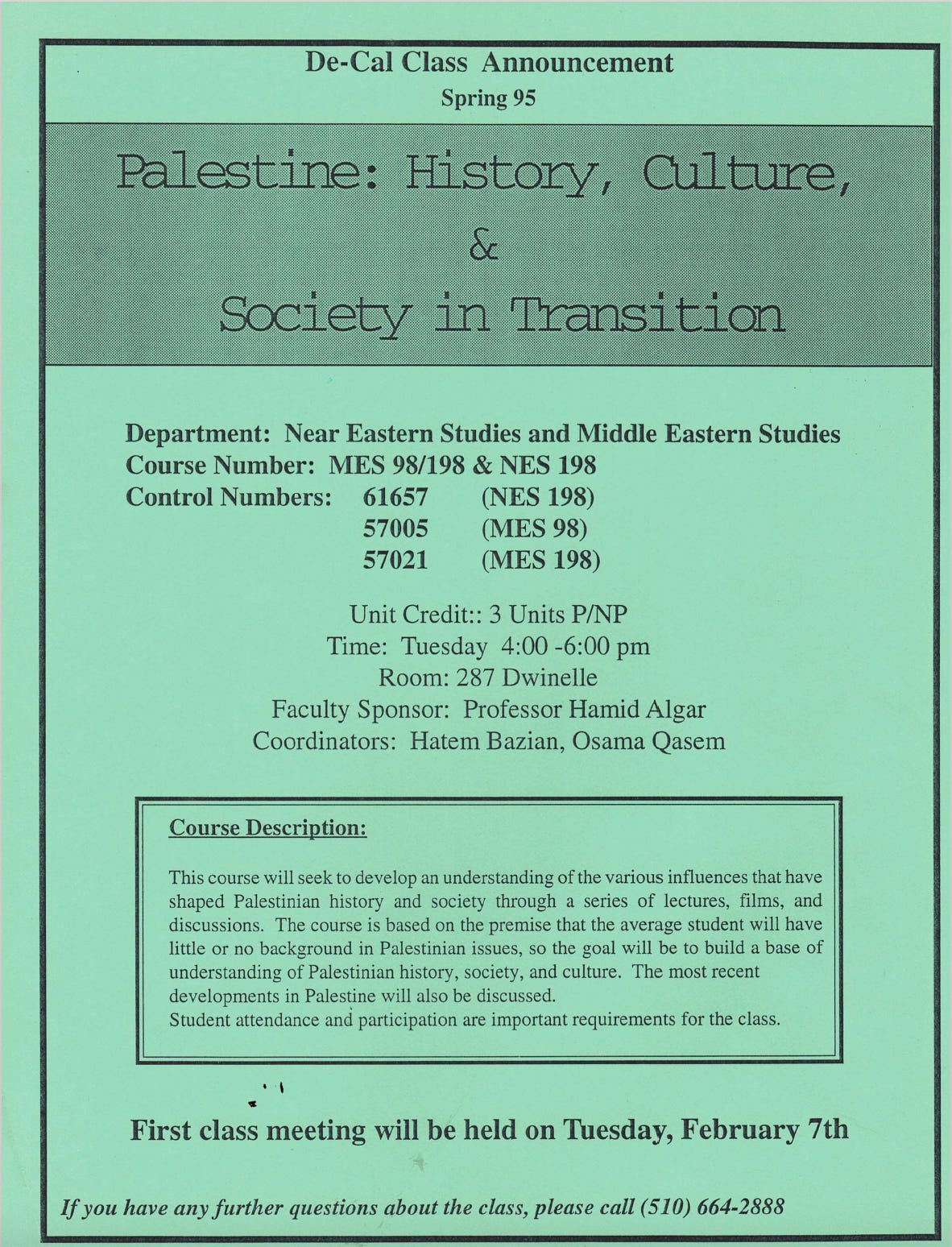
SJP lecture in 1995
SJP presently sets at the crossroads of national debates on issues such as free speech, academic freedom, identity politics, and the challenges faced by activists in navigating a polarized political landscape that has taken center stage post-October 7th and the ongoing Genocide in Gaza. Here, the Doxing strategies, social media bullying with lists and photos of activists listed, legal targeting, investigations, professors’ Op-Eds in national newspapers defaming and targeting SJP student activists, and employer cancelation of job offers are all attempting to rescue Israel’s standing in the face of a live-streamed unfolding Gaza genocide. SJP has become the object of attacks and demonization by pro-Israel, Republicans, right-of-center Democrats, and Right-wing media because the shifts in public opinion on campuses and among the young population are no longer favorable for Israel brand and overwhelmingly support the Palestinian quest for freedom.