Anyone working on the Palestine cause in the West must recall the moment when arguments invariably veer toward “historical” biblical claims, then logic, human rights, and justice no longer matter. When discussion reaches the un-discussable, and that which is “uncontested” and firmly established upon “rock solid” belief, then Palestine’s advocacy hits the wall of irrationality.
In essence, Palestinians have a major hurdle to overcome, not in the form of power disparity, but in the firmly established biblical notions, which I coined as the epistemic theology of dispossession. The Palestinians facing a disparity in power relations with the Israelis is only one dimension of a larger and more systematic epistemic challenge represented by a particular reading and interpretation of the biblical text giving authority to the theology of dispossession and sees in the expulsion process of the native population, pillaging their homes and lands a fulfillment of an ancient textual divine promise that must be actualized. For this biblical theology of dispossession, Palestine and its population are only objects delaying the actualization of a pre-determined course of events and the quicker “we” are able to remove them the faster it will be for ancient triumph to be a modern re-enactment and divine fulfillment in the present. In addition and more problematic is the link between this epistemic theology of dispossession and the foundation of certain strand of Western thought and notions of civilization, modernity and progress.
Palestine, the imagined ancient landscape, is constructed as the taproot for western civilization that is textually affirmed by the biblical narrative through the systematic epistemic eraser of the indigenous Canaanites rights and for the benefit of and affirmation of the trans-historical rights of the invading Israelites of ancient times and its re-emergence to lay claim once again to what is “rightfully” belongs to it, the biblically promised land. Thus an unbroken link between the ancient and the present is made with Palestinians being a transitory people having meaning only through the conqueror written narrative in the past and impediments to the re-emergence of Israel and its people. Palestine, the location of “western” geneous in the ancient past is often mobilized to create a continuity and a specific structural differentiation to contrast it with a less evolved “human” group, the Canaanites of old and Palestinians of the present, or as Orientalist often assert that they have not intellectually evolved to reach the threshold of real “civilization” and are needing “our” intervention to bring it about. Not to mention that the term Palestine is contested so as to prevent the people connected to it from having any rights to assert claims ancient or contemporary.
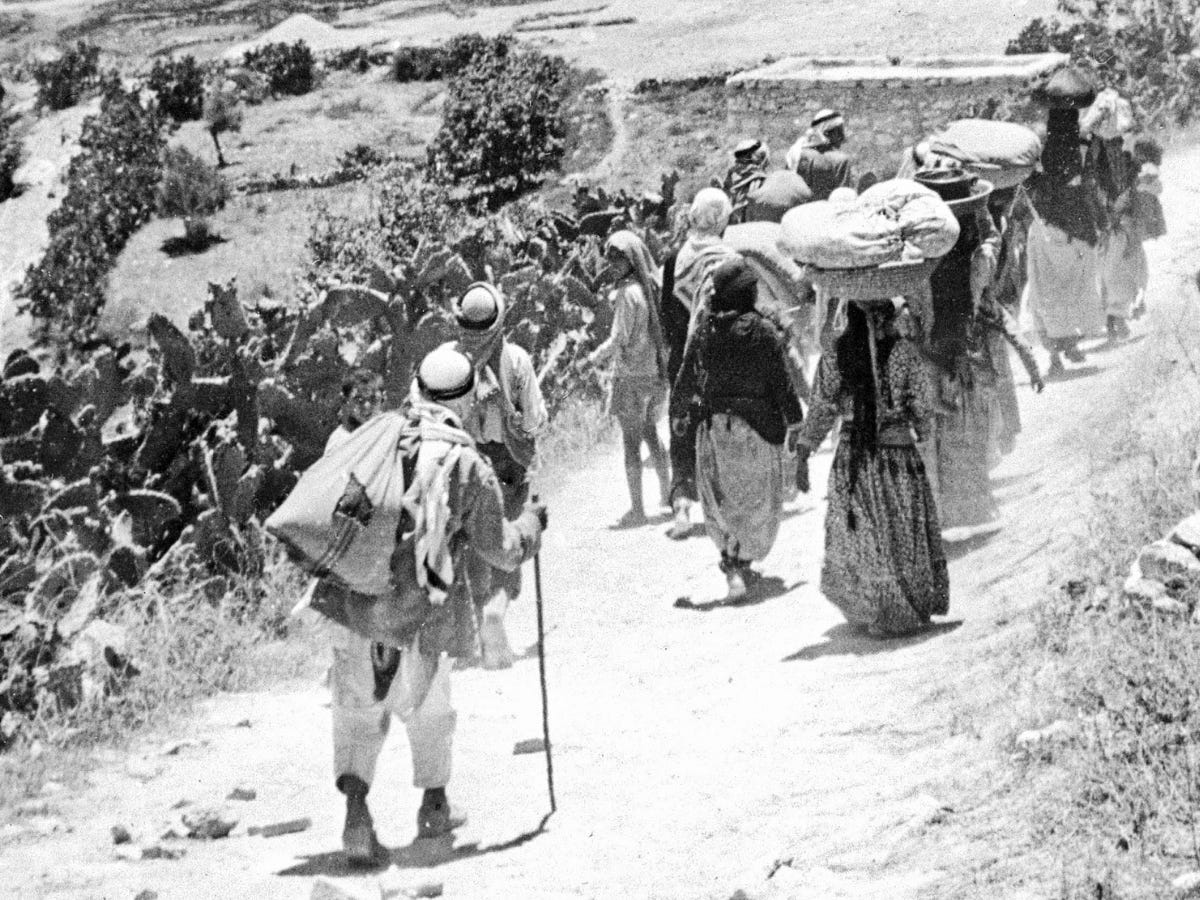
Indeed, when speaking of Palestine and the Palestinians, often we are not far away from a particular colonial, imperial and Zionist friendly reading of biblical narrative, which continues to unfold in a systematic process of dispossession many times over in a landscape that is both within history but not subject to history itself. One can see the deployment of this narrative daily by settlers in Occupied Palestine, and supported and defended by right-wing Christian groups in the US and other parts of the world. It is not a mere conquest and defeat of the Palestinians; instead, we must understand the particular notions emerging from the biblical theology of dispossession, seeing the expulsion of the indigenous population, stealing their private homes and lands, cutting their trees, and livelihood as divinely mandated and fully sanctioned actions. Thus, Palestinians are victims of an epistemology rooted in a theology of dispossession, and their role is to “accept” their expulsion as a legitimate price to fulfill divine purpose.
Locating Palestine and Palestinians
To locate one’s self, one’s history and civilization in the confines of biblical narrative is to become an inheritor of its content, to become, in reality, a real subject of history, a master of one’s own life and circumstances as well as being the quintessential human agent in civilization’s march toward progress, ingenuity, and creativity. The “other” is therefore characteristic of the opposite who stands in the face of and in confrontation with the progress, salvation, and biblical narrative and theology of dispossession, both in ancient times and the modern.
The Canaanites of ancient times and the Philistines are constructed, in the Zionist and imperial and colonial friendly Christianity in the West, to represent the mirror images of the modern Palestinian, who refuse to see the value of progress and the “global civilizational project” represented by modern Israel that is explicitly connected to that which is ancient. From this vantage point, the Palestinians are deemed to be the “un-authentic people” for they don’t belong to history, they have no history, they are only objects of the real biblical history or if they appear in it they do so only to give meaning to the subjects of real and civilizational history, the Israelites. Today’s Israel is spoken of as a continuity of the ancient thus the epistemic theology of dispossession is sanctioned today for it is “god’s” people acting on His behalf and according to His wishes. I am afraid that this point is beyond argument and it is the wall that many will hit in discussing Palestine, human rights and international law discourse can’t penetrate this sealed off epistemic fortress of the mind.
Furthermore, the Palestinians have no authentic religion –in ancient times the Canaanites religion was inferior if compared to the genius of the bible and its subject- while today they are mostly Muslims, an “inferior, imposters and a distorted” imitation of the original, real and authentic Judeo-Christian tradition. This does raise the issue of Palestinian Christians and in their case their cultural affinity and co-existence with Muslims makes them less “authentic” Christians and are not allowed to be the interpretive voice for global Christianity and are kept at a distance from the civilizational megaphones or centers of religious discourse for they, like their Palestinian Muslim neighbors play a disruptive role to the colonial friendly and imperially constructed Christianity that seeks to support the Zionist project of dispossession and the affirmation of the epistemic biblical theology of dispossession.
Palestine-Palestinians in the ancient/present have meaning through or only by being the other standing in opposition to the development of the “state”. In ancient times, the Canaanites stood in opposition and threatened the survivor of the divinely inspired “state” and as a consequence emerged to symbolize and act as the archetypal stateless people and their action and refusal to submit, in the particular and narrow reading in the present of the text, was asserted to be the real cause of their defeat, expulsion, massacre and eventual statelessness. The conquered people in the cities were subject to an epistemic eraser and leave the pages of history since the records written about them comes to us from those victorious in the past and at present practitioners of the global biblical theology of dispossession
Thus, for the divinely inspired “state” to come into existence we must accept and defend the continued statelessness of the Canaanites in ancient times, as the legitimate cost, divinely mandated nonetheless, for the “superior human” evolutionary progress narrative and Western civilization eventual trajectory. This same logic was very instrumental in the dispossession of Native Americans and indigenous people across the Americas. Once the civilizational trajectory is located in a distant past then all actions is rationalized as a legitimate cost for progress but in this it is surely “divinely” mandated and is not subject to a counter narrative or rational argumentation to the contrary. Religious discourse becomes a closed box starting with biblical dispossession and re-emerging in a new and improved theology of dispossession i.e. God is commanding me to take your land!
For the settlers in Occupied Palestine, the act of dispossessing the Palestinians is a religious duty and a “divinely” mandated act and to bring about the final chapter or an important next stage in what started three or four or five thousand years ago and the Palestinians are a “type of pollution” or an “impediment” that must be removed for this major event to be actualized. When it comes to the Palestinians and their rights this same view is shared by many in the rightwing Christian movement but they also have a more pernicious agenda and eventual plan for Jews themselves. The final solution envisioned through a particular and disturbing reading of the biblical text calls for massacring the majority of the Jewish population while the remaining minority is saved because they agree to convert to Christianity. Those who use this biblical theology of dispossession are rationalizing death, massacres, and destruction with the authority placed at the footsteps of god, but no one can ask God directly whether He actually gave such permission or power. The more critical issue is that we witness individuals and groups speaking as if they are God rather than mere interpreters of the text, which, if taken appropriately, would allow multiple possibilities rather than a single one, thereby rationalizing a colonial, imperial, and dispossession-centered worldview.
In looking at Palestine-Palestinians today one can see the immediate link if not the actual language used to defend and accept their collective statelessness in the face of a “divinely” mandated state that distinctively emerged out of the “civilized modern.” At present, the Palestinians are standing in the path of the “superior human” represented by the distinctively evolved Zionist and at the same time opposing Western civilizational trajectory not to mention their “infantile” attachment to Islam and its “primitive war-like” traditions.
The Palestinians are a constant challenge to modernity with its multifaceted colonial entanglement in the post-colonial, even though Palestine itself is a never-ending colonial project. Palestine’s entanglement with the modern colonial comes at a critical juncture in the history of colonization, as it was coming to an end in much of the world, it actually begins to take hold with the Zionist project. From a particular reading of history, Palestine and its people represent a fixed challenge to the modern progress narrative, a feature that can be located in the distant past and in the Canaanites of ancient times who refused to get out of the way and exit stage left to allow for the massive civilizational project to move forward.
(Article published initially in 2013 and I am respoting it)

