

Home
/
“It Is Something Colonial,” Reading the Genocide in Gaza Through the Western Incubation of Zionism
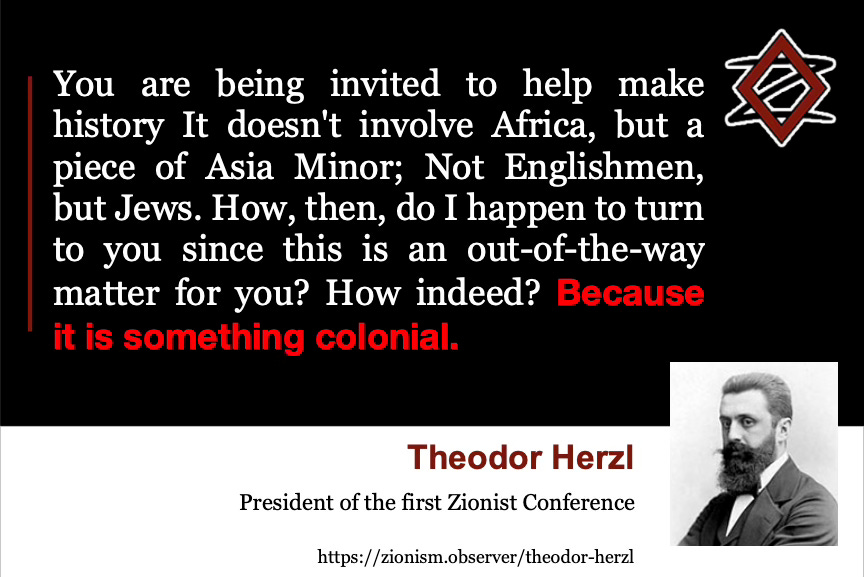
In 1902 Theodor Herzl, the founder of modern political Zionism, wrote to Cecil Rhodes, Great Britain’s minister of colonies and the most notorious empire-builder of the age, to solicit support for the Jewish project in Palestine. “You are being invited to help make history,” Herzl told him. “It doesn’t involve Africa, but a piece of Asia Minor; not Englishmen but Jews… How, then, do I happen to turn to you since this is an out-of-the-way matter for you? How indeed? Because it is something colonial.” The sentence is not an accusation invented by Palestinians after the fact. It is a confession, offered freely in a letter to the Minister of Colonies by the movement’s own founder, addressed to the era’s archetypal colonizer. Zionism understood itself, from the outset, as a colonial enterprise seeking a colonial patron. Any honest reading of what is unfolding in Gaza today must begin there and not with the past three years. Gaza is experiencing Herzl’s “something colonial,” which is a genocide and transfer plan.
The main idea of this essay is that the catastrophe in Gaza is not an aberration, not a tragic excess in an otherwise legitimate national story, and not the unfortunate by-product of a “conflict” between two symmetrical parties. It is the predictable culmination of a settler-colonial project conceived in Europe, incubated by the European powers throughout the nineteenth century, and handed to a settler movement that adopted the colonial epistemology of its sponsors and carried it to its logical end. The direct hand pressing on Palestinian bodies today is Zionist, but behind that hand stand the powers, British, German, French, Russian, Dutch, and American, that prepared the ground, supplied the instruments, provided the protection, and continue to underwrite the project at the expense of the land’s indigenous population.
Long before the first Zionist Congress at Basel in 1897, the European powers had already begun the patient work of cultivating Palestine as a field for colonization. The instrument of choice was the consulate structure that entered Palestine almost 600 years after the last Crusader left the region. Britain opened a vice-consulate in Jerusalem in 1838; France, Prussia, Sardinia, the United States, Austria, Germany, and Russia followed over the next two decades. On paper, these were diplomatic missions, but in practice, they were beachheads for Western colonization of the region and, at a later stage, adopted the Zionist project. Operating under the protection of their own state flags and the capitulation privileges extracted from a weakening Ottoman order, the consuls accumulated land, registered companies, opened banks, extended protection to clients, funded “improvement” schemes, and assembled a detailed inventory of the country’s resources, all under the respectable cover of scientific curiosity, cultural and religious interests, and humanitarian concern.
The inventory was meticulous and far from innocent. The Palestine Exploration Fund, founded in London in 1865 under royal patronage, dispatched military surveyors, among them a young Royal Engineers officer named Horatio Herbert Kitchener, to produce the Survey of Western Palestine, a map of the country down to the contour line, the spring, the ruin, and the village. Water resources were cataloged, soils were classified, rainfall was measured, and the agricultural potential of each district was assessed. This was knowledge gathered in the idiom of disinterested science, but it was knowledge of exactly the kind an incoming settler population would require. Where the water was, what the land could grow, and how a European presence might be planted and sustained is not “neutral” science; rather, it was colonial science. The German Templers built their agricultural colonies and model farms; Russian, French, and German institutions bought up land and established footholds; and the data accumulated by all of them flowed, directly or through a dense network of intermediaries and European-registered entities, into the channels that Zionist colonization would later put to effective use. This was knowledge production for a colonial project, the same surveillance knowledge assembled today to further Israel’s genocide.
Alongside the survey came the archaeology aimed at locating or creating the biblical narrative. Biblical archaeology, pursued under consular protection and European funding, was never a neutral excavation of the past. It was the material recreation of a scriptural narrative, a search for the Israel of the text beneath the soil of Palestine, conducted in such a way that the living population on the surface became, in the scholarly imagination, a backdrop or an obstacle. Out of this enterprise grew the powerful current of Christian Zionism, which gave the colonization of Palestine a theological warrant and which would become, especially in the Anglo-American world, one of the most durable pillars of political support for the project. The trowel and the theodolite worked in concert; one mapped the land for settlement, the other mapped the “biblical” past to justify it.
The same powers deployed the full repertoire of soft power. Missionary educational institutions like the Syrian Protestant College in Beirut (later the American University of Beirut) and the network of British, French, German, and Russian schools across Palestine trained local elites in European languages and European frames of reference. Foreign capital was invested in the local press, including those owned by Arabs themselves, to shape public opinion. Training programs, charitable societies, model farms, and even sport at the local level were cultivated, each presented as a gift to the natives, each quietly establishing a foothold and a constituency. The genius of the arrangement was its deniability. Every act of incubation could be described as philanthropy, scholarship, faith, or development. Underneath, the consolidated effect was the construction of the political, economic, demographic, and ideological infrastructure on which a settler state would be raised. One can understand how the Abraham Accords of the current period is inscribed with the same logic of incubating Zionism by expanding its reach across the region.
The physical removal of a people is always preceded by an epistemic one. Before Palestinians could be displaced from their land, they had to be displaced from history, written out of the story of their own country so that their presence would register as an anomaly rather than a fact. I have elsewhere called the machinery that accomplishes this the biblical theology of dispossession: the use of religious text as a vehicle by which to grant legitimacy to the displacement and collective silencing of the Palestinians. The archaeological projects of the nineteenth century, the cartography of the surveyors, and the theology of Christian Zionism all fed into a single operation, the recreation of the biblical text in the modern, religious-nationalist period through a colonization project supported by the West.
Scholarship has long since dismantled the foundations on which this dispossession rests. Keith Whitelam, in The Invention of Ancient Israel, demonstrated that “the history of ancient Palestine has been ignored and silenced by biblical studies because its object of interest has been ancient Israel conceived and presented as the taproot of Western civilization.” Thomas Thompson, who was driven out of academia for a time for arguing against the historicity of the patriarchal narratives, and, later, Israel Finkelstein and Neil Asher Silberman in The Bible Unearthed showed that some of the most famous events of the biblical story “clearly never happened at all,” or did not happen in the era or manner described. The point is not to adjudicate ancient history for its own sake. It is to recognize that a humanly constructed colonial project has been clothed in divine purpose, and that this clothing is precisely what licenses the treatment of the indigenous population as disposable, as figures standing in the way of a divinely scripted Return.
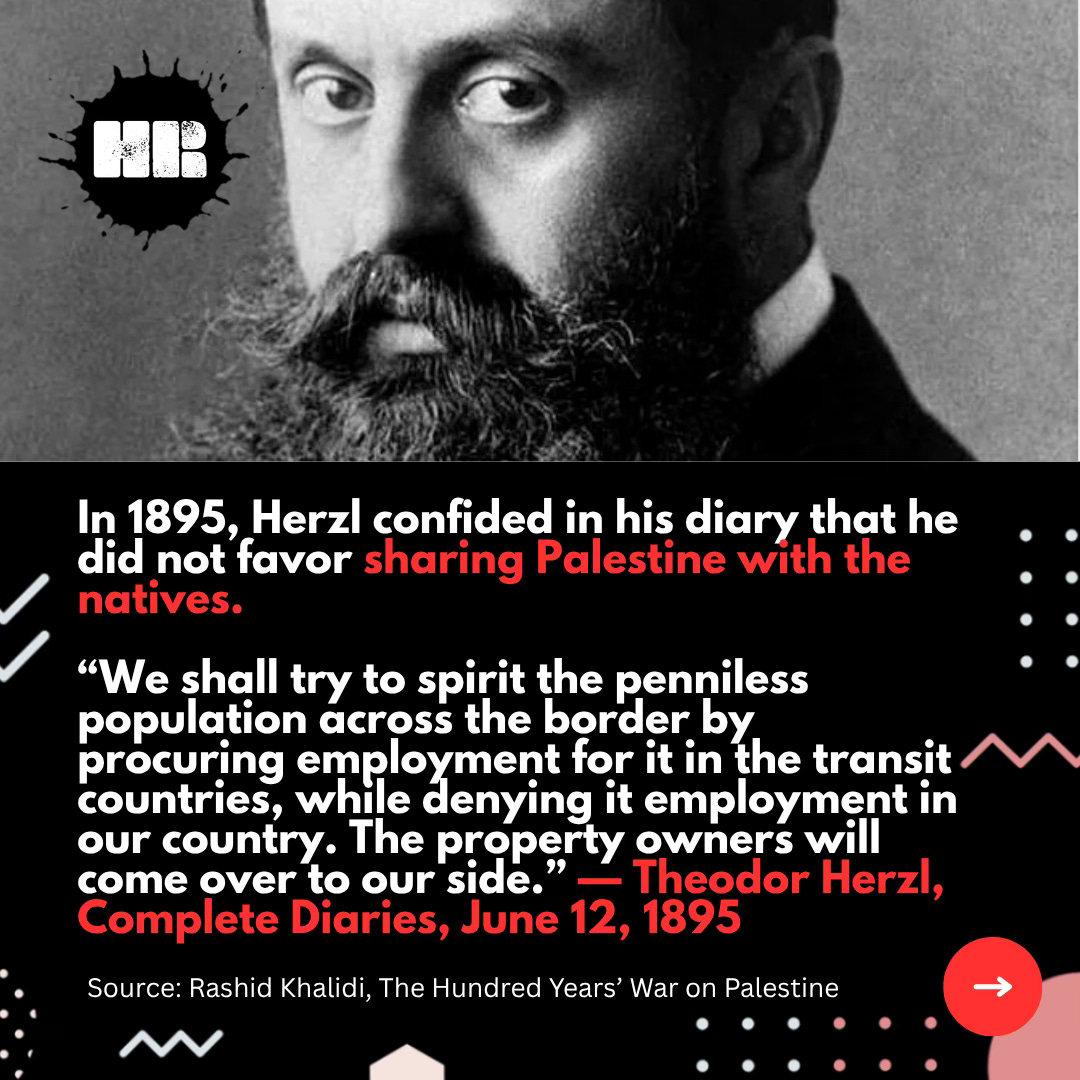
This is why the slogans matter so much. “A land without a people for a people without a land” and “making the desert bloom” are not quaint relics of early Zionist enthusiasm. They are the operative grammar of erasure, which, on the one hand, imagines the territory as empty or uncultivated, and on the other, casts the settler as a member of a religious community returning to claim what rightfully belongs to it. The Palestinian, the Canaanite continuity of the land, the fellah who terraced its hills, the Bedouin as ancient as the landscape itself, must be made to vanish from the frame for the slogan to hold. When a people are denied a history, their capacity to interrogate the past and act in the present is constrained to an impassable limit. That is the function. The first act of liberation, then, is located in the mind, the reclamation of the history and memory of Palestine.
Settler colonialism is a distinct formation, and it is worth naming its logic precisely. Unlike a colonialism of extraction, which needs the native as labor and therefore preserves him in subjugation, settler colonialism wants the land and not the people. Its organizing principle, in Patrick Wolfe’s well-known formulation, is the “logic of elimination”: the settler society is built on the replacement of the indigenous population, whether by expulsion, by confinement, by legal erasure, or by death. This is not a charge to be hurled; it is a structural description, and it fits the Palestinian case with brutal exactness. Zionist settler colonialism sought, and to this point has largely succeeded in, taking over the land, expelling large sections of the indigenous population, and tormenting those who remained behind, all while building a formidable garrison underwritten by the major Western powers.
Seen in this light, the recurring assaults on Gaza, in 2008–09, in 2012, in 2014, 2018, 2021 and in the cycles since, are not discrete “rounds” in a contest between equals. They are normative settler colonial patterns, intended to crush the indigenous population’s will to resist and to compel an eventual acceptance of the oppressive structure set in motion at the project’s inception. The same logic operates wherever the settler state confronts the indigenous fact: the confiscation of land in the West Bank to build new settlements; the demolition of Bedouin villages in the Naqab such as Umm al-Hiran and the schemes, like the Prawer plan, that would uproot tens of thousands on the premise that “there is no Bedouin land ownership”; the uprooting of trees, the burning of crops, the theft of water, the demolition of homes, the apartheid wall, and the fragmentation of the West Bank into disconnected Bantustans. Each is a local expression of a single settler colonial structure. The preoccupation with Palestinian violence and resistance, the demand that the colonized first renounce resistance before their grievances may be heard, is a strategically deployed obfuscation, one that inverts cause and effect to protect the settler and his global allies.
Even the diplomacy that the world calls peace has functioned as an instrument of this structure rather than a brake upon it. When Yasser Arafat signed the Oslo Accords in 1993, the Declaration of Principles promised negotiations on settlements, borders, refugees, water, sovereignty, and Jerusalem. In practice, the only clause that became fully operational was security, and that in the perverse form of Palestinians being assigned responsibility for protecting the very settlements built on their confiscated land. What began with a ceremony on the White House lawn was converted, over the following decades, into “facts on the ground”: bypass roads, an apartheid wall, a tripling of the settler population, and the fragmentation of the West Bank into disconnected enclaves. The “peace process” did not interrupt colonization; it administered it, supplying the appearance of a horizon while the structure consumed what remained of the land. To mistake the management of dispossession for its resolution is to misread the entire enterprise.
This is the frame within which the present genocidal horror in Gaza must be set, the deeper understanding of settler-colonial logic. As of mid-2026, after more than two and a half years of non-stop assault, the official count maintained by the Gaza Ministry of Health records over seventy-three thousand Palestinians killed, the overwhelming majority of them civilians, a vast share of them women and children. Demographers regard even this figure as a conservative floor; a 2025 study by the Max Planck Institute for Demographic Research estimated violent deaths in the range of one hundred thousand to one hundred and twenty-six thousand, and that estimate does not capture the further tens of thousands who have died from the engineered collapse of the health system, from starvation under blockade, and from disease. Whole extended families have been erased from the civil registry. The infrastructure of life- hospitals, universities, bakeries, water systems, housing- has been systematically destroyed.
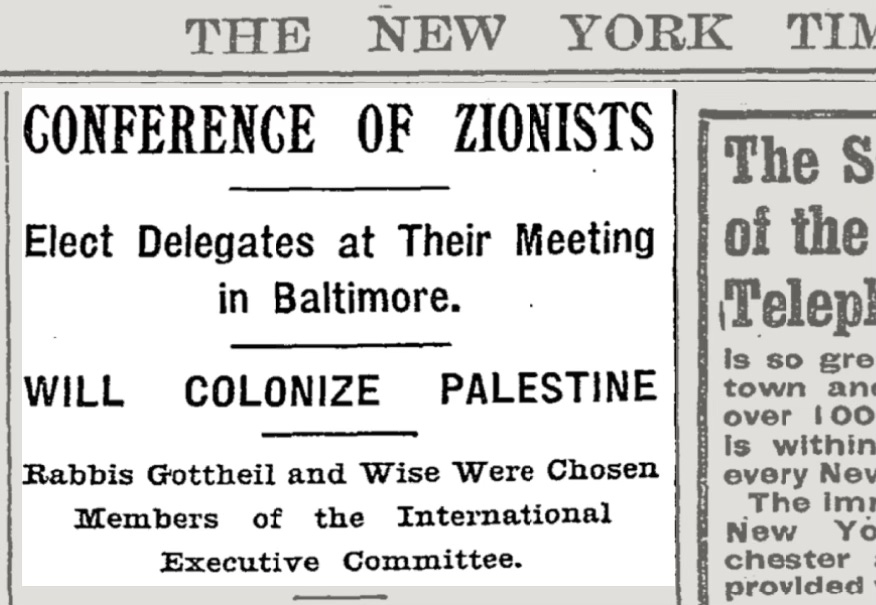
The language of the international legal order has begun haltingly to catch up with reality, but it is too slow and remains captive to Western domination, threats, and obfuscation. In response to South Africa’s application under the 1948 Genocide Convention, the International Court of Justice found the claim plausible enough to impose provisional measures ordering Israel to prevent acts contrary to the Convention; the case on the merits remains in its written phase, with growing numbers of states intervening. United Nations experts, human rights organizations, and genocide scholars have increasingly named what is happening with the word the Convention reserves for the gravest of crimes. To insist on the settler-colonial frame is not to evade that legal vocabulary but to explain it. Genocide, in the settler-colonial setting, is not a departure from the project; it is the logic of elimination arriving, under conditions of total siege and overwhelming firepower, at its most concentrated expression. The same impulse that animated the slogan of the empty land animates the emptying of Gaza.
It is here that the comparison to other indigenous histories becomes unavoidable, and my insistence on it is deliberate. Since 1492, the world has witnessed the systematic, industrialized dispossession and elimination of indigenous peoples across the Americas, Africa, and Asia, ravaged by greed, disease, and military destruction, and justified, again and again, by a manifest destiny that dressed conquest in the robes of providence. The Palestinians are victims of a Zionist manifest destiny and Christian Zionism manifest destiny that creates facts on the ground and stages the reenactment of a mythical past in the present to hasten the Second Coming of Jesus. To recognize this is not to deny Jewish suffering, nor the reality of the Holocaust; each people has the right to speak of its pain. But at no point should historical suffering be permitted to authorize an open-ended settler-colonial project, sanctioned by a theology of dispossession, against another indigenous people who bear no responsibility for European crimes.
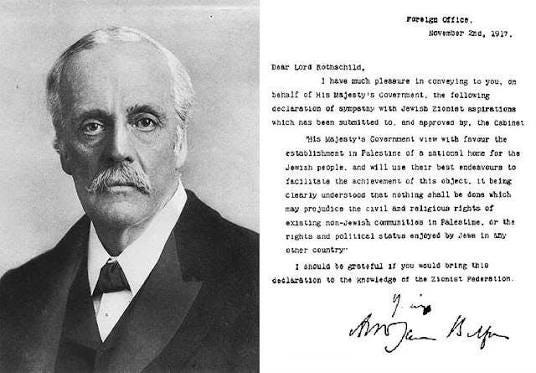
The incubation that began with the consuls did not end with the founding of the state in 1948; the patron simply changed seats. Britain’s Balfour Declaration of 1917, a European power promising a national home in a land it did not yet hold, to a movement of European settlers, over the heads of the country’s overwhelming indigenous majority, was the formalization of everything the nineteenth-century groundwork had prepared and is colonial legalism at work. The Mandate translated promise into administrative reality. And in the postwar period, the United States assumed the role of principal sponsor, with the diplomatic shield at the United Nations, the flow of arms and finance, and the cultivation of a domestic Christian-Zionist constituency whose theology was seeded by those same nineteenth-century currents. The recent declarations of intervention by Western states on Israel’s side in the proceedings at The Hague are only the latest expression of co-production of settler-colonialism in Palestine, co-production of the genocide and a complicity that is more than a century old.
This is the sense in which Gaza is not Israel’s crime alone. The settler state is the instrument; the structure was built, armed, financed, and legitimized by a succession of Western powers that adopted Zionism as a colonial partner and have defended it through every stage of dispossession and genocide before the state even came into existence in 1948. To speak of the genocide in Gaza without naming this scaffolding is to mistake the trigger finger for the whole apparatus of the gun, the supply chain, the legal international protection, and the punishment of opposition. The complicity is not passive, for it is the active provision of weapons, money, vetoes, capture of TikTok, censorship on a massive scale on all social media platforms, and media narrative cover, without which the project could not be sustained for a week.
Nothing about Palestine is uncontested, not its name, its borders, its history, its people, nor the term indigenous itself. But contestation is not a reason to fall silent; it is the very topography of speaking Palestine in the modern world. The Palestinians are an amalgamation of all the peoples, civilizations, and faiths that have left their imprint on the land, with the Canaanites as the most ancient stratum and everyone else, in the long view, a passer-by. Their claim does not rest on a fiction of racial purity, which no people can assert, but on a critical and sustained presence on the land across millennia. The Bedouin of the Naqab live rightfully on their land, and no apartheid law can alter that fact. Palestine is a land with people, no matter what the settler-colonial genocidal institutions maintain.
To read Gaza through the frame offered here, settler colonialism incubated by the West and sanctified by a biblical theology of dispossession, is not to offer a grand scheme for resolving the question but a starting point in a decolonization worldview that centers Palestine and its people. It is to insist that the question of genocide and what happened and is happening in Palestine today is posed correctly. So long as the catastrophe is described as a symmetrical conflict, a security problem, or a tragic cycle of violence, its driving logic will remain hidden, and its Palestinian victims will continue to be asked to apologize for their own resistance. The starting point for anyone who genuinely seeks justice that leads to peace is the setting aside of the theology of dispossession and the recognition, in word and in deed, of the Palestinians as the indigenous people and custodians of the land. Only after that recognition can there be any honest conversation about what is to be done within the framework of decolonization. Herzl told Rhodes the truth: it is something colonial. More than a century later, with the indigenous population of Gaza facing a genocide in full view of the world, the task is to take him at his word, and to draw the conclusions he and his Western patrons spent a century trying to bury. Every settler-colonial project must be confronted on the basis of its genocidal logic, which is the first step toward decolonial horizons.