
Islamophobia and stoking anti-Muslim racism across the West is the new but old magic bullet for Israel and Zionism. Having no shame is the only way to understand what Israel and the network of supporters are doing to cover up, explain away, and divert attention from the ongoing genocide and ethnic cleansing. Recognizing genocide and bringing it to an end is a tall order for Zionism and Israel. Death, destruction, and mayhem visited upon the Palestinians in Gaza and increasingly in the West Bank is not enough to bring “victory” to Israel and Zionism, but adding a heavy dose of Islamophobia might bring the needed results that frame the genocide as a defense of Western civilization.
The entanglement between Islamophobia and Palestine activism is not accidental; it is structural and strategic. Drawing on my article for the American Studies Association journal, “The Islamophobia Industry and the Demonization of Palestine,” which traces how a web of pro-Israel organizations, philanthropic foundations, and state-linked “hasbara” (public diplomacy) operations have positioned Islamophobia at the center of efforts to defend Israel’s image and suppress Palestine solidarity.
In this architecture, organizations such as the Anti-Defamation League (ADL), the American Jewish Committee (AJC), and the Zionist Organization of America (ZOA), along with a wider ecosystem of hasbara networks and funders, function as key hubs. They help mobilize resources, shape narratives, and legitimize policies that normalize suspicion of Muslims and criminalize Palestine activism—all under the banner of “security,” “counter-extremism,” or “combating antisemitism.”
The Islamophobia Industry and Pro-Israel Funding
Over the past decade and a half, researchers have shown that Islamophobia in the United States operates as an industry rather than a loose collection of prejudiced views. Reports by the Center for American Progress, Islamophobia Studies Center, and the Council on American-Islamic Relations (CAIR) documented an “Islamophobia network” of think tanks, media platforms, and advocacy groups receiving hundreds of millions of dollars to spread anti-Muslim narratives.
CAIR’s more recent “Islamophobia in the Mainstream” report found that 35 major charitable foundations funneled over $105 million to anti-Muslim groups between 2014 and 2016, while a related analysis shows the broader network’s revenue capacity reaching at least $1.5 billion in that period. A 2015 report from the International Jewish Anti-Zionist Network (IJAN) argued that Israel and its supporters had poured more than $300 million into Islamophobic, anti-Arab, and anti-Palestinian efforts.
Building on this body of work, I estimated from 990 tax returns that roughly 70% of organized Islamophobia funding in the United States originates from pro-Zionist, pro-Israel sources. The research on “Jewish Federations and the Diller Foundation” further shows how ostensibly liberal, community-oriented institutions have supported some of the most notorious anti-Muslim ideologues and organizations, weaving Islamophobia into the fabric of mainstream philanthropy rather than leaving it to fringe extremists. So, when we speak of Islamophobia, then we are confronting a well-funded ecosystem that is connected to every aspect of civil society with a heavy dose of pro-Israel discourses.
In my own framework, Islamophobia is not just an unfortunate by-product of U.S. foreign policy or media bias; it is a deliberately cultivated social imaginary that portrays Muslims as inherently suspect, culturally backward, or prone to violence. This imaginary, I maintain, is indispensable to justifying unconditional U.S. backing for Israel and delegitimizing Palestinian society.
Islamophobia as a Tested Hasbara Strategy
“Hasbara” is the term commonly used for Israel’s public diplomacy and propaganda efforts, communications aimed at “explaining” and justifying state policies to foreign audiences through media, diplomatic outreach, civil-society partners, and coordinated campaigns. Major U.S. organizations such as AIPAC, the ADL, AJC, JCRC, and ZOA are routinely identified as part of this broader hasbara ecosystem, working in tandem with Israeli state agencies and affiliated NGOs to shape perceptions of Israel in the United States and Europe.
Critically, recent research confirms that Islamophobia is not simply adjacent to hasbara; it is a tested messaging strategy. A leaked, government-commissioned study by Stagwell Global for Israel’s Ministry of Foreign Affairs tested different propaganda frames in the U.S. and Europe. The research firm was founded by Mark Penn, a political operative who serves as the company’s chairman and CEO. For the context of the research, “Penn donated $100,000 to AIPAC after October 7, 2023, with established ties to Likud dating back to his work on Menachem Begin’s 1981 campaign for prime minister.” In addition to this research, Stagwell is also on the verge of getting a no-bid contract from the Trump administration to study American attitudes toward vaccines. Stagwell report concluded that Israel’s “best tactic” to rehabilitate its image was to foment fear of “Radical Islam” and “Jihadism”. When respondents were shown messages that combined fear of Islam with familiar “pinkwashing” themes—such as highlighting Israel’s support for women’s and LGBTQ rights—support for Israel rebounded by an average of more than 20 percentage points in each country surveyed.
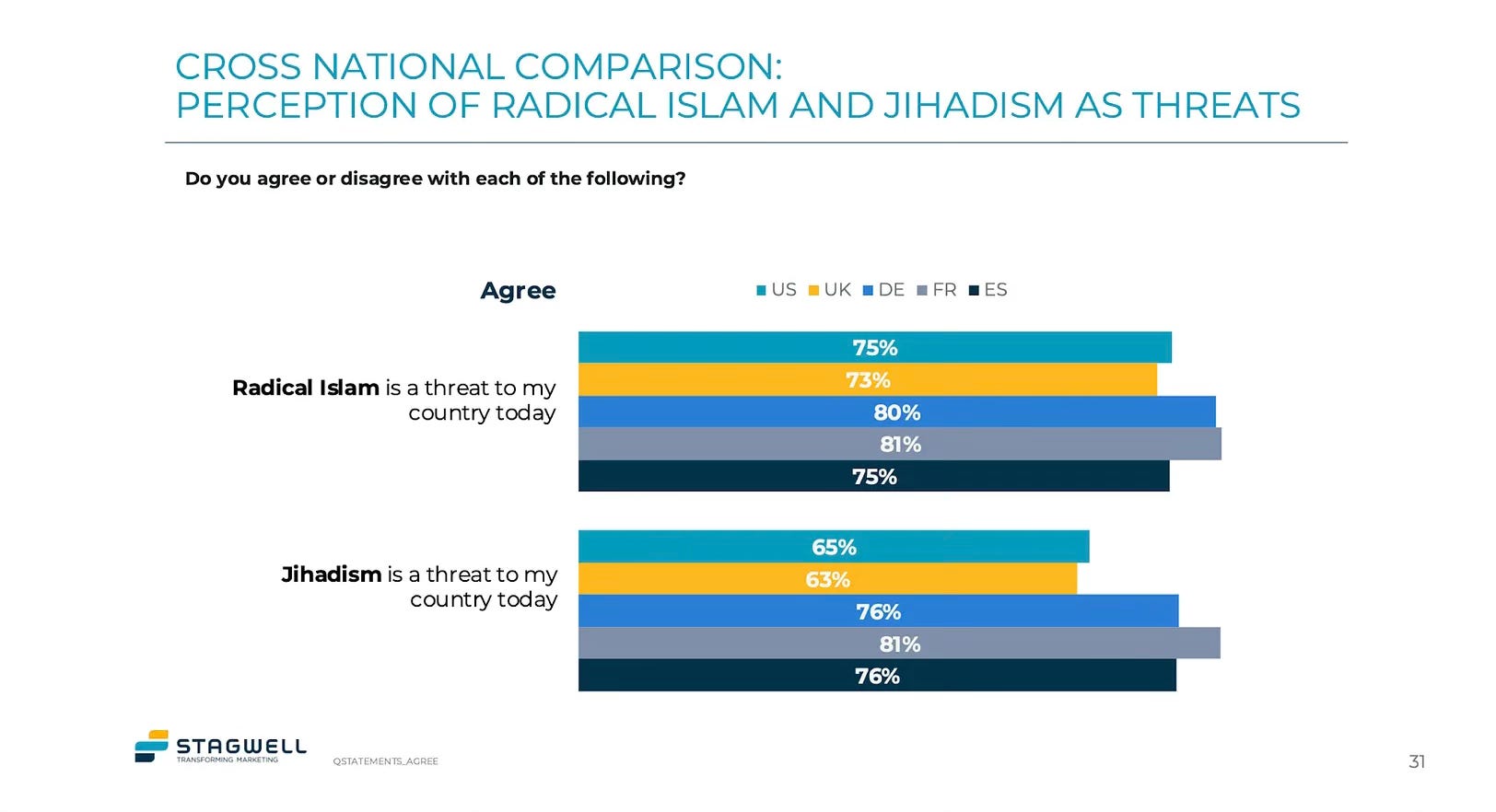
This is precisely the dynamic that I have been describing for years: Islamophobia is instrumentalized to make Israel appear as a bulwark of “Western civilization” against a supposedly monolithic, threatening Islam. The more Muslims are framed as dangerous, the more Israel appears necessary and virtuous, as a frontline fortress whose violence is rebranded as “self-defense.” Israeli Prime Minister Netanyahu’s interview on French TV around May 24, 2024 is illustrative in framing the genocide on Gaza as a defense of Western civilization:
French: “Notre victoire, c’est votre victoire ! C’est la victoire de la civilisation judéo-chrétienne contre la barbarie. C’est la victoire de la France !”
English translation): “Our victory is your victory! It’s the victory of Judeo-Christian civilization over barbarism. It’s the victory of France!”
On May 26, 2025, German Chancellor Friedrich Merz echoed Netanyahu’s framing of the war in Gaza as “protecting Western Civilization,” which fits perfectly into fear-mongering and the Islamophobic imaginary.
ADL: Civil-Rights Branding to Protect Israel, and Islamophobic Structures
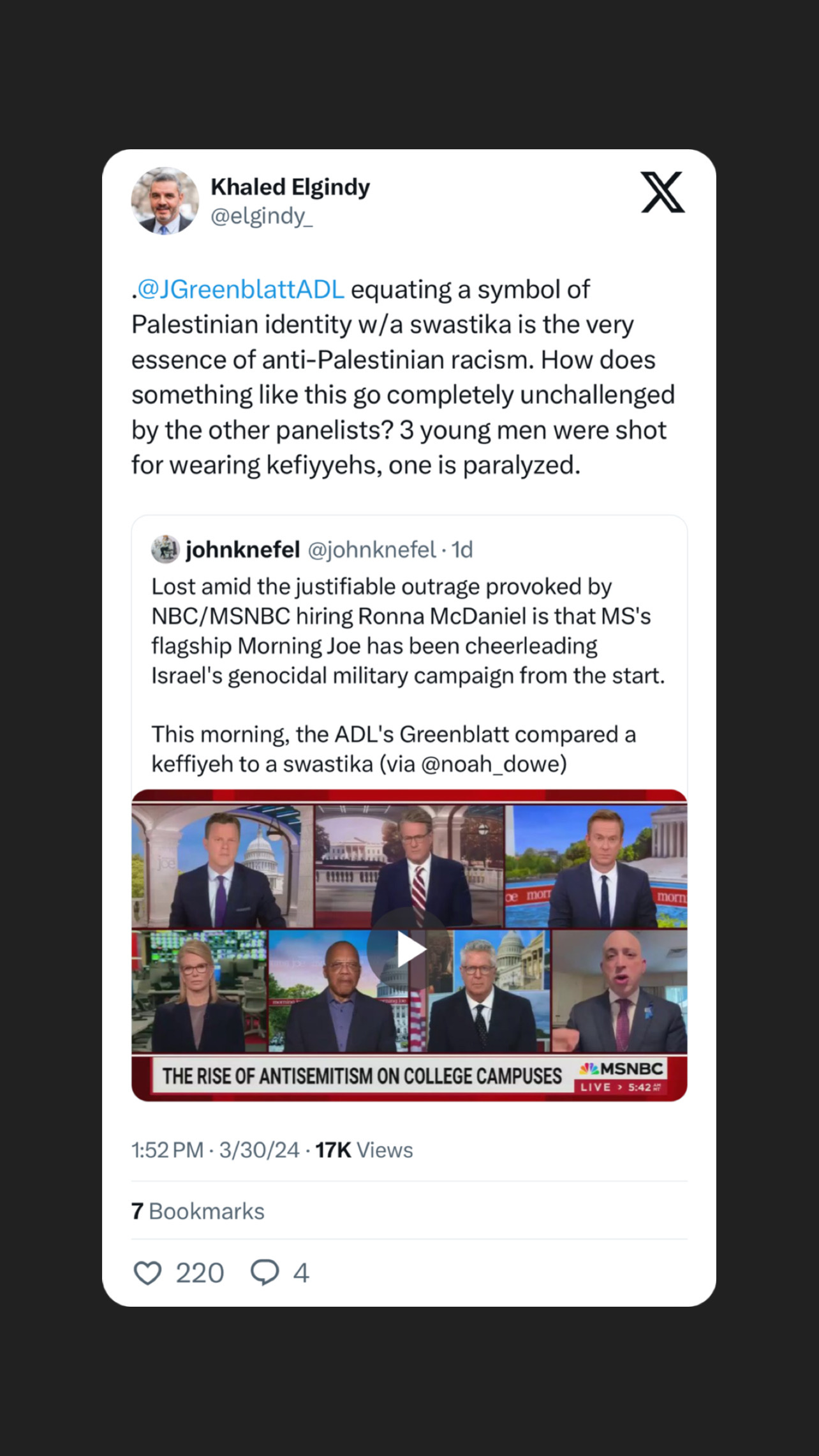
The Anti-Defamation League presents itself as a leading civil-rights organization combating antisemitism and all forms of bigotry, and it has indeed opposed some anti-Muslim policies, such as state anti-Sharia bills and explicit calls for a Muslim ban. Yet Muslim, Arab, and Palestine-solidarity groups have increasingly documented a contradictory pattern, whereby ADL partnerships and positions that legitimize or amplify Islamophobic narratives even as they publicly issue statements opposing Islamophobia.
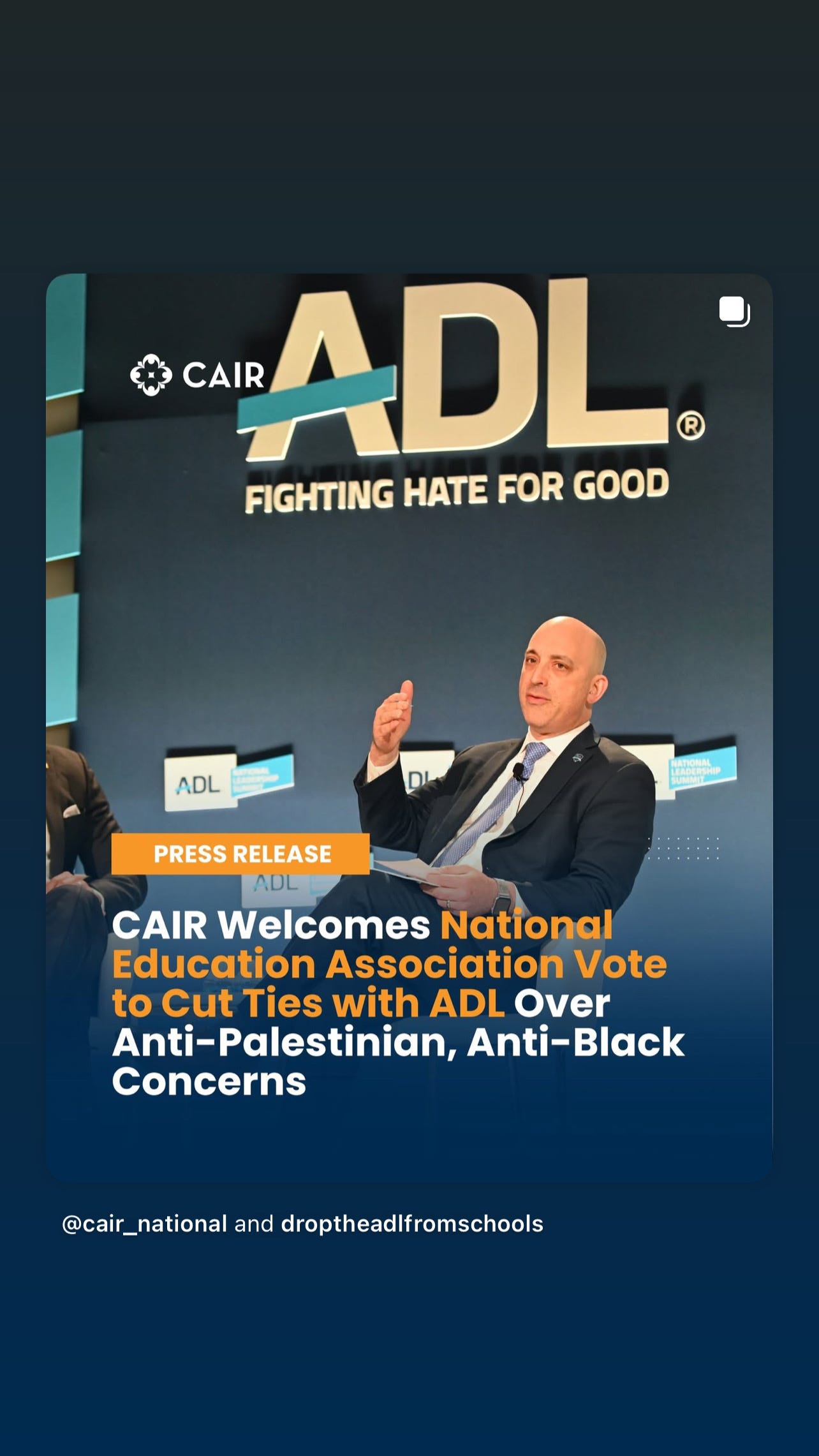
A broad coalition of more than 100 rights organizations, including CAIR, issued a statement criticizing ADL’s “pattern of undermining social justice movements,” highlighting, among other things, its alignment with policing and surveillance initiatives that disproportionately target Muslims and Arabs, and its repeated smearing of Palestine activism as antisemitic. From this vantage point, ADL’s aggressive conflation of anti-Zionism with antisemitism operates as a gatekeeping function: it pathologizes Palestinian advocacy and Muslim civil-rights organizing, folding them into a security discourse rather than treating them as legitimate expressions of dissent.
I tend to situate the ADL within a larger hasbara infrastructure whose civil rights brand has significant power in elite institutions, the media, universities, Congress, and tech companies. When such an actor promotes training, “resources,” and policy frameworks that map Muslim communities through the lens of radicalization and extremism, Islamophobia gains institutional legitimacy and becomes embedded in law enforcement, corporate policy, and higher education. The ADL and its allies are primarily responsible for mainstreaming Islamophobia and provide the social imaginary that frames Muslims, Palestinians, progressive Jews, and their allies as a threat to civil rights and call for exclusion, cancellation, and constant surveillance.
AJC: “Islamophobic Social Imaginary” and Muslim Zionism Strategic Alliances
In my essay “The AJC’s Role in Anti-Muslim Discourses: Negotiating Alliances in the Age of Islamophobia,” I examine how the American Jewish Committee has, over many years, partnered with and amplified Islamophobic figures while simultaneously presenting itself as a champion of interfaith dialogue. I maintain that ADL’s and AJC’s leadership helped “forge the Islamophobic social imaginary in American society,” motivated in part by a strategic calculation that anti-Muslim narratives would help consolidate U.S. support for Israel in a changing demographic landscape. Network Against Islamophobia materials and related research show that AJC has received substantial funding from philanthropies identified as major donors to the Islamophobia network. This funding pattern is not incidental: it reflects a conscious “marriage into the Islamophobia industry” designed to push Muslims to the margins of civil society, making it harder for them to influence U.S. foreign policy or build broad coalitions for Palestinian rights.
Here again, we see the structure that I emphasized in research on Islamophobia: a mainstream, respectable institution leveraging Islamophobic tropes—about Muslim backwardness, irrational violence, or incompatibility with “Western values”—to secure Israel’s privileged position in U.S. politics. Islamophobia becomes a tool of foreign-policy discipline, not merely a prejudice to be regretted. Here, we must take stock of the emergence and nurturing of the Muslim Zionist while AJC, ADL and others using the false claim of countering Islamophobia.
The term “Muslim Zionist” is itself a contradiction in terms, a manufactured identity forged in the workshops of empire and gifted to native informants whose utility is measured by their distance from their own people. What is Muslim Zionism? Muslim Zionism refers to normalization steps taken by Muslim individuals and states that seek to build relations with Israel and the Zionist settler colonial project in Palestine or abroad while clothing it in an Islamic epistemological, legal, or theological cloak. A ready cadre is marshaled to offer soothing Qur’anic or selected Prophetic statements (all are quoted out of context, but this does not stop them from deploying them in their discourses) to sanction that which is beyond the pale, settler colonialism in Palestine.
The Muslim Zionists are individuals who engage and center their relationships with Israel, Zionism, and major Zionist organizations in the US and Europe (ADL, AJC, JCRC, and others), while silencing, ignoring, demonizing, and blaming Palestinians for the ongoing conditions in Palestine. Blaming the victims of settler colonialism, the Palestinians, is offered as evidence of their “sophistication” and “intelligence” in developing relations with Zionism. Muslim Zionism locates its agency, upward mobility, and access in circles of influence on the proximity and through the engagement with ADL and AJC, among others, in the West, and never misses an opportunity to use “Israel speak” to explain its actions when challenged. The claim is that these efforts are intended to counter Islamophobia. In reality, they only go to entrench the Islamophobic imaginary and empower the Zionist organizational effort at protecting Israel’s brand in the West.
If ADL and AJC often operate through coded policy language, the Zionist Organization of America and AMCHA represent a more openly hard-right pole within the same ecosystem. ZOA’s president Morton Klein has repeatedly attacked refugee agencies and immigrant-rights groups because the (predominantly Muslim) refugees they serve are a threat to Jews. Educational materials from Jewish Voice for Peace’s Network Against Islamophobia point to ZOA leaders describing Palestinians as having a “shocking difference in values from ours in America and the West” and cite right-wing media that depicts Palestinians as vermin—classically dehumanizing language that links Islamophobia with broader anti-Arab racism.
Other critical mappings of the U.S. pro-Israel landscape describe ZOA as “peddling overt racism, Islamophobia, and homophobia,” and document how it benefits from the same pro-Israel funding streams that support anti-Muslim organizations explicitly.
Within the analysis from my own research, ZOA embodies the unvarnished edge of a continuum: from “respectable” institutions that normalize Islamophobic policy frameworks to more nakedly racist actors that translate those frameworks into openly dehumanizing rhetoric and aggressive repression of Palestine activism.
From Individual Prejudice to Structural Islamophobia
Taken together, these networks of funders, think tanks, media outlets, and pro-Israel organizations produce “structural Islamophobia” that operates across multiple domains in society and transnationally. In law and policing, Islamophobia underwrites “counter-terrorism” programs, surveillance, and police-exchange schemeswith Israeli security forces that treat Muslim communities as pre-criminal populations. These exchanges are explicitly framed as opportunities to learn from Israel’s methods of managing “terror,” which in practice includes collective punishment of Palestinians.
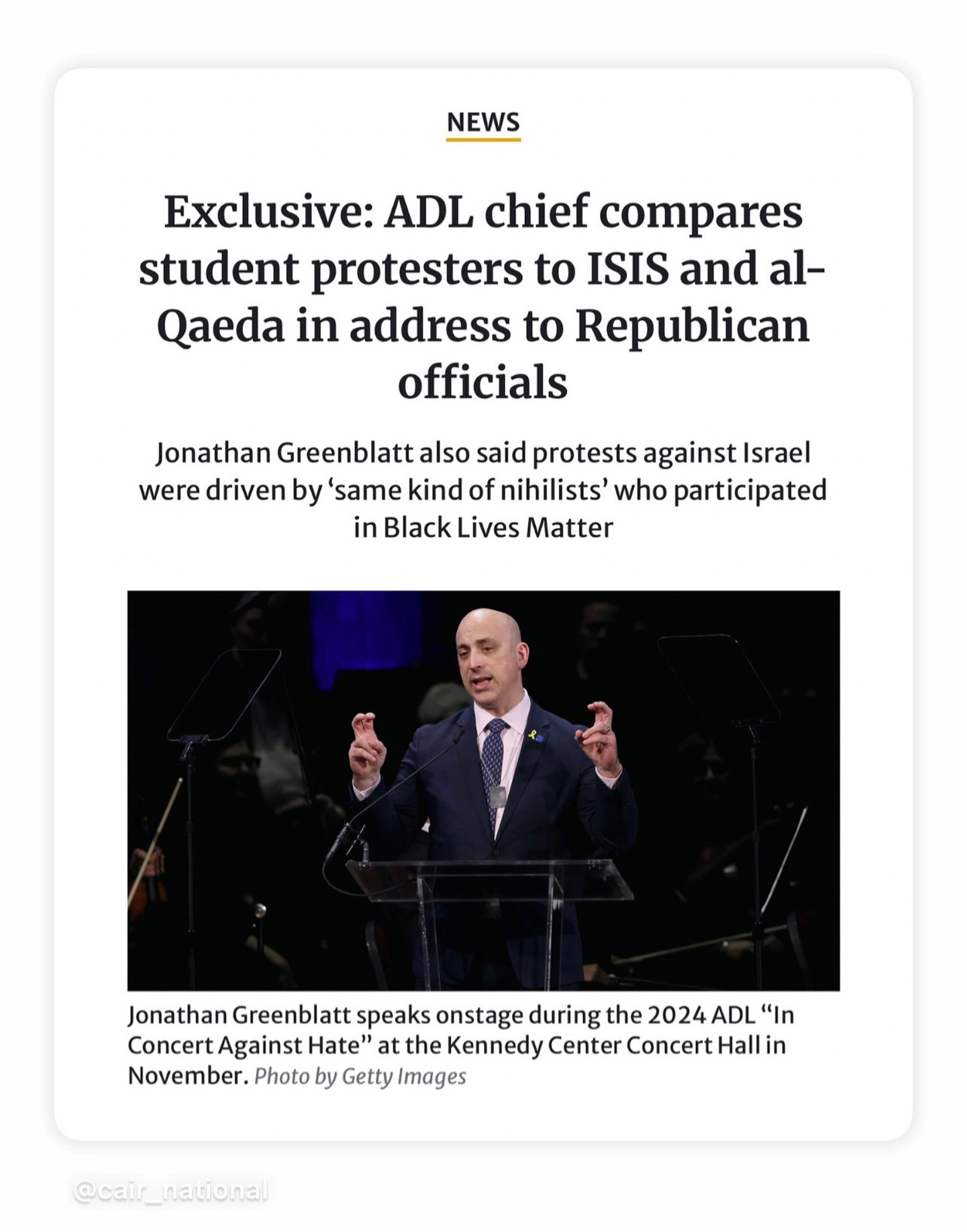
In media, hasbara campaigns and Islamophobia networks flood the public sphere with narratives that frame Israel as a democratic outpost in a hostile Muslim region, and Palestinians as irrational or fanatical. Messaging like “Hamas is ISIS,” deployed by Israeli officials and echoed by allied organizations, collapses very different political actors into a single Islamic bogeyman.
In education and civil society, campaigns against Students for Justice in Palestine, MSA, AMP, academic boycotts, and ethnic-studies initiatives use Islamophobic tropes—terror, extremism, foreign influence—to portray Palestine activism as a security threat rather than a human-rights movement. This is precisely the “delegitimization network” that Israeli strategists openly discuss monitoring and countering through hasbara.
The leaked Stagwell study makes brutally clear that this is not accidental: when fear of Islam is heightened, support for Israel rises. In that light, my estimate that 70% of organized Islamophobia funding is tied to pro-Israel actors is not just a descriptive statistic—it is a window into the underlying logic of the system. Islamophobia is politically useful; it delivers measurable gains for genocide.
Contesting Islamophobia and Reimagining Solidarity
It is important to note that Jewish communities are not monolithic, and many Jewish organizations explicitly reject Islamophobia, anti-Palestinian racism and anti-Arab hate, affirming that the struggle against antisemitism must not be weaponized against Muslims or Palestinians. Statements signed by over 100 Jewish groups have insisted that Islamophobia and antisemitism are intertwined forms of racism that must be fought together.
My own work invites us to take that insight further: to recognize that challenging Islamophobia in the U.S. is inseparable from challenging the structures that sustain Israeli genocide and domination over Palestinians. As long as major pro-Israel institutions, funders, and hasbara networks treat fear of Islam as a strategic asset—backed by massive resources, focus-grouped narratives, and high-level access to policymakers—Muslim communities and Palestine activists will continue to face demonization, surveillance, and repression.
To confront this reality, justice movements must do more than denounce individual bigots. They must map and expose the systemic connections between Israel-advocacy infrastructures, Islamophobia funding, and the policy regimes that criminalize dissent. That is precisely what scholarship on the Islamophobia industry, ADL, AJC, ZOA, and the wider hasbara apparatus sets out to do: to reveal Islamophobia not as an unfortunate prejudice at the margins, but as a core technology through which empire and settler colonialism reproduce themselves in the twenty-first century.

