Introduction: At the outset of this chapter, we must take account that Islamophobia in Muslim majority states requires a different definition that can address the specificity of the phenomena and the set of factors that are at play in this context. The definition must take account of the basic fact that Islam is deeply rooted in these Muslim majority states and the contentions revolve around its role in modern nation-states, in mostly post-colonial settings that attempt to form a secular polity in religiously committed communities. As such, the writing approach to Islamophobia in Muslim majority states is far more complex and daunting because it calls for deciphering legitimate contestations arising from different philosophical, theological, legal, and historical interpretations of the textual sources versus problematizing Islam, as Islam, in society by a utilitarian use of these existing differences to drive toward maintaining or claiming power as well as giving support for external interventions. The idea of who speaks for Islam[3] and what type of Islam is entangled with the modern mostly secular nation-state projects complicates the task at hand. Islam, in post-colonial secular nation-state projects, is both central and peripheral to the genesis of each state.[4] Accounting for differences within the vast and complex Islamic tradition and history while separating it from those elements that are being monetized or problematized in a modern post-colonial nation-state setting will be the primary source of confusion and I admit might bring about possible weakness in some of my own analysis. Admitting to this possibility at the outset is an invite for the reader to engage in this work and offer alternatives that might bring a better understanding of what is underway in Muslim majority states.
Another note of caution, the scope of this work takes a selective and limited sample from a number of countries and is not intended nor is it possible to cover details of all or even some Muslim majority states around the Globe in a single chapter. If critics point to this fact as a sign of weakness, then I concur that it is the case and invite scholars and researches to undertake a detailed and a single country approach in future investigation to remedy the wide gap in this initial work. The task at hand is to theorize the notion of Islamophobia in Muslim majority states, which I admit is not a simple and straight forward endeavor. The approach to this theorization must begin with a definition[5] of Islamophobia in Muslim majority states that can point to the nature of the phenomena.
Accordingly, I define Islamophobia in Muslim majority countries as: a political, social, economic, military, cultural and religious process emerging out and shaped by the colonial-Eurocentric hegemonic discourses dating to late 18th century, constituted and internalized through an imitative project by post-colonial elites that posited itself or was designated by Western powers as the custodian for the modern, secular, nationalist and progressive Muslim nation-state projects. The definition addresses the historical background that bears on the forging of modern nation-state project, which was centered on replicating the European state formation experience that witnessed a break away from the Church, the actual center of power in the pre-modern Europe.
At the core, Islamophobia in Muslim majority nation-state emerges out of a 19th and early 20th century developments that witnessed shifts among Muslim elites away from Islam, as an epistemological foundation for the society, and into embracing a particular anti-Islamic modernity and secularity.[6] Losses by the Ottomans on the battle field and shrinking territories and fragmentation resulted in an evaluation of the causalities for this rapid deterioration of position visa via European powers. Among many possible options, barrowing and adopting European scientific knowhow and military technology was the chosen response by the Ottomans, which was considered the best choice without undermining the Islamic foundations of the society. Initially, the effort called for bringing German and French advisors to help train the Ottoman army in adopting new military technologies and methods. However, in a short period the effort went further to transform the Ottoman educational system and adoption of the European methods, for the military in the beginning but became invasive to cover every aspect of the bureaucracy. Precisely in late 19th century, Muslim elites shifted into secular Eurocentric epistemology, which contributed to the development of an antagonistic worldview toward Islam.[7] Islamophobia in its early formation emerges out of this adoption and abandonment of Islam’s ontological and epistemological foundations. This should not mean that the specific societal problems did not exist, they did and still do today but the theorization of the causalities was a faulty one and the sought after remedies made the problem more acute.
A second aspect to approaching Islamophobia in Muslim majority nation-states must also begin with the colonial project that problematized the “native” populations and their relationship to Islam, as a source ontological and epistemological meaning. The colonial and orientalist project posited that Muslims are violent, terrorist, barbaric, uncivilized, backward, despotic, oppressive toward women, irrational, and a death culture celebrating destruction while suffering deficiency in human rights, innovation, progress, love, mercy and imagination. At the core, colonialism was not a mere mechanism for control and domination of territory and resources; rather it was a project centered on developing an internalized sense of inferiority in the colonized population and constituting the supremacy of Eurocentric epistemology.[8] Thus, colonialism forged the inferiority of the colonized and the superiority (racial, political, economic, social and religious) of the colonizer in all fields.[9] I will get to this point in more later-on but also the Muslim world is impacted by a more complex set of imprints that bear on its contemporary entanglement with the modern world.
Not to imply that colonialism is the only factor at play, on the contrary the Muslim world has many imprints that bears on its collective discourses and impacts the relationship to Islam, as the primary field of contemporary contestations in modern post-colonial nation-state. The list of imprints that have a bearing on the collective worldview of the Muslim world include the Crusades; the Inquisition; the expulsion from Spain in 1492; colonization; 19th and early 20th century Islamic reforms and push toward modernization of the military; nationalism and drive toward modernity in politics, economics, education and social structures; the orientalist decline thesis and “theories” and projects set-up to supposedly reverse it; the anti-communist and anti-nationalist Cold War and post-Cold War discourses; discovery of Oil, globalization, privatization and technology; regional conflicts in Sub-Sahara Africa, Yemen, Somalia, India-Pakistan-Bangladesh and the post-colonial divisions; the invasions of Afghanistan and Iraq, the open-ended war on terrorism; the Clash of Civilization arguments; the Israeli-Palestinian conflict; the Arab Spring; and last but not least the Muslim sectarian divide. Approaching Muslim majority societies and modern post-colonial nation-state must take account of the historical specificity and its impact on the contemporary and unfolding events in each setting. Thus, Islamophobia in Muslim majority nation-states has distinctive features that the genesis of which must be understood while keeping in mind the above listed imprints because they impact the contemporary developments in a complex way. The list of imprints is not intended to be exhaustive nor will this chapter be able to tackle any single one of them in detail but are included to offer an illustration to the complex nature of theorizing and understanding the genesis of Islamophobia in Muslim majority states in a post-colonial world order bereft with conflicts and contradiction.
Islamophobia in Muslim Majority States: History and Context
My interest in the role of Islam in Muslim majority states has been a scholarly and intellectual concern for over 30 years and is not only an outcome of recent events. Admittedly, the intensified focus on Islam post 9/11, the Israeli propaganda machine use of Islamophobia as a communication strategy to demonize the Palestinians[10] and the events that led to the Arab Spring and post-Arab Spring[11] brought the urgent need to examine the demonization of Islam in Muslim majority states discourses. I would like to situate the examination of Islamophobia by discussing three different examples that shaped my view of the serious existence of an Islamophobic problem in Muslim majority state settings. Each one serves to contextualize the problem before embarking on addressing the causes behind it.
First case, I was alarmed of the visit and official welcome by Al-Azhar to Marine Le Pen, the leader of the extreme right French National Front party, which marked a level of recognition and linking between domestic Muslim world contestations and the Global Islamophobia industry. Why would such a visit occur and why would Al-Azhar welcome a well-known and established Islamophobe! The French National Front Party and Marine Le Pen are not your causal French visitors, as she represents a very vicious and racist segment of the far right forces in Europe and very much a leading voice in anti-Muslim and anti-immigrant discourses. At the time of the visit, Le Pen was unleashing an avalanche of xenophobic and Islamophobic attacks on disenfranchised Muslim and sub-Saharan African immigrants in France. The visit and welcome, I maintain, inscribed creditability Marine Le Pen, a party leader that has neo-Nazi origins and advocates racist and white supremacist policies in France. Al-Azhar gave the reasons for the meeting as “openness to positive dialogue with all currents and intellectual trends and in order to promote Muslim interests across the world.”[12]
On her part, Ms. Le Pen wrote a Twitter post about the visit: “Meeting in Cairo with the highest Sunni authority: strong agreement on the fight against extremism.” Al-Azhar’s own press release said the meeting was “to discuss matters related to erroneous ideas and concepts about Islam and extremist ideologies and racism that some Muslims in Europe are suffering from.” Furthermore, Al-Azhar’s statement indicated that Tayeb warned Le Pen about her “hostile opinions” of Islam, which in his view must be “reviewed and corrected,” and that the Sunni institution had “serious problems” with the National Front’s positions on this matter.[13]
It was clear that Al-Azhar and Le Pen’s issued divergent statements afterward and were in damage control mode as responses to the meeting in France took a very negative tone among Muslim and civil society representatives. National Front leaders and supporters were very critical of Le Pen’s visit and condemned the meeting. Likewise, the Arab press was very critical of the meeting and took issue with the welcome extended to a major Islamophobic figure. Welcoming Le Pen to Al-Azhar point to the shifts that were under way in Egypt which inserted the historical seat of Sunni scholarship into the domestic French debates pertaining to French Muslim communities and their status, which are heavily islamophobic in nature. Certainly, the National Front and its leader have been contesting the role and place of Muslims and sub-Saharan Africans in French society while seeking greater restrictions on immigrants. Le Pen was seeking a Muslim cover for her then presidential campaign and an attempt to rehabilitate her deeply xenophobic image in an appeal to the right-of-center and possibly independent voters. Visiting Al-Azhar was hoped to accomplish this goal and help insert the institution once more into the debate concerning the status of French Muslims. In 2003, Al-Azhar defended the French veil ban and issued an opinion that sanctioned the proposed law, which won wide approval. The important fatwa was issued by then Al-Azhar Sheikh Mohammed Sayyed Tantawi, who delivered the opinion during a visit to Egypt by then French Minister of the Interior Nicolas Sarkozy.[14]
Sarkozy was running for the presidency at the time and Islamophobia and anti-immigrant policies were an important building block in his campaign. Al-Azhar extended a Muslim cover and granted Sarkozy much-needed breathing room to shift more to the right and monetize Islamophobia and anti-immigrants sentiments into votes at the ballot box. Le Pen was following in Sarkozy’s footsteps, but this time the debate is much deeper, and problematizing the Muslim subject in France has become a mainstay of French politics and likewise in Egypt, which certainly pre-dates the events of the Arab Spring.
Not to imply that Egypt or Marine Le Pen are the only ones being welcomed in parts of the Muslim world, on the contrary others are being met with open arms. “Will Dubai’s good times last?” was the December 31, 2015, Asia Times article by non-other than Daniel Pipes, who confided that “I recently visited the United Arab Emirates to seek answers”[15] to the question. Another visit was announced and planned for November 4-11, 2017,[16] and promoted with the following opening line, I am pleased to inform you that a few spots remain for the trip to Dubai and Abu Dhabi on Nov. 4-11, 2017. I hope you will join me.”[17] In promoting the program and visit, Pipes indicate that: “In preparation for this trip, I spent a month in the UAE in 2015-16; you can see my two articles reflecting on the country here and here.”[18] The relations and links between Western Islamophobes and elites in part of the Muslim world is a development that raises serious concerns of legitimizing and providing a stage for some of the most pernicious anti-Muslim voices in the West.
Second case, the front runner in the 2014, Tunisian presidential elections Beji Cassid Essebsi cast himself, starting with the formation of the new party Nidaa Tounes, as the rescuer of the country from a supposed Islamist party. Because, in Essebsi view, “the Islamists don’t have experience being in power. They are incompetent and have been in favor of radical Islamist movements.”[19] In another interview with France24 Mr. Beji pushed further on this framing declaring, “Islamism is a political movement that instrumentalises the religion to get to power, which has nothing to do with religion. Islam here in Tunisia is a religion of openness, of tolerance.”[20]
Essebsi’s strategy was centered on the one hand, on casting the Islamist as ‘incompetent’ and unable to effectively rule thus should not be allowed to govern. On the other hand, Essebsi makes sure to problematize political Islam while offering himself and Nidaa Tounes as the custodian of the Tunisian national project with the expertise and know-how to rebuild the collapsed state. The interview in France is very important for it engages a French political elite that is highly Islamophobic and problematizing Islam further fits into domestic programs directed at otherizing Muslims in France.[21] In this context, Islamophobia in France is given an Arab and Muslim leadership cover if not an alliance on policy levels, which was similar to the Le Pen’s visit to Egypt.
For outside observers, the Tunisian presidential election was framed as a competition between a secular candidate, Nidaa Tounes’s founder Beji Cassid Essebsi, versus a human rights activist Moncef Marzouki, who was defamed of being close to Ennahda, thus soft on Islamist. Here, Islam or an Islamic party is a threat that must be countered while closeness and appeal to the ex-colonial motherland is celebrated and welcomed to rescue the country. At the time, the vote was the second round pitting the two top vote getters in an attempt to elect a new president for a five-year term. Since 2011 revolution Tunisia has been in the middle of turmoil and unsettled political and security situation that witnessed assassinations and an emergent militant insurgency. The Ennahda Party won the immediate elections after the revolution but was unable to govern effectively while being beset with a deepening economic crisis and a most fractured political landscape that provided an opening to the old guard to come back into center stage through Nidaa Tounes and an effort to contest the elections.
The second round presidential elections was after Nidaa Tounes came first in the October 26th, 2014 parliamentary elections winning 85 seats while Ennahda coming in second place with 69 in the 217 seat parliament.[22] For sure, parliamentary results and the 1st round of the presidential vote point to a shift away from the revolutionary coalition and a return to Ben Ali’s old guards under the new rubric of Nidaa Tounes but why was it necessary to appeal to Islamophobic themes considering the post-Arab Spring development.
Indeed, the framing of the elections took a reductionist approach by constructing a secular-religious binary in the then upcoming vote while glossing over critical developments in the country since the 2011 peaceful revolution. The old guard that has ruled the country since independence has come back into the driver seat through the careful use of Islamophobic themes and framing Islamic parties as a threat that can be trusted. The cast of old-guard characters offered themselves as the champions of a post-revolutionary Tunisia through the deployment of Islamophobic themes.
Consequently, the 2014, Tunisian elections need to be placed in the larger regional context whereby the old bureaucratic faces, military and security apparatus, neoliberal economic elites and authoritarian minded politicians are back at the driver seat by utilizing Islamophobic tropes. In addition, the ever-present machination with ex-colonial and Western powers so as to project creditability and assurance to keep the ship moving in the ‘right’ post-colonial, “modern and progressive” direction. When it comes to Tunis and political developments in the Arab world reality is indeed the theater of the absurd since Essebsi and the ancient regime guards are accusing others of being incompetent in running the economy and the country! Mind you this charge is coming from a group that was in a position to drive the country into the ground, practiced torture regularly and imprisoned anyone that dared to challenge its dictatorial rule for more than 30 years. Fear of Islam and monetizing into votes at the ballot box made it possible to re-constitute the old order but under a new garb and aided by support from an islamophobic ex-colonial power.
What is significant is that the use of Islamophobia and constructing a fear of the Islamic party was used to obfuscate and remove critical analysis of what has been under way for a long time. Certainly, the split in Tunisia’s society is more a north-south one than secular-religious one. Also, it is a split between an elite that relegated to itself the right to construct the state in its own distorted post-colonial image and narrow interests while preventing all others from having a say about it. While for sure those who took power briefly after the 2011 revolution were ill prepared to deal with the multitude of economic, political, social and religious problems inherited from a most corrupt regime. However, a problem 50 years in the making can’t be undone in few months by new political actors Muslim or otherwise. From one perspective, we can say that the post-revolution government was unable to find a solution to the problems they inherited, which is a correct assessment of the factual record but the reasons for it are located in the structures inherited over generations since independence and constant external intervention; rather than in Islam or being an Islamic party. One can fault Ennahda for using their Islamic identity to frame a type of moral politics but this is not unique to Tunis or Muslim societies considering the role religion plays across the world.
The ousting of Ben Ali and his regime was a step in a long process intended to bring about the birth of a real modern state where the rule of law is foundational and citizens are accorded their rights fully. Furthermore, the transition away from authoritarian rule is not a function of one election or vote but about building democratic state institutions that can protect and nurture a vibrant civil society that can resist the ever-present tendency for dictatorship. Tunisia’s state project is a work in progress and having numerous challenges at hand with the constant risk of sliding back into a despotic form of government. As it stands today, Essebsi is really starting to use the same type of language and approach that created the despotic regime in Tunisia in the first place and problematizing the opposition through the careful use of Islamophobic discourses and utilization of fear of Islam’s role in society.
By problematizing and otherizing the democratically inclined Islamists Essebsi opted to ride the wave of Islamophobia and monetize it into votes at the ballot box. In this way, the elections are focused on the supposed threat of the Islamists rather than offering an agenda on how the economic and political issues will be solved. The elites around Essebsi offer neoliberal economics, foreign investments, further privatization and possible loans or investment from the Gulf States, which was also similar to what Ennahda offered upon coming to power post 2011 revolution. In economic terms, Tunisia[23] was facing a monumental challenge with unemployment hovering around 30%, skyrocketing inflation, collapsed infrastructure and an elite that stashed billions outside the country, mainly in France.
Adding to this economic and political mix a pernicious insurgency fueled by external support from the Gulf States that opted to frustrate and roll back any and all inspired movements for change in the region. For sure, the complexity of the internal situation was furthered by the intervention of regional and global actors wanting a ‘new’ order that is more inline with their own economic and political plans than anything independent or unique in Tunisia and other Arab Spring countries. Gulf States strategy included funneling money into elections, supporting violent groups and calling for even more draconian approaches to Islamic parties with the intent of terrifying the populace back into submission and accepting the ancient despotic guards. Clearly this is evidenced in Egypt, Libya and Syria while for sure Tunisia had had its own share and the current political climate is influenced by it.
Tunisian parliamentary and presidential elections were marketed as a fight between the secular minded Essebsi and Islamist supported Marzouki. However, a more accurate assessment would be to think of the population being forced into a binary so as to keep it away from asking more critical questions about the background and the real ability of the old despotic but new ‘democratic’ leadership. How would the old guard fix what they themselves broke, stole and bankrupted at least for the past 30 years! Using Islam as the boogeyman was an easy and well-tested strategy and has been deployed successfully in Europe and today it is in vogue in Tunisia, Egypt, Libya, Turkey, Pakistan, Bangladesh and other Muslim majority states. Islamophobia was monetized into votes at the ballot box in Tunisia and the results led to further demonization of Muslims at home and abroad.
Third case, a March 11, 2018, editorial by Mr. Salah Muntasir in Al-Ahram, a major Egyptian daily newspaper, addressed as a suggestion to Mohamed Salah, Liverpool’s leading striker of Egyptian origin, to change his appearance or get a “new look”. On the face of it, the editorial could have been mistaken for the fashion section or celebrity news and development, which was not the case since this was a piece published as regular political column and not the sport or entertainment pages. The critical part of the editorial on Mohamed Salah recommended: “… his need for a ”new look” so as to change his appearance in front of his fans. It is imperative for his to shave his thick beard that does not match his age and stardom, which [if not done] would place him, at least from appearance, in the same basket with the extremist fundamentalist if not even placing him with the terrorist or at least those who are sympathetic with them. After this, [Muhammad] has to totally reexamine his bushy hair style that appears untidy and puffed-up as if the barber did not know his way into it for years…”[24] This editorial was met with some push back from other columnist on the neutrality of the beard and that the specific look that Muntasir critized is complaining about in Mohamed Salah can be a fashion statement rather than religious in nature.[25] Not content of leaving the issue and the debate, Muntasir wrote a follow-up column titled “Mohamed Salah and His Hair”[26], which made a far more explicit link between the beard and terrorism. In a March 14, 2018 editorial responding to critics, Muntasir lists 6 reasons for his position on Salah’s hair and beard but the most critical were items 4 and 5:
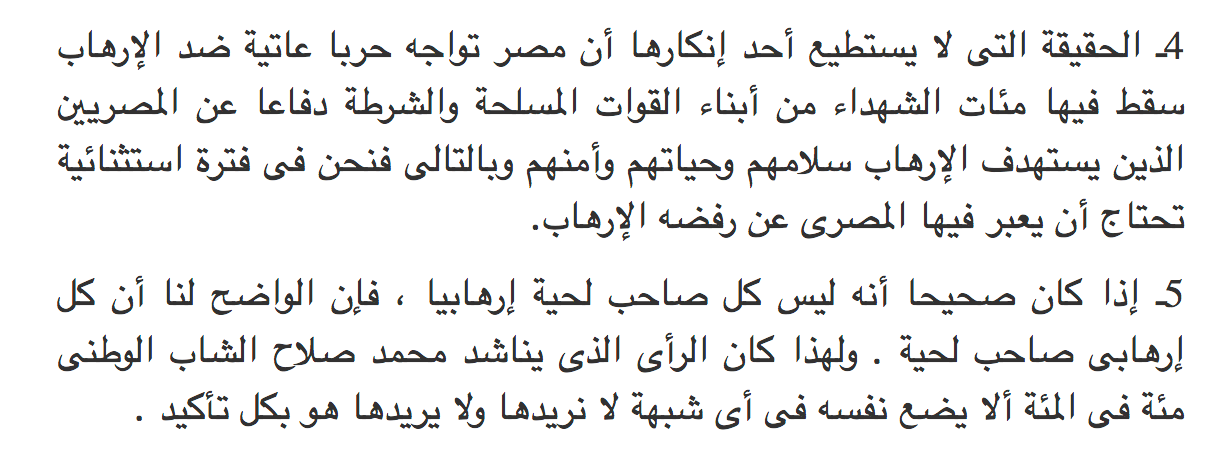
“4. The truth that no one can deny is that Egypt is facing ferocious war against terrorism that [saw] hundreds of martyrs fall from the sons of military forces and police while defending the Egyptians, whom safety and security are targeted by terrorism. Therefore, we are in an extra-ordinary period that requires the Egyptian person expresses his opposition to terrorism.
5. If it is correct that not every bearded person is a terrorist, then it is clear that every terrorist possess a beard. Therefore, there is the opinion that pleades with Mohamed Salah, the 100% young patriotic person he is, that he does not put himself in any type of doubt, which we don’t want for him and he does not wanted certainly for himself.”[27]
The debate concerning Mohamed Salah’s hair and beard is paradigmatic of the pernicious nature of Islamophobia in Muslim majority states and Egypt representing an extreme case at this point but by no means is isolated from the general trend. I focused on the debate about the beard and hair of a man, Mohamed Salah, because the norm has been a constant pre-occupation with Muslim women, the Hijab and Niqab,[28] which has been a main stay of orientalist writings and contemporary Islamophobes across the world. Muslim men’s hair and beard represents the re-emergence of a specific type of Islamophobic discourse that had an earlier manifestation during the 1920s and 30s, when Muslim majority states, including Turkey, Iran and Egypt to name a few, embraced a set of secular reforms that sought to disconnect the society from the traditional and religious legacies of the past and embrace secular modernity. The contestation of men’s and women’s dress in Muslim majority nation-state has been a mainstay of the secular and modern nation-state project and the re-emergence in the current period is a continuation of this phenomena.
The above three examples are not exhaustive of what is underway in Muslim majority nation-states and each example was selected to point to a particular development and not necessarily to isolate it in a given country or nation-states mentioned above. Certainly, the post-Arab spring brought more focus on the role of religion in modern Muslim nation-state but this has been the case since the colonial era. Critically, examining the epistemological trajectory of this contestation should occupy the better part of our efforts, which will be addressed in the pages to follow.
From Cold-War Embrace to “Religion-Building”
Islamophobic elites in Muslim majority nation-states have adopted almost all of the countering violent extremism policies developed in the US and Europe, which are built on extensive orientalist and stereotypical imaginary and the targeting of the Muslim subject as a unique violent specimen different than all other human groups. One can even ask the question whether Muslims are granted a human status or is the sub-humanness the only default status. Immediately after the events of September 11, 2001, strategies were put to work to bring about the transformation of the Muslim world anew, which was articulated by Cheryl Benard, in Civil Democratic Islam, using the following framing: “It is no easy matter to transform a major world religion. If ‘nation-building’ is a daunting task, ‘religion-building’ is immeasurably more daunting and complex.”[29] While the report might seem to be a little dated, nevertheless the main arguments advanced by it are still at work today. Rand’s “religion-building” project is still underway and called for stoking intra-Muslim conflicts so as to bring about an Islam that is compatible with the modern world, meaning the Western version of it. According to Benard, the problem in the Muslim world is that “Islam’s current crisis has two main components: a failure to thrive and a loss of connection to the global mainstream. The Islamic world has been marked by a long period of backwardness and comparative powerlessness; many different solutions, such as nationalism, pan-Arabism, Arab socialism, and Islamic revolution, have been attempted without success, and this has led to frustration and anger. At the same time, the Islamic world has fallen out of step with contemporary global culture, an uncomfortable situation for both sides.”[30] The definition of the problem is so over-generalized to encompass 1.2-1.4 billion people and almost 55 Muslim majority nation-states. Transforming the problem from the end of the Afghan-Russian war into a crisis engulfing the totality of the Muslim world is a very poor attempt at theorization.
Remedying this defined crisis, for Benard and those involved in this project, involves navigating, fomenting and managing conflicts between Fundamentalists, Traditionalists, Modernists and the Secularists. In Civil Democratic Islam, Benard does admit that “these groups hold distinctly different positions on essential issues that have become contentious in the Islamic world today, including political and individual freedom, education, the status of women, criminal justice, the legitimacy of reform and change, and attitudes toward the West.”[31] The groups closest to the West are the “Modernists and Secularists” but each group faces limitations on its ability to capture the ground in the Muslim world. Salient in Benard’s framing is the notion that Islam is the problem and the various clusters representing the identified trend must undertake a gladiator type of civil society combat to the death until they are victorious, not for the benefit of their own society or nation but to fulfill the interest of the West. Islamophobia, in its current manifestation in the Muslim majority states, emerges from this fomented contestation that is driven by problematizing Islam and Muslims in their own society. Thus, the events of September 11 are seen not as singular act of individual terrorist or possibly a blowback from the Afghanistan operations; rather in the religious norms of Muslims and the Islam’s imprint on the society. Long discredited orientalist and colonial theories are given a new garb by Benard and unleashed under the rubric of bringing about civil democratic Islam or more accurately the civilizing mission toward the new but old barbarians at the gates of civilization, the everyday Muslim him/herself. Talal Asad’s observation is important and must be understood in relations to Benard’s and Rand’s project: “A secular state does not guarantee toleration; it puts into play different structures of ambition and fear. The law never seeks to eliminate violence since its objective is always to regulate violence“.[32] The ambition to secure power by the fundamentalists, traditionalists, modernists and secularists in Muslim majority states centered Islamophobia as a strategy and to effectively monetize it to secure governance and authority by various groups that embraced one aspect or another of this framing. Islamophobia becomes the lens through which each group contest power and authority since all prescribe to erroneous definition of the problem in the first place and accept their assigned role to remedy it. Islam must be rescued from the misguided group or groupings was the developed talking points for each participant. All want to rescue Benard’s Islam or the violent type of Islam, which means that the problem of violence, governance, economic stagnation, corruption, women’s rights, human rights and environmental crisis all located in Islam’s supposed failure to thrive and a civil war is the way to remedy it.
While Benard’s plan to foment a Muslim civil war emerged after the events of September 11, 2001, nevertheless the process actually begins to take shape as early as 1980s with the Iranian Revolution and the Russian invasion of Afghanistan.[33] Islam’s role in both was very critical and Sunni Muslim groups, sects and organizations were globally mobilized and instrumental foot soldiers to contain Shia Islam and defeat the “evil empire”, the USSR (Here, important to remember that from the end of WWII until the collapse of the Soviet Union, Islam and Islamic groups globally were recruited by the US, Europe and major Arab and Muslim states to neutralize communism, socialism and Arab nationalism and I would argue that it was a very successful strategy). The end of the 1980s witnessed the success of the strategic deployment of Sunni Islam in both confrontation and need to shutdown the operation required a re-orientation or another “religion-building” project considering that the Jihad movement was itself a CIA and Muslim majority nation-state global partnership to achieve a strategic policy objective, the bleeding of the Soviet Union in Afghanistan and containment of the Iranian revolution in the Persian Gulf. During the decade of the1980s or even before, the “fundamentalist” (various groups fall under this problematic rubric) were celebrated as representing the global and friendly Islam, because it fulfilled the foreign and domestic policy needs of US, Europe and various Muslim majority nation-states that were committed to the two-front campaign against Iran and the Soviet Union. The “traditionalists” and “secularists” (various groups fall under the designation as well) represented the unwanted or must be marginalized version of Islam in Muslim majority nation-states because it did not serve the identified policy objectives or at least did not commit themselves fully to the CIA sponsored strategic global project. Consequently, Islamophobia was weaved into the fabric of each Muslim state policy as they attempted to work through the global alignment set in motion to confront Iran and the Soviet Union.
Post-Cold-War and the end of the Iraq-Iran war brought about the need to shift away from “Jihadi” Sunni Islam and into a de-escalation of the educational, political, economic, social, media and religious infrastructure that kept humming for over two decades. At the of the Afghan and Iran operations, the massive training infrastructure set-up in Iraq and Pakistan-Afghanistan boarder as well as the large number of volunteers required de-programing and re-orientation back into normal society and away from the particular version of Islam that drilled into them and was needed for the war effort. Transitioning smoothly from war to post-war posture for many of these Muslim front lines troops volunteers was interrupted by the Iraqi invasion of Kuwait and the subsequent arrival of US troops into the Saudi Arabia and the region in general. Had Iraq’s invasion of Kuwait did not take place or the US did not intervene in Arab-Arab conflicts, it is possible that the last three decades would have been different and the rise of Al-Qaeda would not have come around! Desert Storm or what is referred to as the 1st Gulf War interrupted the de-programming campaign and led to re-consolidation and re-mobilization of the CIA and Arab and Muslim world intelligence services crafted Jihadi Islam but this time around targeting the powers that incubated them in the first place.[34] Contestation over the Gulf War is at the center of the re-emergence of the “fundamentalist” Islam that Benard’s plan seeks to counter without giving actual recognition of how it came into existence in the 1980s and beyond. “Islam failure to thrive” is Benard’s lazy and Islamophobic way to define a problem rooted in wrong-headed and one dimensional policy choices that was further complicated with Iraq’s invasion of Kuwait.
The Arab “volunteers” returned from Afghanistan triumphant believing that they took on the Soviet Union, a superpower, and defeated it but not realizing that they were part of a larger global operation that involved almost all the intelligence services of the Western world, Arab and Muslim countries and the deployment of massive military and financial resources toward the multi-year operation. Iraq’s invasion of Kuwait and the subsequent US and Western countries deployment of troops in the region resulted in the same Arab volunteers and their allies across the Muslim world to contemplate taking on the only remaining superpower and its allies in Muslim majority nation-states. The first test for this retooled effort came in the aftermath of the December, 1991 Algerian election. Witnessing the Islamic Salvation Front registering a resounding victory in the first round of elections, on January 11, 1992, the Algerian military stepped-in and nullified the results, arrested leaders of the movement and unleashed a reign of violence in civil society against anyone affiliated or supporting the movement. For the ensuing 4 or more years, Algeria witnessed bloodshed, terrorism and never before seen violence directed at civilian populations. Rather than contextualize the problem around contestation of power and a military coup nullifying democratic election, Islamophobia was unleashed by the Algerian government against the FIS and anyone who dared to take their side.[35] The Algerian army resorted to violence to settle the power struggle, which brought about the re-mobilization of those volunteers that came back from Afghanistan. Thus, the roots of the Algerian civil war can be traced, on the one hand to Afghanistan’s war and, on the other the failure of a post-colonial democratic program in the country whereby the military posited itself as a custodian of the secular and modernist project, the idea of rescuing democracy from itself!
Facing a renewed challenge to their legitimacy and power, the post-colonial and modern Muslim nation-states (with few exceptions) mobilized Islamophobia discourses and cast their opposition in Orientalist and stereotypical fashion. Not to sweep the threat under the rug, the emergence of violence and terrorism was very much a feature of the 1990s but it would be a mistake to assign the responsibility solely to those who returned from Afghanistan. It was a complex process that witnessed regimes in the region attempting to consolidate power at a moment of rising expectations from a population that got tired of corruption, economic stagnation and a post-colonial one party or one family rule. More relevant, the expansion of forms of mass media and communication enabled people to see other regions in the world are going through (Eastern Europe democratization, Central and South America and Southern Africa) and compare their conditions to what is taking place across the world, which informed the rising economic and political expectations. Resorting to Islamophobia; rather than introducing meaningful and serious reforms, was the choice for regimes across the Muslim world, which resulted in coordination, training and close intelligence services sharing of information. “Political Islam” becomes the problem and strategies to counter it begins to take shape across the Arab and Muslim world, which heavily depend on Islamophobic content as well as embracing another type of Islam, an apolitical type. Benard’s “traditionalists” who were on the outside looking-in during the Cold War, Afghan and Iran-Iraq war eras became the preferred Islam and invited to theorize religious based remedies for countering the other types of Islam. The search for the correct, pristine and apolitical Islam begins in the mid 1990s and have not yet stopped since the prevailing conditions that gave rise to Muslim involvement in political affairs have not changed or shifted much since the 1980s. It actually gotten worst!
Islamophobia and the Search for Pristine Islam
The subject of the contemporary Muslim world is often entertained rudimentarily with a sole focus on Islam and utilized as a singular causality without any reference to the long and complex history that shaped or formed the subject matter itself and the people connected to it in vast territories and diverse societies. As such, the subject of Islam is treated as ahistorical and confining the understanding or supposed research to an examination of the legal text to explain everything that takes place. Consequently, the issue is not the importance of Islam’s primary texts, theology and law but the reductionist nature of approaching Muslim societies through an ahistorical examination of the inter-play between text, societies and the diverse set of contexts across generations. This reductionist view makes it possible to ignore the specificities of Muslim societies under consideration while permitting for the wholesale stereotyping of causes and outcomes and connecting it to Islamic texts alone. The issues that are often stereotyped are overwhelmingly disconnected from Islam’s itself and its textual sources but it makes no difference since the dominant lens overtakes and shadows any other sound and scholarly grounded approaches. All events and actions are reduced to one causality, the “fixed and regressive”[36] nature of Islamic text and a demand to alter it and embark on a reform course of action that intends to replicate Europe’s historical reformation trajectory, which is often treated as the singular universal norm.
Exploring Islamophobia in the contemporary Muslim world must be undertaken with the long list of imprints that bears on Muslims, which are often utilized to drive the otherization discourse. A profound difference exists the Islamophobia problem in Muslim majority nation-states, which amounts to the insistence on affirming a non-existent abstract Islam in the process of demonization and otherization of the experienced and lived Islam of the existing population. The imagined abstract notion of Islam, I would add also an idealized non-existent Islam, is set against and utilized to construct a series of negations that revolve around the actual and practiced form of Islam at any given moment, whether looking back into history or examining contemporary unfolding events. An Islamophobe in Muslim majority states always affirms the greatness of the abstract and non-existent Islam while unleashing the most offensive and bigoted attacks on the real, practiced and lived Islam. Thus, the Muslim Islamophobe posits himself/herself as the spokesperson of the pristine, uncorrupted, abstract and idealized Islam i.e. the perfect Islam facing the wrong and corrupted Islam of the people or at least those who take Islam seriously and seek social justice through it. The boundaries of the wrong Islam always shifts according to the interest of those positing themselves as representing the ideal, pristine and un-corrupted Islam. Furthermore, the Islamophobes in Muslim majority nation-state maintains that Islam, capitalism, secularism and modernity are commensurate with each other and only those who are infected with the wrong understanding of Islam that prevent the actualization of the real progress intended in the pristine message of Islam. This point is often lost on people who rally behind the forces that construct this binary and often are happy when their sect, brand or approach to Islam correspond to the one promoted by the custodians of particular nation-state project. The affirmation of a sect, brand or approach to Islam by state actors is a double edge sword and is never lasting since the scope of acceptability is constructed around state priorities and totally external to all Islamic groupings even when it appears that they are perfect and constitute an identical match. Thus, the only Islam that is permitted by the modern nation-state is that which affirms the unconditional power and authority of the state, nothing more and nothing less is demanded.
Indeed, recent events in Egypt, Tunisia and Turkey unearthed deep-seated Islamophobic attitudes among a sizable segment of the population claiming the “nationalist secular” mantel and asserting exclusive “sacred” right to undemocratically contest power on its basis. While each of these states and others in the region have their own historical specificity; nevertheless the common thread at present is the re-emergence of a distinct anti-Muslim and anti-Islam attitudes that conflates contestation of political policies, power and governing programs with its supposed origination in a “backward” and “religiously authoritarian” paradigm located in a distant “pre-modern” system: Islam itself is the problem and anyone epistemologically identified with it. In this context and for this segment, Islam is viewed as “backward, traditional, irrational and opposed to modern civilization”; the same attitudes and perspectives were held by the colonial powers in not so distant past and also contemporary Islamophobes in the West. The Gulf states have taken also a trajectory that claims to contest political Islam while affirming their own right to claim authority via a process located in crafting a power accommodating type of apolitical Islam. Islam becomes the agency through which power and authority are claimed and negated, i.e. in both cases Islam is part of a political project that is serving different groupings that are contesting power in a post-colonial nation-state structure.
The purported spokespeople recycle every negative orientalist trope directed at Islam and Muslims over the past 200 plus years. However, in the process of attacking Islam they end-up inserting themselves as the true guardians of “democracy”, “modernity” and “rationality” opposite the Islamic oriented political parties that have won elections across the region and in the countries mentioned above. How should we understand this phenomena and what are the impacts on the local and international levels at a time when Muslim “otherness” has become a norm in Europe and the United States?
The emergence of Islam and Muslims in the political arena has caused a disruption in the forum and structure of the modern nation-state in the post-colonial Muslim world. The ontological assumption in the modern Muslim nation state is that religion has no role or if it does then it is must be subsumed under the secular project and subject to its hegemonic and epistemological limitation. In the Formations of the Secular, Talal Asad maintained that “secularism is not simply an intellectual answer to a question about enduring social peace and toleration. It is an enactment by which a political medium (representations of citizenship) redefines and transcends particular class, gender, and religion.”[37] Moreover, Asad’s asserts that “Modernity is a project- or rather, a series of interlinked projects- that certain people in power seek to achieve,” which in the case of the Muslim world are those elites who were trained by the colonial powers to administer the native populations in the colonies or the post-colonial elites that have been educated in the Global North, internalized the Eurocentric epistemology and embarked on creating an imitative nation-state, whereby European experience and history is constituted as the universal norm.[38]
Thus, the theory and concept of the state for the post-colonial secularist elites is an imitative one and must follow the “universal” norms set in European models with a profound hostility toward religion due to real experiences with the Church in the past. An important point that must be emphasized is that the emergence of the “modern secular” nation state in the Muslim majority states was set in motion under a colonial and anti-Islamic framing whereby Muslim history was problematized and cast as a distant relic not suitable for contemporary and “progressive” formations. One can contest the idea that secularism in the Muslim world was a real undertaking since many newly formed post-colonial states included an explicit reference to Islam or Sharia’ being the primary source of legislation, which clearly is a contradiction. A quest for legitimacy was behind the inclusion of such language in the constitution at a time when Muslim societies continued to seek an explicit link to its rich Islamic tradition.
The idea that Islam is a relic, anti-progress and not fit for inclusion in the “modern nation state” became a foundational thesis and was strongly present in colonial discourses as well as constitutive and productive for the “secular state” in Muslim majority countries.[39] To be “modern” meant to take an anti-Islam perspective to demonstrate a break with the “regressive” past and not a mere separation of state from mosque. Mind you that the idea of separation of Church from the State must be understood within the specific historical experience of Europe and the Divine rights of kings, a non-existent dynamic in the Muslim world. Europe’s structural problem with the Church should not become the main philosophical, ontological and epistemological driving logic for the demand for reforms in the Muslim world or any other parts of the globe for that matter.[40] Elites in Muslim majority nation states, who were educated and internalized the western epistemologies with the penchant of problematizing Islam in the same way the Church was in European history and assigning to it the causes of decline, despotism and backwardness, ended-up constructing a “modern nation-state” that had embedded in it an anti-Islam “secular theology” while building walls of structural exclusions to keep out “the barbarians” at the gates of civilization i.e. the Muslim subject him/herself.
Orientalist postulated that the cause of decline and lack of progress in Muslim majority states was Islam and its followers’ adherence to despotic modes of governance as well as an inability to think “modernly” and “rationally”. The Muslim “elites” educated in the West and set loose to re-create the modern nation state in light of the existing thesis adopted these notions and incorporated it into the state structures.[41] Modern Muslim nation-states were imitative, colonial and epistemologically anti-Islam and anti-Muslim with an enforced despotic and undemocratic secularity. Yes, Islam, as a cultural identity, was allowed in civil society but was put under extreme controls and relegated to ceremony and distorted notions of “traditionalisms” and “spirituality” emptied of meaning and agency.
Could Muslims speak, the political (which includes the economic), and could they develop a program reflecting their perspectives with agency on important matters including Islam’s role in their own societies.[42] At the heart of these issues is an attempt to contest Muslim agency and the ability to construct a different and independent narrative than what was ascribed to them in the colonial and post-colonial periods. If the world is Eurocentric, which it is and constitute the singular universal then modern Muslim nation-states must be, according to this view, constructed on the basis of on an anti-religious foundation, which means Muslims can speak only in Eurocentric and colonial terms. In this regard, Islam’s role in the modern nation-state is measured in relations to European experiences with the Church and Muslims ability to enter into the “modern” must adhere to the Eurocentric prescriptive and normative paradigm for the state.[43]
In the case of Turkey, the opposition to AKP and its success in governing can’t be simply explained away due to dissatisfaction with the political programs, a valid and correct if it is rooted in policy differences. However, the language and content of opposition is Islamophobic in nature for it focuses on the supposed defective Muslim genes that produce backwardness and anti-modernity discourses. A similar case can be made in relations to the ongoing debates in Egypt, Tunisia, Pakistan and a host of other nations that are attempting to construct a modern nation-state project through replication of European experience. Mind you that modernity and secularism are never problematized or analyzed as well as the Eurocentric universals are taken for granted without contextualizing the specific history that gave birth to them in the first place.
Modernity, secularism and Eurocentric discourses can’t be taken as universals for they represent a specific context that gave birth to a range of political expressions. Indeed, one can access these experiences but not as the sole normative and universal; rather part and parcel of a diverse set of global expressions that maybe utilized to understand, compare and when appropriate to use. Here, Islamophobia takes the form of a singular focus on the image of Islamic party members, the supposed backwardness of the headscarf, beards, incoherence of their language and more critical the supposed uncivilized and unrefined “humans” they appear to be in public gatherings: all of these originate in colonial, Orientalist and Eurocentric thesis concerning the supposed Muslim otherness. The focus is not on policy debates or differences but on Muslim subjectivity with all the problematics contained therein. One can take issue with policies and I do have a profound problem with neo-liberal economic programs that are utilized by Muslim political parties and the acceptance of a military industrial complex type of economies coupled with “war on terrorism” discourses against opposition. These are not rooted in Islam per say but represent policy formation and ideas that can and should be debated vigorously. In more than one way, Muslim political parties are themselves part of modernity and despite often arguing against it in general terms they end-up developing programs and implementing economic policies that adhere to its specific requirements.
Islamophobia takes root in attempted implementation of secularism while at the same time crafting programs to shape and control the expressions of Islam in the modern Muslim nation-state. Democracy and elections for the secular elite is valid only in so far as it keeps Islam out and any Muslim asserting agency based on deeply held epistemologies that uniquely his/her own out of power. The Islamophobic “secular theologians” maintain that Muslims who assert agency in contesting the political on democratic basis must be opposed and frustrated otherwise if they succeeded will manage to bring the “traditional backwardness” into the “modern-rational-progressive” and in doing so will bring the positivist state to an end. Islamophobia in Muslim majority nation-sates is rooted in a contestation over who has the right to define the society and what sets of ideas, real or imagined, can be brought to bear in this effort. Coming back to Talal Asad framing of the secular is important: “the secular’ should not be thought of as the space in which real human life gradually emancipates itself from the controlling power of ‘religion’ and thus achieves the latter’s relocation. It is this assumption that allows us to think of religion as ‘infecting’ the secular domain or as replicating within it the structure of theological concepts. .... Secularism doesn’t simply insist that religious practice and belief be confined to a space where they cannot threaten political stability or the liberties of ‘free-thinking’ citizens. Secularism builds on a particular conception of the world.”[44]
An article by Imogen Lambert, The Case of Liberal Islamophobia, published on the Muftah website, uses Talal Asad argument to assert that “secularity is not purely the separation of religion and state, or freedom of religion in the public sphere. It is, instead, state control over religiosity and its power to distinguish the religious from the profane.” This is an important distinguishing feature of the modern notion of secularism. Lambert correctly observes that “it is a mode of governance that regulates religion” which “can be traced back to the formation of the modern Arab state and the manner in which the region’s authoritarian regimes attempted to quell opposition from Islamic groups (notably the Muslim Brotherhood) by appropriating religion and bringing religious authorities under their control. This can be seen in how Egyptian President Gamal Abdel Nasser exerted control over mosques and Al-Azhar, as well as Bashar Al-Assad’s alliance with the urban Grand Ulema.”[45] Thus, the Muslim who arrives to power through democracy is not to be trusted for his/her ultimate political goal is to recreate the backward, despotic and irrational past. Thus, the argument goes, the Muslim must be prevented from disrupting the progressive march toward the modern and civilized: saving democracy from itself by urging and supporting military interventions and military coups to safeguard the anti-Islam secular post-colonial project.
The public debates in Egypt, Turkey and Tunisia as well as other Arab and Muslim majority states has taken a most profound turn toward Islamophobic discourses, which locates the differences in Islam itself. In taking this track, the participants have provided amble source material for the global Islamophobic industry since the statements and perspectives emerging from the local context in each state are recycled in the West to illustrate the veracity of negative claims made against Islam and Muslims. What we have here is that Islamophobic content originating in the West from the past is utilized by internal secular forces to contest civil society after failure in governance, which is then recycled back to Western Islamophobes. More alarmingly, the current engagement and cooperation between some Muslim majority nation-state and individuals that are part of the Western islamophobia industry.
Conclusion
Islamophobia in Muslim majority nation-states has historical genesis dating back to the 19th and early 20th century and the attempts to embracing modernity in a rapidly shifting world order. Embracing modernity by Muslim elites was the needed antidote to economic stagnation, military defeats on various fronts, ethnic and religious fragmentation and corruption. Muslim elites thought it to be possible to barrow and replicate European scientific advancement without undermining the ontological and epistemological foundations of Muslim society. Here, a major error in assumption arose that viewed the possibility of transferring scientific knowledge and knowhow without the epistemology that gave rise to it in the European context. Moreover, the primary focus for Muslim elites then, as it is still now, on acquiring military scientific knowledge and knowhow to close the power gap. Embracing modernity and forging a modern Muslim nation-state called for imitating the only living model, the European experience, which open the door for inviting experts to the Muslim world and sending student delegations to learn and translate the existing body of scientific knowledge. At the same period, the rapidly expanding colonial powers sought to penetrate the vast Muslim territories and lay claim to existing resources and dominations of trade routes.
Thus, Modernity and the secular nation-state came into the Muslim world through a convergence between Muslim elites who sought education and knowhow in the military scientific arena and the colonial powers that pursued domination, territorial and resources of the Muslim world. The tension between religion and modernity that is foundational to the secular nation-state project was absorbed by the emerging Muslim elites who, for the most part, abandoned Islamic epistemology or if they did maintain any relations it was tenuous at best and confined to religious observance and ceremony. The reformist in late 19th and early 20th centuries adopted modernity and the epistemological structures behind it even though they differed on the specific role that Islam can play in the modern nation-state. Islam becomes a predicament that must be addressed in the same way that the Church was the problem solved by the emergence of the European modern and secular nation-state.
Early to mid 20th century Muslim world was ravaged by the birth of the modern nation-state centered on dislodging Islam, as a primary epistemic for the society, and replacing it with a Eurocentric imitative project. Leading the charge was post-Ottoman Turkey, Iran and Egypt who set in motion a violent reform program that contested every aspect of the Islamic tradition and commensurate identities. Transforming and transfiguring the Muslim society into a modern and secular one meant contesting the foundations of the society and all external manifestations. Women’s Hijab, Niqab and other aspects of religiously articulated clothing requirements must be abandoned to fit into modern secular hoped for society.[46] Men’s beard, turbans and loose fitting clothing and other aspects of modes of conduct based on spiritual courtesies must be abandoned to bring about the benefits of modernity. Legal, administrative, structural, economic, social, educational and familial reforms were set in motion but all founded upon the notion that Islam is the problem that is keeping society away from progress and development.
Today’s Islamophobia in Muslim majority nation-states is a direct outcome of the contestations for the nature of the society, the state, economy, military and the basis to formulate responses to the complexities that confront or are created by modernity or if you may post-modernity. The early 20th century reforms have put Islam at the heart of the contestations in building the modern and secular Muslim nation-state project. Adopting of the barrowing or transplanting modern scientific knowhow and technology transformed the role of the military in Muslim states from securing the borders of the country to the mantle of defenders of the secular project itself. Custodians of the secularism or various renditions of the same concept is the response of the military in carrying out coups in Muslim majority nation-sates while being assisted by the ex-colonial motherland power of the past or the present post-colonial interventionist powers. Simply put, the modern Muslim secular post-colonial nation-state is built on two foundational pillars, the Eurocentric reformist and colonial nurtured, educated and empowered elites. The two clustered elites both problematize Islamic epistemology and tradition while laying claim to their own distinctive form of Islam to legitimize power and authority on its basis. Contesting and regulating the hijab, niqab, beard, turban, modes of teaching, dress and other external manifestation of Muslimness in Muslim majority nation-state is rooted in questions of epistemology and the source of meaning and future horizons for the society. The modern nation-state is an exclusivist and self-referential edifice that precludes other possibilities and Islam is posited as the challenge in crafting such secular state by an elite that is does not identify with Islam or if it does, then only permitted on narrow terms i.e. the private domain.
Islamophobia is a problem of Muslim elites that are generationally disconnected from the foundations of their own Islamic tradition while experiencing and engaging a full complement of Westernization, globalization, militarization and pernicious forms of capitalism. Islam or Muslims intrusion into civil society vexes the elites and contest their prerogative to administer the modern Muslim majority nation-state within the scope of the universal norms, the Eurocentric universal norm. Modernization and secularism were constructed around an anti-Islam epistemic and the increasing levels of religious adherence starting in late 1970s have brought the tension to the fore anew, which was further complicated by the end of the Cold-War, Western intervention in regional conflicts and the current open-ended war on terrorism that problematized the Muslim, as a global category and a distinct class of humans. Just like the colonial era connected the colonial powers to internal elites seeking reformation, the current period is witnessing a coalescing between similar clusters that take an anti-Islam trajectory while giving lip service to the notion that Islam is peace or other renditions of this type of message. The same logic underpinning the contestation of the early 20th century are at work in the Islamophobia era and the mission to civilize of old is transformed into a mission to counter the propensity to violence by the supposed Muslim subject. Here, the purported violence is of Muslims, as a group, and not as single agents causing harm. Muslims must be civilized away from violent tendencies through a wholesale sophisticated campaign to civilize them through new educational programs, translated children stories, media projects, technology hubs and camps as well as civil society orientations that once again replicate the Eurocentric modality, which I may say is facing its own failures considering the reemergence of fascism and economic chaos. Islamophobia serves as a most convenient veneer to conceal the real global and local problems while keeping a most oppressive and destructive status quo. Islamophobia in Muslim majority nation-state is secularism and colonialism new lease on life allowing for problem projection on Islam and its supposed inability to address contemporary challenges.
[1] See IRDP bibliography: https://irdproject.com/publications/bibliography/
[2] The existing bibliographical work on Islamophobia in the US and Europe has few references on the subject. As far as I know, Professor S. Sayyid organized a workshop hosted by Centre of Ethnicity and Racism Studies at the University of Leeds (Thinking Thru’ Islamophobia) from which the collection of 28 essays co-edited with Abdoolkarim Vakil emerged (Thinking Through Islamophobia: Global Perspectives) that had an engagement with Muslim majority states. This volume pioneered a radically novel typology of Islamophobia recognizing its global scope including its occurrence in Muslim contexts, a political (rather than media and representational theorization of Islamophobia) which articulates local racism and global colonial hierarchies.
[3] Esposito J. & Mogahed D. (2008) Who Speaks For Islam?: What a Billion Muslims Really Think. New York, NY: Gallup Press
[4] Each modern Muslim majority nation-state (secular or otherwise) include an article in the constitution that Islam is the official religion of the state and Sharia is the primary source of legislation. This inclusion makes Islam a central theme in state formation but the rest of the adopted constitution or articles thereof are often an amalgamation of barrowed or direct translation from French, British, Swiss, German and US codes, which creates a peripheral role for Islam and religion. One can argue that religion or religious ideas are embedded in Western legal codes but this is would be a different discussion altogether than the role of Islam and Sharia in Muslim majority modern post-colonial nation-states.
[5] I define Islamophobia in Western context as: “Islamophobia is a contrived fear or prejudice fomented by the existing Eurocentric and Orientalist global power structure, which is directed at a perceived or real Muslim threat through it the maintenance and extension of existing disparities in economic, political, social and cultural relations is made possible, while rationalizing the necessity to deploy violence as a tool to achieve “civilizational rehab” of the targeted communities (Muslim or otherwise). Islamophobia reintroduces and reaffirms global racial hierarchies through which resource distribution disparities are maintained and extended.”
[6] Asad T. (2003) Formations of the Secular: Christianity, Islam and Modernity. Stanford University Press, Stanford, California, pp. 205-256.
Hourani, A. (1983) Arabic Thought in the Liberal Age, 1798-1939. United Kingdom: Cambridge University Press, pp. 67-193.
Kurzman, C. (2002) Modernist Islam, 1840-1940: A Sourcebook. New York, NY: Oxford University Press.
[7] Provence, M. (2017) The Last Ottoman Generation and the Making of the Modern Middle East. London, United Kingdom & New York, NY: Cambridge University Press, pp. 6-48. The work of Professor Beshara Doumani, Brown University, on local history, social history and waqf institutions in late Ottoman period is a must read for anyone approaching the subject. Doumani, B. (2017) Family Life in the Ottoman Mediterranean: A Social History. United Kingdom: Cambridge University Press.
[8] Grosfoguel, R. and Mielants, E. (2006) The Long-Durée Entanglement Between Islamophobia and Racism in the Modern/ Colonial Capitalist/Patriarchal World-System: An Introduction. Human Architecture: Journal of the Sociology of Self-Knowledge: Vol. 5: Issue. 1, Article 2.
Retrieved from: http://scholarworks.umb.edu/humanarchitecture/vol5/iss1/2
[9] Franz Fanon’s work on the impacts of colonization is a must read and no discussion is complete with reading Peau noire, masques blancs (1952; Black Skin, White Masks) which provided “a multidisciplinary analysis of the effect of colonialism on racial consciousness,” which was based on his work under French colonial administration in Algeria. Fanon’s most widely known book and published before his death is Les Damnés de la terre (1961; The Wretched of the Earth) likewise is a necessary to engage the subject matter.
[10] Bazian, H. The Islamophobia Industry and the Demonization of Palestine: Implications for American Studies. The American Studies Association, American Quarterly (2015) pp. 1057-1065. Retrieved from: http://www.hatembazian.com/content/the-islamophobia-industry-and-the-demonization-of-palestine-implications-for-american-studies/
[11] Bazian, H. The Terrorist’ Designation Game: A Tool to Consolidate Power and Saving Islam from Islam! Retrieved from: http://www.hatembazian.com/content/the-terrorist-designation-game-a-tool-to-consolidate-power-and-saving-islam-from-islam/
[12] Retrieved from: https://www.washingtonpost.com/news/worldviews/wp/2015/05/29/in-egypt-to-meet-moderate-muslims-frances-far-right-leader-is-scolded-for-her-views-on-islam/?utm_term=.53e609615003
[13] Retrieved from: https://egyptianstreets.com/2015/05/29/grand-imam-of-al-azhar-tells-leader-of-far-right-french-party-to-correct-views-on-islam/
[14] Retrieved from: https://www.nytimes.com/2009/07/03/opinion/03iht-edeltahawy.html
[15] Retrieved from: http://www.atimes.com/article/will-dubais-good-times-last//
[16] Retrieved from:
http://uae.heritagestudyprograms.com
[17] Retrieved from: http://www.danielpipes.org/17612/invitation-uae
[18] Retrieved from: http://www.danielpipes.org/17612/invitation-uae
[20] Retrieved from: http://www.france24.com/en/f24-interview/20141125-tunisia-essebsi-exclusive-ennahda-islamist-party/
[21] I recommend the reports and studies developed by CCIF in France as it provides a comprehensive coverage of Islamophobia in the country. Retrieve materials on their website:
http://www.islamophobie.net
[22] For the Tunisian elections see the National Democratic Institute Final Report on the 2014 Legislative and Presidential Elections. Retrieved from: https://www.ndi.org/sites/default/files/Tunisia%20Election%20Report%202014_EN_SOFT%20(1).pdf
[23] King, S. (2003) Liberalization against Democracy: The Local Politics of Economic Reform in Tunisia. Bloomington and Indianapolis, Indiana: Indiana University Press.
[24] Retrieved from http://www.ahram.org.eg/NewsQ/641343.aspx
[25] Retrieved from http://www.ahram.org.eg/NewsQ/642429.aspx
[26] Retrieved from http://www.ahram.org.eg/NewsQ/641763.aspx
[27] Ibid. http://www.ahram.org.eg/NewsQ/641763.aspx
[28] Wiles, E. (2007) Headscarves, Human Rights, and Harmonious Multicultural Society: Implications of the French Ban for Interpretations of Equality. Law & society (41) Rev. 699.
[29] Cheryl Benard. (2003) Civil Democratic Islam: Partners, Resources, and Strategies. Rand Corporation. Santa Monica, CA. p. 3.
[30] Ibid. p. ix.
[31] Ibid. p. x.
[32] Asad, T. (2003) Formations of the Secular: Christianity, Islam and Modernity. Stanford, California: Stanford University Press, p. 8.
[33] Coll, S. (2004) Ghost Wars: The Secret History of the CIA, Afghanistan, and Bin Laden, from the Soviet Invasion to September 10, 2001. New York, NY: Penguin Books.
Coll, S. (2018) Directorate S: The C.I.A. and America’s Secret Wars in Afghanistan and Pakistan. New York, NY: Penguin Press.
Ansary, T. (2014) Games Without Rules: The Often Interrupted History of Afghanistan. New York, NY: Public Affairs. Pp. 255-307.
Rashid, A. (2010-2nd Edition) Taliban: Militant Islam, Oil and Fundamentalism in Central Asia. New Haven, CT: Yale University Press
[34] Coll, S. (2004) Ghost Wars: The Secret History of the CIA, Afghanistan, and Bin Laden, from the Soviet Invasion to September 10, 2001. New York, NY: Penguin Books.
Coll, S. (2018) Directorate S: The C.I.A. and America’s Secret Wars in Afghanistan and Pakistan. New York, NY: Penguin Press.
[35] Mundy, J. (2015) Imaginative Geographies of Algerian Violence: Conflict Science, Conflict Management, Antipolitics. Stanford, California: Stanford University Press.
Martinez, L. (200) The Algerian Civil War. New York, NY: Columbia University Press.
[36] I am using the notion of “fixed and regressive” framing from the Islamophobic and Orientalist claims about Islam and Muslim societies, which I completely disagree with based on multi-layered studies on various aspects of Islam’s vast tradition. Islamic tradition is complex, vast and at the core represent a wide stream of scholarly debates, disagreements and counter positions on almost every subject imaginable. Islamophobes and Orientalist tend to use a single text or point to the original primary text but not to all the accompanying commentaries, interpretations, case law or court records and tools to regulate the approach and methods of accessing given sources.
[37] Asad, T. (2003) Formations of the Secular: Christianity, Islam and Modernity. Stanford, California: Stanford University Press, p. 5.
[38] Ibid. p. 13.
[39] Modood, T. Moderate Secularism, Religion as Identity and Respect for Religion. The Political Quarterly (2010) 81/1: 4–14.
Mahmood, S. (2006). Secularism, Hermeneutics, and Empire: The Politics of Islamic Reformation. Public Culture (2006) 18/2: 323–47.
[40] Asad, T. (2003) Formations of the Secular: Christianity, Islam and Modernity. Stanford, California: Stanford University Press, pp. 181-205.
[41] Provence, M. (2017) The Last Ottoman Generation and the Making of the Modern Middle East. London, United Kingdom & New York, NY: Cambridge University Press, pp. 6-48.
Reading about the first Egyptian student delegation to France is important and the primary focus of studies: Rifa’a Rafi’ al-Tahtawi, Trans. Newman, D. (2011) An Imam In Paris: Al-Tahtawi’s Visit To France 1826-1831. London, United Kingdom: Saqi Books.
[42] Sayyid, S. (2014) Recalling the Caliphate: Decolonisation and World Order. London, United Kingdom: Hurst.
[43] Hallaq, W. (2014) The Impossible State: Islam, Politics, and Modernity’s Moral Predicament. New York, NY: Columbia University Press.
Sayyid, S. (2014) Recalling the Caliphate: Decolonisation and World Order. London, United Kingdom: Hurst.
Massad, J. (2016) Islam in Liberalism. Chicago, USA: University of Chicago Press.
Feldman, N. (2012) The Fall and Rise of the Islamic State. Princeton, New Jersey: Princeton University Press.
[44] Ibid. p. 191
[45] Imogen Lambert, The Case of Liberal Islamophobia. Muftah, September 15, 2017. Retrieved from: https://muftah.org/case-liberal-islamophobia/#.W3Ee6n4na8U
[46] Kilic S. et al. (2008) Introduction: The Veil: Debating Citizenship, Gender and Religious Diversity, Soc. Pol. (15) p. 397.

