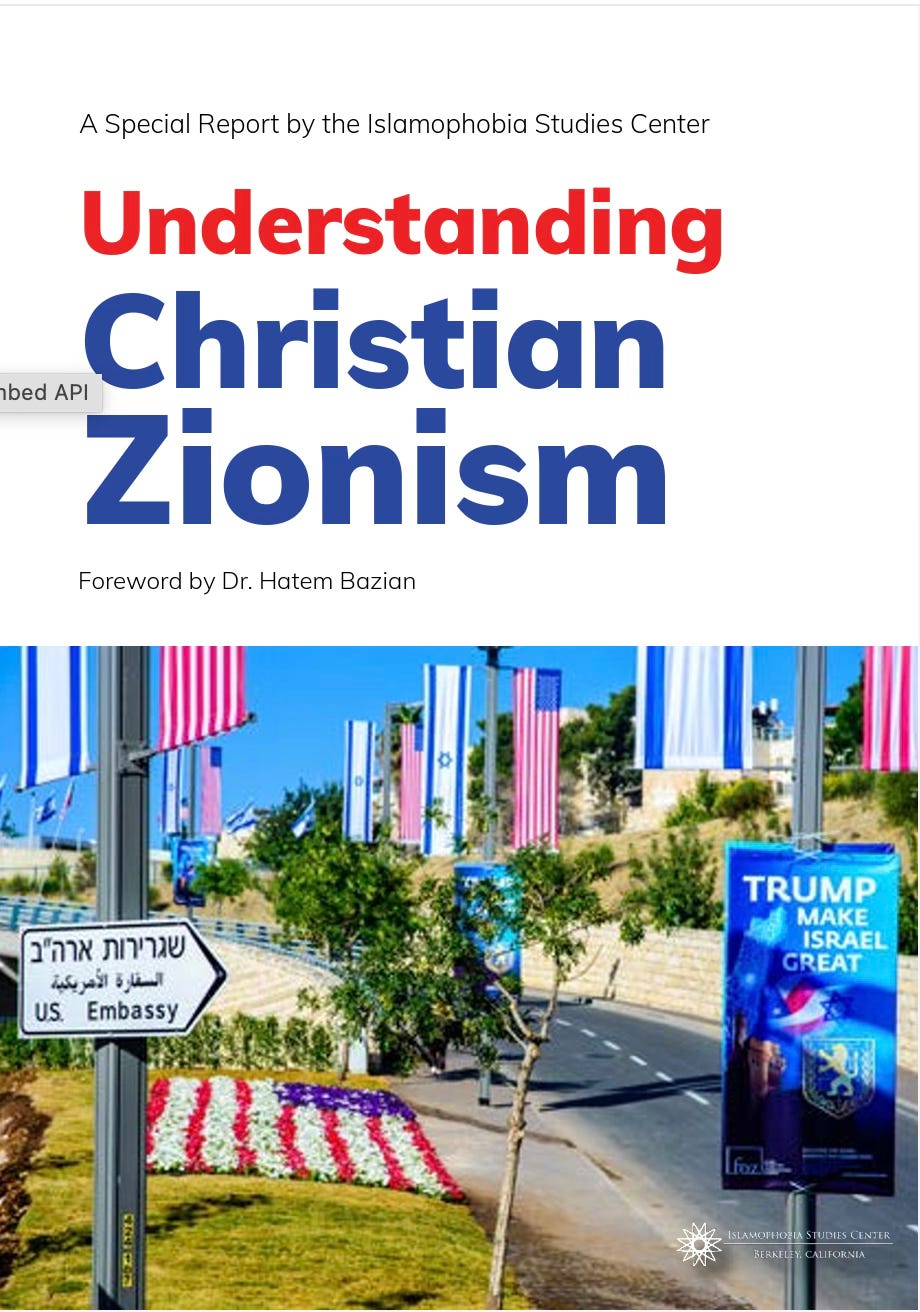
Access full report: https://www.iphobiacenter.org/content/understanding-christian-zionism
Forward by Dr. Hatem Bazian
The report on Christian Zionism is an important and timely research to unpack one key driver among others that contribute to a distinctive form of Islamophobia that is connected to theology and religious discourses. Moreover, the strong relationship between several evangelical groups and Zionist organizations has made it possible to provide political pressure to shield Israel from accountability for its continued violations of international law. The report is intended to generate the needed conversations on how Christian evangelical groups and others play a role in preventing the actualization of peace, justice, and dignity for the Palestinians. Not to imply that this is exclusively a Christian problem; on the contrary, future research will focus on the emergence of Muslim or Islamic Zionism, which articulates relations with Israel on the basis of a distorted religious discourse that rationalizes normalizations of relations at the expense of Palestinian rights.
Palestine, as a geographic and contemporary issue, is entangled in every aspect of US and European domestic and global discourses, encompassing the socio-political, military, economic, and religious imagination. The US and European relations with Palestine center on their long-standing support for Zionism and the State of Israel. Zionism, a secular political movement born in the 19th century, emerged on the world stage as a result of a complex set of socio-political, economic, and religious factors that were unique to 19th-century Western and Eastern Europe, which was then implanted in Palestine as a junior partner to British colonial plans in the Muslim world. At times, separating US and European interests and entanglements in Palestine from that of Zionism and the State of Israel is nearly impossible since the relationship between them is both ideologically constitutive and productive. Critically, Western Christianity, both institutionally and theologically, is implicated in the global colonization project and for rallying support in the postcolonial era to maintain and extend political, economic, and religious power disparities and hegemony. Palestine is facing a settler colonial project, and Christian Zionism played a major role in the past and present in cementing Zionist colonization through the constant deployment of religious discourses to justify the indefensible and the illegal dispossession and transfer of the indigenous Palestinians.
Religious texts, symbolism, and rhetoric are never far from Palestine; the history of the land and its people is the tapestry on which imperial prophecies, theology, and future imaginings are written, reinterpreted, and implemented. Western Christian imaginary and historiography is never far away from Palestine and colonization. In reality, the Palestinians, Zionist Jews, Arabs, and Muslims appear as mere supporting actors in a theater piece about their own lives, but it is written and acted to bring about the only “real” history, theology, and meaning, the Western Christian world, for none other exists or is allowed to exist. Palestine was colonized first by Great Britain, which deployed religious discourses in the lead-up to the conquest and in the aftermath, and then European Zionism was given the needed access to build a “homeland” under the British Mandate’s protection.
Palestine’s colonization begins in earnest toward the end of World War I. The Ottoman army withdrew its troops and surrendered Jerusalem to the British command on the 8th or 9th of December 1917, with a letter from the city’s governor: “For the past two days bombs have been raining on Jerusalem, holy to all communities. Therefore, the Ottoman Government, in order to safeguard the religious places from ruin and destruction, has withdrawn its forces from the city and has commissioned officials to take care of the religious places like the Holy Sepulcher and the Aqsa Mosque. Hoping that your treatment will also be similar, I am sending this paper with Husain Bey al-Husain, deputy mayor of the Jerusalem Municipality.” (‘Isa al-Safari, Filstin al-‘Arabiyah, p. 27) Two days after the Ottomans’ surrender of Jerusalem to safeguard it from destruction, General Edmund Allenby entered the city on foot through the Jaffa gate while declaring on this historic occasion: “The wars of the crusades are now complete.” (Eitan Bar-Yosef, p. 17) Allenby’s reported statement is such a powerful indicator that the British considered, at least rhetorically, their arrival in Palestine and entry into Jerusalem as a continuation of and bringing into “successful” conclusion the Crusades. The then Prime Minister of the United Kingdom, David Lloyd George, described the capture of Jerusalem as “a Christmas present for the British people,“ and made sure to direct Allenby to take the city before the holidays, per Cabinet instruction. (Eitan Bar-Yosef, Journal of Contemporary History, p. 86)
Allenby’s statement and referencing the Crusades was not isolated or unique as illustrated by a number of British press and book publications from the period. The Punch main caption on December 19th, 1917 declared “The Last Crusade” showing “Richard Coeur de Lion looking down towards Jerusalem and nodding contentedly, ‘My dream comes true!’” (Eitan Bar-Yosef, Journal of Contemporary History, p. 87) The British press which was initially instructed in a “private and confidential” memo dated November 15th, 1917, not to refer to the “military operations against Turkey in any sense as a Holy War, a modern Crusade, or anything whatever to do with religious questions,” moved very quickly and in a short period of time after the instruction started to center religion in discussing the Occupation of Jerusalem. (Eitan Bar-Yosef, Journal of Contemporary History, p. 87). From the government point of view, the reason for the memo was to prevent any possible friction with Muslim troops recruited from British colonies to fight in the war as well as the alliance with Sharif Hussein of Mecca against the Ottomans. This “private and confidential” directive was very quickly set aside as the article from Punch above shows but more importantly the British Department of Information itself began to use the term Crusade and convey very distinctive religious and historical connections to earlier periods.
In a telegram wired from Palestine, the British information office mentioned “two of the commanders who have played a great part in the South Palestine campaign are descended from knights who fought in the wars of the Crusades.” (Eitan Bar-Yosef, Journal of Contemporary History, p. 88) In addition, the Department of Information few months after the conquest of Jerusalem “released a 40 minute official film entitled The New Crusades: With the British Forces on the Palestine Front,” which once again articulated the adventure in the region in religious terms. (Eitan Bar-Yosef, Journal of Contemporary History, p. 88) Furthermore, in the period after WWI, a large number of published books had the Crusade incorporated into it: “Khaki Crusaders (1919), Temporary Crusaders (1919), The Modern Crusaders (1920), The Last Crusade (1920), With Allenby’s Crusaders (1923), and The Romance of the Last Crusade (1923).” (Eitan Bar-Yosef, Journal of Contemporary History, p. 87)
Eitan Bar-Yosef correctly observes that the British government effort was consciously staged “as an exercise in propaganda, shaped, filtered and capitalized on in order to enhance nation’s morale.” (Eitan Bar-Yosef, Journal of Contemporary History, p. 88) This observation would be also in line with the Crusades period because the efforts then were intended to construct Europe’s identity in the face of fragmentation, internal disunity and the contestation of the Catholic Church’s authority. What is of importance in the framing of the campaign in Palestine is the extensive use of religious terms and viewing it as a continuation of the earlier Muslim-Christian conflicts, despite the claim of fighting the Ottomans on the basis of secularity and anti-religious modernity. A similar account to the British press and Allenby’s comes from Tariq Ali citing the account of the French commander Gouraud supposedly traveling to Saladin’s tomb upon entry into Damascus, kicked it and proclaimed: “‘The Crusades have ended now! Awake Saladin, we have returned! My presence here consecrates the victory of the Cross over the Crescent.’” (Tariq Ali, The Clash of Fundamentalisms: Crusades, Jihads and Modernity, p. 42). Religious epistemology was present all along in the Palestine campaign, and the debates in London, France, and other Western capitals focused on supporting Zionism as a way to reconstitute the Jews in the Holy Land and a re-enactment of ancient history, but to prepare the ground for Jesus’ Second Coming.
Even the drawing of the borders and the discussions concerning what constitutes Palestine were framed by re-reading and affirming biblical narrative relating to the ancient Jewish polity in the land of Canaan and attempting to recreate it. Furthermore, the modern colonial borders were projected back to the ancient biblical period, and contemplating what defensible borders should look like based on how and why the earlier polity failed under attacks from the north or was defeated. In the British government debates and discussions arose about the Golan Heights and why it is critical to include them in the newly crafted state so as to prevent history from repeating itself through an attack from the north. Thus, the Western reading of the Bible was present in the debates, and colonial discourses in Palestine were written through the lens of the Bible. Colonizing Palestine began first as a Western epistemic followed by direct British conquest, French, European, US, and Russian powers’ consent and approval for dispossessing the Palestinians and granting their land and country to the Zionists, as a modern re-enactment of ancient biblical narratives and preparing the ground for the Second Coming.
Significantly, the birth of Christian Zionism can be traced to this formative period and the emergence of Dispensationalist theology in the mid-19th century. The teachings and theology of John Nelson Darby provided unique views on eschatology and ecclesiology, which became widely used in the United States through the works of D. L. Moody and Cyrus Scofield’s 1909 Reference Bible. Theology in the service of policy is not new, and this was yet another example where the religious text was mobilized to serve such a role.
Indeed, Dispensationalist theology played a major role in shaping the US mainline Christian denominations’ view and eventual embrace of Zionism while accepting the erasure and silencing of Palestinian Christians, Muslims, and Jews. Dispensationalist theology was constructed around seven main dispensations, which were viewed as unfolding progressively, whereby Zionism and the emergence of Israel get connected to the awaited last stage: 1. Innocence (pre-Fall of Adam-Eve); 2. Conscience (from Fall–Noah’s floods); 3. Government (Noah–Abraham); 4. Promise (Abraham–Moses); 5. Mosaic Law (Moses–Christ on earth); 6. Grace (current age of the world); 7. Millennial Kingdom (1,000-year reign of peace under Christ, which is yet to come). Precisely, the progressive nature of Dispensationalist theology, which views every period of history to be dependent on the previous era, that embracing of Zionism by the Church and the establishment of Israel is constructed as the needed precondition to bring forth the Second Coming. Here, Israel, Christian Zionism, and Western colonialism get their marching order and are clothed in the highest purpose of all, the human being taking concrete action to facilitate the return of God in “the flesh” to the earthly plain and the ushering in of a 1000-year reign of peace with Christ. Destruction, death, wars, displacement, and every other consequence are an acceptable price or precondition to be offered so as to give birth to this Seventh Stage.
Dispensationalist theology gives rise to Zionist colonial geography over Palestine and the need to reconstitute “Greater Israel” as the stepping-stone for the re-emergence of Christianity, the Kingdom of God, or more accurately, the centering of rapture theology and eschatology in political discourses. In recent history, Dispensationalist theology has receded and no longer has sway over mainline Christian Churches in the US and Europe; however, it has found re-articulation within Evangelical circles and the utilitarian alliances struck with Zionism and Israel to serve domestic and global interests. Evangelicals’ support for Israel builds upon the mainline Christian churches Dispensationalist theology that is still lurking from the 19th and 20th century writings, the massive rise of membership, and the intertwining of rapture speculative theology and millennialism with unfolding complex global political events. Moreover, the events of September 11, 2001, and the wars in Iraq and Syria provided fertile ground for the strong re-emergence of a rapture and millennialism mega churches and movements that worked to explain geopolitical events through theological discourses that centered on Christian Zionism, Israel, and the utilization of Islamophobia.
Loving Jews to die for the Second Coming and loathing Muslims for Christian future horizons to unfold is the pinnacle and driver for theologically constructed anti-Semitism and Islamophobia. In both cases, Christian Zionism uses distorted and erroneous theology to give the perception of concern for Jews while all along instrumentalize the contemporary relations with Zionism, and the State of Israel, in reality, to consolidate an insidious affirmation of self-love, which if it comes to pass will lead to the death and genocide of most Jews and the conversion of the rest to Christianity, while Muslims are to be eliminated altogether. Speculative theology, preparing the ground for genocide, is the new version of manifest destiny and Whiteman’s burden that uses the Jewish and Muslim subject to envision and bring forth a future era of Christian dominance. Nothing is wrong with self-love, but since one of the main pillars of normative Christian theology is love, then its utilitarian use by Christian Zionism to construct a false love of the other to drive self-benefits puts the whole theological foundation into question. Thus, Christian Zionism loving and supporting Israel and Zionism is not founded upon loving and supporting Jews for being Jews or Zionism, as a political movement seeking a “homeland” in Palestine; rather it is an affirmation of the singularity of Christian theological worldview and assertion of political hegemony in the here and now while awaiting for the total domination of the world through the idea of the Second Coming.
Importantly, to contextualize the critique offered here of Christian Zionism, rapture, and millennialism theologies is that their focus is on power and domination of the world while using the backdrop of an expected Second Coming as the vehicle to achieve it. The critique offered here is not of Christianity having or making universal claims or theological articulation of the Second Coming in itself. Rather, it is the immediate translations of the ideas into geo-political policies that have had and continue to have profound, destructive impacts on the Palestinians, first and foremost, then Jews, Arabs, Muslims, and Western Christians themselves. Being mobilized to support immoral and unethical engagements in Palestine and other parts of the Muslim world, Western Christianity's support for war footing and interventions gets erroneously framed on the basis of high spiritual and theological ideals, which only further undermines religion and theology in society. Support for Zionist conquest and colonization of the Holy Land and its geography is constitutive of Christian Zionism theology that then gets articulated politically in constantly urging for the unconditional support of Israel, no matter what it does, and pressing Congress and Senate members, as well as the White House, to maintain Israel as a close and uncontested ally.
Setting aside relations with Muslims, the question for Christian Zionists is where they stand on the rights of Palestinian Christians to self-determination, sovereignty, and statehood, considering that the Palestinians did recognize Israel’s right to exist, but so far, no reciprocation has occurred. The constant questioning of Palestinians on whether they recognize Israel's right to exist is a fictitious question intended to shield Israel from critique and framed as a victim of Palestinian intransigence and rejection, while allowing it continued expansion to actualize the Biblical narrative at the center of their theological understanding. Furthermore, the strong relations and advocacy with the organized aspects of Zionism in the West make it possible to drive more strongly Islamophobic discourses on the basis of theology and transforming religious space and teachings into instruments of racism, oppression, and interventionist policies abroad.
The report in your hands is intended to generate conversations, foster open debate, and inspire people to examine their views on Palestine and the role it plays in shaping Islamophobic discourses in contemporary America. The Palestinian struggle against settler colonialism has been used by Christian Zionists and segments of the organized Zionist movement to drive Islamophobic discourses in the US, and the time to address it is more urgent today than at any other time in the past. Wrong theology is destructive and undermines the foundation of religion in an increasingly complex and diverse world. Silence is no longer acceptable in the face of the unfolding calamity in Palestine, and religious leaders and institutions should be at the forefront of bringing about the needed change.

