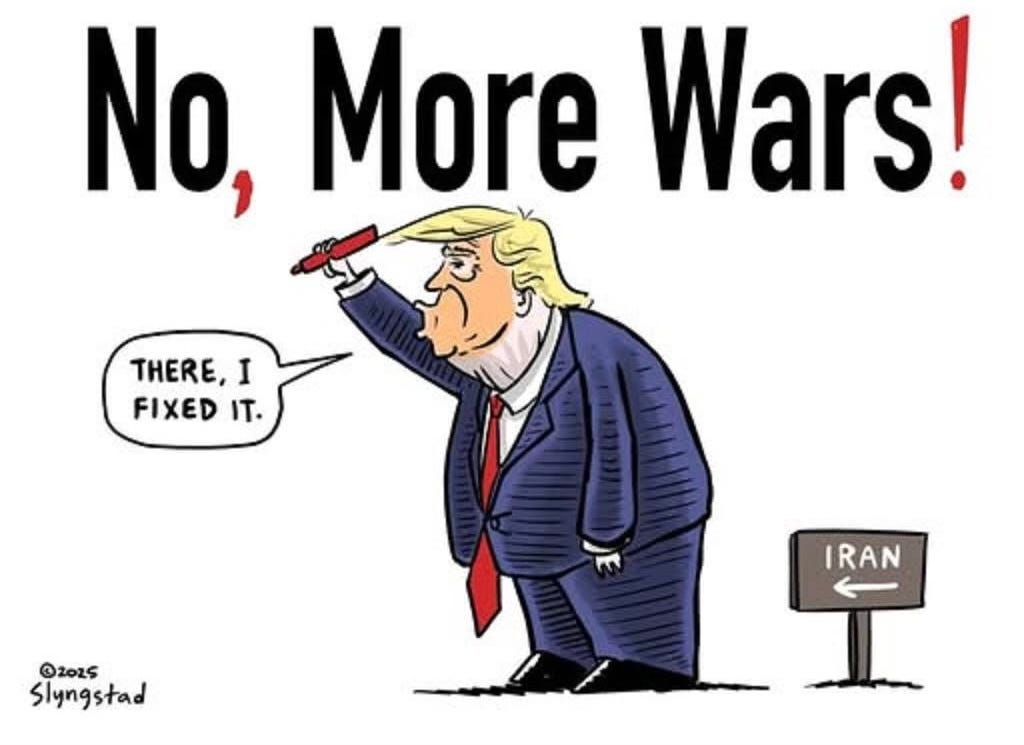
On Friday, the Trump administration submitted to Congress what it calls a defense budget for fiscal year 2027. The number is $1.5 trillion. Say it slowly. A trillion and a half dollars — proposed for the Pentagon alone — in a country where the administration simultaneously seeks to eliminate funding for heating assistance for the poor, dismantle housing discrimination programs, gut public education, and erase clean energy investment. This is not a budget. This is a confession.
It is the confession of an empire that has lost the plot. One that mistakes the sound of artillery for the sound of progress. One that cannot distinguish between strength and spending, between security and spectacle, between leadership and the performance of dominance. We have seen this story written before, in Latin, in Arabic, in Ottoman Turkish, and every single time, it ended the same way.
Before Paul Kennedy, before Toynbee, before Spengler, there was Ibn Khaldun. Writing in 14th-century North Africa, this Muslim historian, sociologist, and philosopher produced what may still be the most precise diagnosis of civilizational collapse ever written. His masterwork, the Muqaddimah, completed in a single year of concentrated solitude at a fort near Oran in 1377, was not prophecy. It was pattern recognition, an early development of social science and analysis methods. And the pattern he identified maps onto the United States of 2026 with the eerie precision of a key fitting a lock.
The central concept in Ibn Khaldun’s theory is asabiyyah, loosely translated as group solidarity, social cohesion, and collective purpose. It is the force that enables a people to act together, sacrifice for one another, and build something larger than any individual. For Ibn Khaldun, asabiyyah was not just a sociological observation. It was the engine of history. Dynasties rise because they possess it. Dynasties fall because they lose it. And they always lose it the same way, through the corrupting weight of power, luxury, and the gradual abandonment of the very people whose solidarity made the enterprise possible in the first place.
His cycle has five stages, and they are merciless in their regularity. First, the rise: a group forged in hardship, bound by shared purpose, disciplined by necessity. Second, the consolidation of power and its early fruits. Third, the decay: born-to-privilege generations lose the original solidarity, replace collective purpose with personal enrichment, and confuse the trappings of power for power itself. Fourth, the crisis: state expenditures balloon on military campaigns, bureaucratic luxury, and the coercion needed to replace the loyalty that has dissolved, while taxation crushes the population and the economy hollows out. Fifth, the collapse: a new group, possessing the asabiyyah that the ruling dynasty has squandered, rises from the periphery and finishes what the dynasty’s own choices began.
“The ruling group loses its grip on the reins of power. In order to raise money for its luxuries, it imposes more and more taxes. Gradually, the ruler becomes a ruler in name only.”
— Ibn Khaldun, The Muqaddimah, 1377
What Ibn Khaldun understood, with a clarity that still stings, is that the cutting of the social compact, the abandonment of the poor, the erosion of shared investment in the common good, is not just morally wrong. It is structurally fatal. When a ruling class stops serving the people whose solidarity sustains it, it doesn’t just lose legitimacy, which is the foundation for a state's continued functioning. It loses the very cohesion that made it capable of governing and then begins to rely on coercion where it once relied on consent, on mercenaries where it once relied on citizens, on spectacle where it once relied on substance. The empire becomes a performance of itself. And performances, eventually, end.
Look at what the 2027 budget is doing through this lens. The administration is not simply cutting domestic programs. It is severing, deliberately and with stated purpose, the bonds between the federal state and the tens of millions of Americans — the poor, the sick, the young, the marginalized, whose well-being once formed the moral justification for the state’s existence. It is replacing that justification with military projection. It is, in Ibn Khaldun’s precise terms, a dynasty that has abandoned its asabiyyah and is now spending on coercion what it can no longer command through solidarity.
The Pattern That Does Not Lie
Historian Paul Kennedy spent his career mapping the arc of great powers, and the conclusion he reached was uncomfortable in its simplicity; empires decline when their military ambitions exceed their economic capacity. He called it imperial overstretch. It is not a theory so much as an observation, a recurring pathology visible across Rome, Spain, Britain, and the Ottomans, each of whom believed, in their moment of peak arrogance, that their empire was different. That the old rules did not apply to them. They were wrong. Every single time.
Rome’s military, at its height during the second century, consumed somewhere between 60 and 80 percent of the imperial budget. The legions were the empire’s identity, its pride, the answer to every question. When “barbarian” pressures mounted at the frontiers, Rome did not invest in roads, in grain, in the civic infrastructure that made Romans Roman; it poured more into the military. It debased its currency to do so and raised taxes on an increasingly resentful population. It hired foreign mercenaries when it could no longer fill its own ranks, loyalty becoming a commodity rather than a calling. The infrastructure crumbled. The social contract frayed. And eventually, when the Visigoths sacked Rome in 410 CE, they didn’t conquer a great civilization. They walked into a shell that was already internally dead.
Constant wars and overspending had significantly depleted imperial coffers, and oppressive taxation and inflation had widened the gap between rich and poor. As more funds were funneled into military upkeep, technological advancement slowed and Rome’s civil infrastructure fell into disrepair.
The Ottoman parallel is, if anything, more instructive because it adds nepotism, cronyism, and leadership failure to the mix. After Suleiman the Lawgiver (the Magnificent in the West), the empire that had stretched from Hungary to Yemen, from Crimea to the Arabian Peninsula, began to hollow out from within. The administrative bureaucracy that once ran with precision became an instrument of personal enrichment. Officials were appointed not for competence but for connection. The Janissaries, the empire’s elite military corps, became politicized, more concerned with preserving their own privileges than with defending the state. And the sultans themselves? Many of them had been raised in isolation within the palace walls, deliberately kept away from governance, society, and reality — producing what historians charitably call “incompetent rulers” and what we might recognize today as a ruling class constitutionally incapable of understanding the people they claimed to lead.
“What was once a great bureaucracy became beset by nepotism, cronyism, and inefficiency. The welfare of the empire ranked low. The good of those in power ranked first.”
The Ottoman debt exploded from £5 million in 1854 to £200 million by 1874. Military spending ballooned from 30 percent to 50 percent of the state budget within fifteen years. The empire borrowed from European creditors, ceded fiscal sovereignty to foreign administrators, and watched its trade routes and revenues dwindle while its rulers built grand palaces and waged expensive wars in every direction. By the 19th century, it was being called, with pity and contempt in equal measure, “the sick man of Europe.” It did not recover.
Now Look At What We Are Doing
The proposed 2027 military budget would represent, according to analysts at the Brookings Institution, roughly 4.5 percent of GDP, the largest year-over-year increase in American defense spending since the Korean War, adjusted for inflation. This is not a response to an existential threat in the mold of World War II. This is a war of choice, a conflict with Iran now in its fifth week, being used as the pretext to permanently restructure the American state around military spending and to gut the domestic programs that hold the social fabric together.
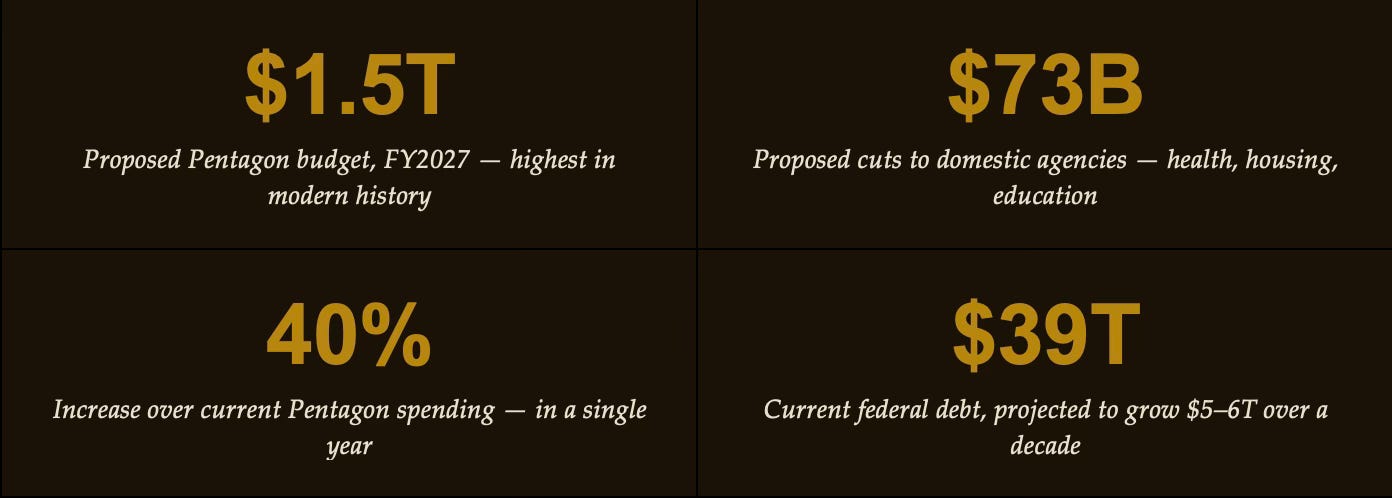
You read this right, and no need to check your computer or phone. Read each line carefully, consider what is lost on the home front, and ask whether this will bring back past glory.
“It’s not possible for us to take care of day care, Medicaid, Medicare, all of these individual things.” President Trump
$1.5T
Proposed Pentagon budget, FY2027 — highest in modern history
$73B
Proposed cuts to domestic agencies — health, housing, education
40%
Increase over current Pentagon spending — in a single year
$39T
Current federal debt, projected to grow $5–6T over a decade
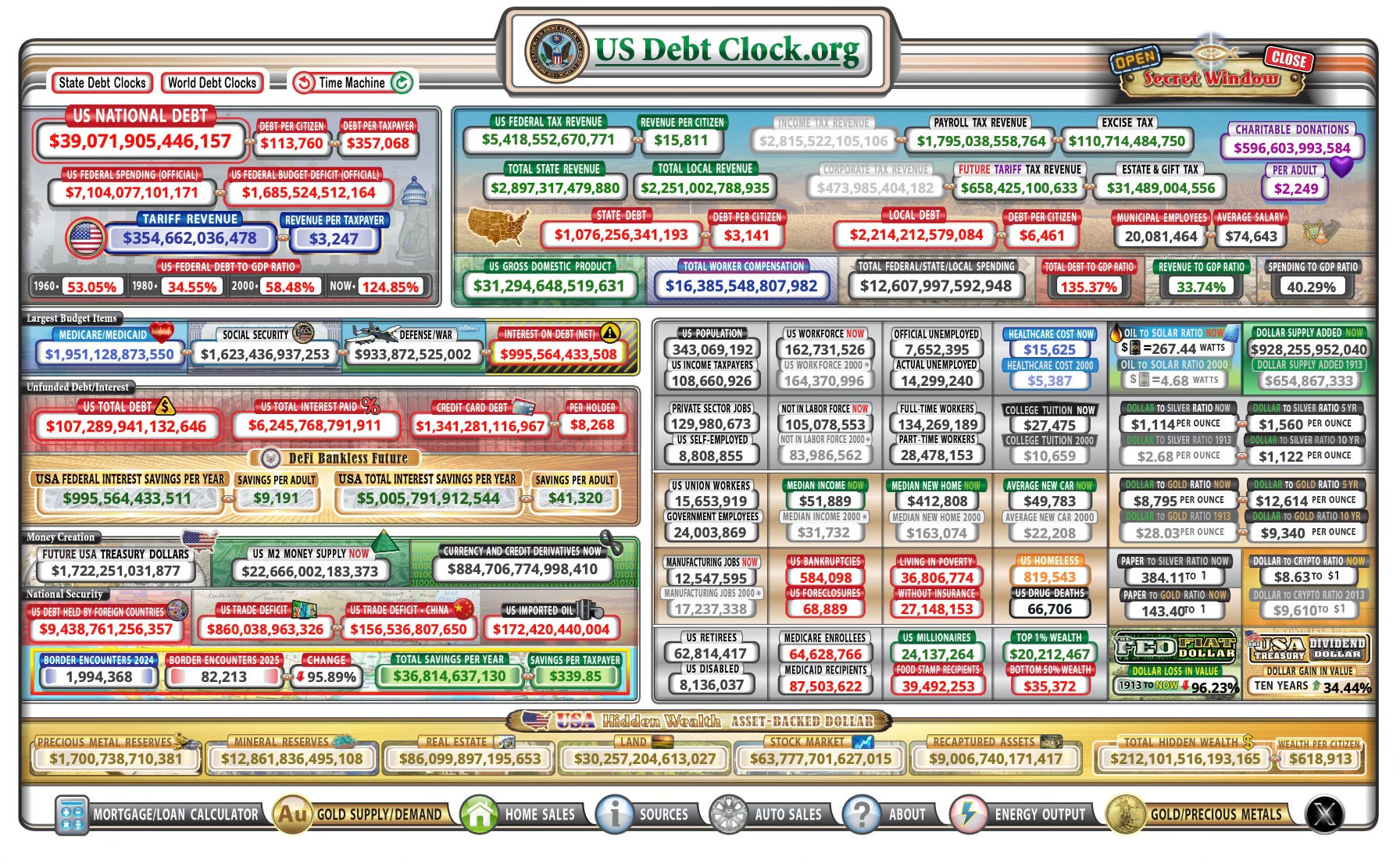
Access the debt clock here: https://www.usdebtclock.org
The administration has been clear about the trade-off it is making, and unlike most of what emanates from this White House, this clarity deserves to be taken seriously. “It’s not possible for us to take care of day care, Medicaid, Medicare, all of these individual things,” the president said at a private lunch. The state, in his formulation, exists for military projection. Everything else, the heating bills, cancer research, teacher training, natural disaster response, and housing for the poor, is a luxury that states can figure out on their own. The federal government is to become, in effect, a military apparatus with a flag.
This is not a governing philosophy. It is a death wish dressed up in patriotism.
It is worth pausing on what exactly is being cut to pay for this military vanity project. The administration seeks to eliminate federal assistance helping low-income Americans afford heating and cooling, not a luxury, but survival, in a country of brutal winters and lethal summer heat. It wants to eliminate programs combating racial disparities in health outcomes, funding for minority-owned businesses, and protections against housing discrimination. It wants to gut the EPA’s budget in half. It wants to defund clean energy research, disease cure research, and teacher training. It is moving toward privatizing airport security screeners after two government shutdowns left those workers without pay and airports in chaos, while spending $40 billion more at the Justice Department and $10 billion for ICE.
Let us be precise about what this is: a government that is choosing, deliberately, to stop investing in the health, education, housing, and economic security of its own people, particularly its most vulnerable and its most marginalized, while escalating its capacity for war and enforcement. It is redistributing the state’s resources from the governed to the instruments of power.
SENATOR PATTY MURRAY (D-WA), SENATE APPROPRIATIONS COMMITTEE
“Imagine how many families we could help if, instead of giving the Pentagon more money than they can even figure out what to do with, we cut people’s heating bills in half and made child care affordable for every family in America.” Senator Patty Murray (D-WA)
Rome’s senators watched this happen in real time and could not stop it. The late Roman Empire’s political class was fractured, self-interested, bought and paid for, not entirely unlike the Congress that is now being asked to authorize the largest military budget in human history while cutting food programs for the people who elected them. The difference is that the Romans at least had the excuse of not having studied Rome.
Nepotism, Incompetence, and the Price of Vanity
No analysis of this moment is complete without confronting the quality of the leadership making these decisions. The health of 330 million Americans has been placed under the stewardship of a man whose primary qualification appears to be a willingness to challenge decades of medical consensus for political effect. The antifraud campaign, nominally aimed at waste and corruption, is being directed by the Vice President, and the president himself announced on social media that it will focus “primarily” on blue states. This is not governance. This is theater. This is a Janissary corps that has turned on the state it was meant to serve.
The Ottoman sultans who came after Suleiman were, as historians note, raised in gilded cages, deliberately isolated from the world they would rule. They emerged with enormous power and minimal understanding of how ordinary life functioned, how the economy worked, how the people outside the palace walls lived and struggled and died. The policy consequences of that isolation were catastrophic and century-long. We do not have centuries to absorb the consequences of this iteration.
Because empires don’t always collapse in dramatic fashion. Sometimes they collapse by a thousand individual decisions, each one defensible in the narrow logic of that moment, each one accelerating the rot. A heating program cut here. A housing discrimination office eliminated there. A public health research budget zeroed out. A war authorized. Another war funded. The debt climbs. The infrastructure ages. The educated leave. The poor get poorer. The social trust dissolves. And one day, what was the greatest power on earth is simply the largest military machine in a country that cannot take care of its own people, cannot provide housing, healthcare, childcare, education and clean water. More expensive death machines will translate to dead-end and preventable death in America’s decaying cities.

— The recurring lesson no empire has managed to learn in time
There is a familiar argument made in the defense of this logic that military strength is itself a form of domestic investment, that a nation that cannot project power is a nation at risk. It is not without merit. But it has a limit, and we passed that limit some time ago, started in Vietnam and for sure culminated in Iraq and Afghanistan. The United States already spent over $8 trillion on wars since 2001, according to Brown University research, while the bridges aged, the schools underfunded, the hospitals closed, and the opioid crisis consumed hundreds of thousands of lives in communities the government had largely abandoned. More military spending did not make those communities safer. It did not make those bridges stronger. It did not make those hospitals solvent.
What this budget tells us, what this moment in American history tells us, is that we are in the advanced stages of a pattern that historians have documented with numbing consistency. Ibn Khaldun named it seven centuries ago. Kennedy named it four decades ago. The Romans, the Ottomans and the British lived it. The empire turns inward in the worst way; not toward its own people, but toward its own mythology. It spends to project strength because it can no longer produce the genuine article. It wages war because war is comprehensible and domestic complexity is not. It cuts care because care is quiet and missiles are photogenic and maybe packaged to the public as strength.
Ibn Khaldun was specific about what the final stage looks like. The dynasty, he wrote, becomes concerned with holding onto its wealth and goods and rejects helping others, especially the poor and rural people who grow resentful toward their rulers for having abandoned them. The asabiyyah that once bound citizens to state has dissolved. What remains is coercion dressed as governance, spectacle dressed as policy, and a ruling class that confuses the performance of power for its substance. Does any of this sound familiar? Do you recognize the pattern? Do you see what is speaking and what are they saying?
The Romans did this. The Ottomans did this. The British did this, eventually, though by the time they were forced to confront it, the empire had already dissolved into a medium-sized Atlantic island with a ceremonial monarchy and a crumbling National Health Service. They at least had the decency to stop expanding. We are, apparently, still accelerating and $1.5 trillion worth of planned collapse.
Behold an empire in collapse. Not because it has been conquered. Not because it has been outcompeted. But because it has made, with its eyes open, the choice that every collapsed empire before it made, the choice Ibn Khaldun diagnosed in the 14th century and no dynasty since has managed to avoid, to spend on projection what it should have invested in its own people, and to call that choice strength.
History is patient and Ibn Khaldun told us how this ends. The question is not whether we are reading him. The question is whether it is already too late to do anything about it.

