Part One:
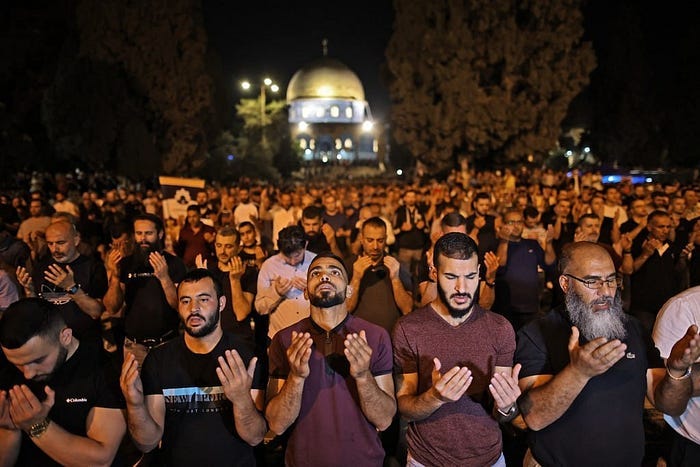
One of the most seminal events in the life of Prophet Muhammad (ﷺ) was a journey that took him from Mecca to Bayt al-Maqdis (al-’Isrā’) and then to the heavens and back (the Miʿrāj) in a portion of a night. The event has been related in the Qur’an and a number of ḥadīṯhs provide greater detail of the event. This episode constitutes a primary theological foundation for Muslims and constitute their attachment and affinity to Bayt al-Maqdis land (al-Quds, Jerusalem). It is therefore important for an understanding of the merits and rights toward Bayt al-Maqdis in general and al-Quds(Jerusalem) as a city in particular. Primary text in this respect is verse one of chapter seventeen of the Qur’an:
“Glory be to Him Who carried His servant by night from the Sacred Mosque to the Farthest Mosque Whose surroundings We have blessed, that We might show him some of Our signs, for He is the Hearer, the Seer.” (Qur’an 17, verse 1)

For Muslims, the verse above makes a direct reference to the miraculous night journey that took the Prophet (ﷺ) from Mecca to the “Farthest Mosque” the location of which as Bayt al-Maqdis. Indeed, one of the titles given to chapter seventeen is al-’Isrā’ because of the episode that is mentioned in verse one. For Muslims several questions arise in connection with al-’Isrā’ wal-Miʿrāj.
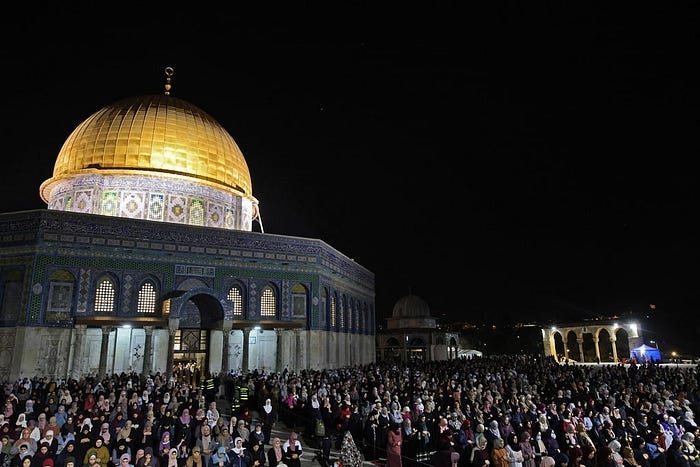
When did this event take place? Was it during the Meccan or Medina period? Was it a onetime occurrence or did it occur several times? Some might ask whether the occurrence falls within the realm of the possible or is it simply a myth made up by Muslims later. This question of possibility is easily answered from the point of view of theology for a believing Muslim or anyone who accepts the existence of an All Powerful God. The issue is secondary to the fundamental question of the existence of God, everything else is but a mere detail of the unfolding divine attributes in the world. What is relevant to our purpose is to examine what Muslims believe with respect to Bayt al-Maqdis, for miracles that are accepted as Allah’s intervention in His own creation for a reason, which is sometimes expressed and known but often is not mentioned. A point of contention among early Muslim scholars is whether this event was a dream or did it take place in both body and spirit.
The answer to many of the questions raised will cause us to consider the stages of al-’Isrā’ wal-Miʿrāj and the conflicting accounts of it appearing in various hadith. These differing accounts actually make a significant contribution to understanding Muslims’ feelings toward al-Aqsa mosque, Al-Quds (Jerusalem) and Palestine in general. In some accounts of the al-’Isrā’ wal-Miʿrāj, we find that the prophet is reported to have prayed in Bayt al-Maqdis. We may ask whether indeed this prayer took place, was it before or after al-Miʿrāj and what was its significance? These are just a few critical questions that are relevant to our main theme.
What is the al-’Isrā’?
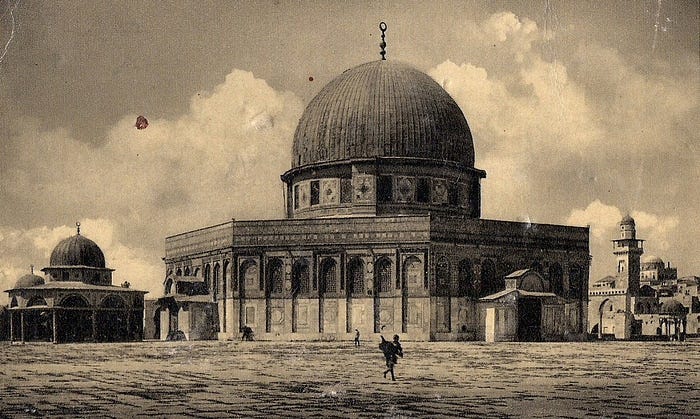
The term al-’Isrā’comes from a root meaning to undertake a journey at night. Thus, the verse and the Qur’anic chapter’s name both refers to the night journey undertaken by the prophet to Bayt al-Maqdis, aided by the angel Jibrīl (Gabriel). Even though the word al-’Isrā’ itself means to travel at night, the Qur’anic verse in Arabic uses an adverbial expression (laylan) meaning ‘by night’ which is understood to imply that the entire event took place in only a portion of the night. The miraculous aspect of this journey is not that it took the prophet from Mecca to Bayt al-Maqdis but that it was completed in a portion of the night something impossible at that time considering the modes of transportation available. People contemporary with the Prophet (ﷺ) viewed this journey as impossible for it would have taken about a month in each direction. The historical context of the miracle is therefore important. The length of the portion of the night is not made clear to us; it is left to the imagination to contemplate this aspect of the miracle.
What is al-Miʿrāj?
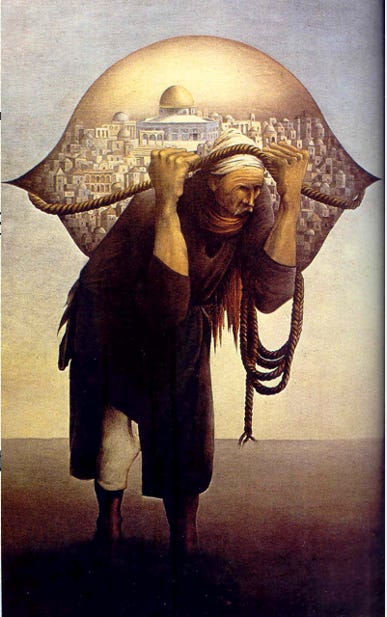
The Mi‘raj, on the other hand, derives from a root meaning to ascend a ladder, and it refers to the Prophet’s (ﷺ) journey to the heavens going by way of a jewel laden ladder the base of which is at the center of a gate leading into another or out of the world. The gate is believed by Muslims to be located in al-Quds (Jerusalem) and it constitutes the link between this realm and the heavens, which explains in part the choice of the location for the Prophet’s (ﷺ) journey to meet his Lord. While it is accepted as a fact by Muslims that the prophet did travel to the heavens, the word Miʿrāj does not appear in the Qur’an, the only direct use of the term is to be in the ḥadīṯhs. The Miʿrāj is considered the second stage of an episode beginning with theIsra’. An absence of the word itself in the Qur’an is not the same as the lack of Qur’anic textual proof to support it as can be seen from verses 5–18 chapter 53.
In verse 9, we are informed of the Prophet (ﷺ) being drawn near to the distance of “two bows length, or even nearer,” and in verse 14, that he came “near the Lote-tree of the utmost boundary.” The reference to the “two bows length, or even nearer” had two possible meanings for early commentators of the Qur’an with the majority maintaining that it refers to Jibrīl while some see it as referring to the Prophet (ﷺ) being drawn near to Allah. As for the “Lote-tree,” it is understood to indicate the Prophet’s (ﷺ) travel toward the “utmost boundary,” the location of the meeting with Allah as indicated in the ḥadīṯh. The meeting with Allah has been a subject of debate among scholars. One group of scholars has maintained that the Prophet (ﷺ) did not see his Lord with his own eyes, but he witnessed Him through his heart’s inner eye, while others hold the view that he did actually see Him, this being possible for him as a prophet.
When Did al-’Isrā’ wal-Miʿrāj Occur?
As to the date of the al-’Isrā’ wal-Miʿrāj, all scholars agree that it took place in the Meccan period of the prophetic mission but they differ on the exact date, month and year. The most widely cited narration is that of Ibrāhīm al-Ḥarbī who states that it took place on the 27th day of Rabīʿ al-ʾĀkhir, one year before the migration to Medina. However, al-Ḥarbī’s position was challenged on the date, and a number of other scholars among them ibn Ḥajar al-ʿAsqalānī disputes the dating as one year before migration while al-Qadi ‘Iyadconsiders five years after the beginning of the revelation to be a more likely date.
In the prophetic biography of Ibn Kathir we find a number of possible dates mentioned. He quotes Ibn ‘Asākir as placing the event ten years after the beginning of the prophet’s mission, al-Bayhaqī as affirming the date of one year prior to the emigration, and al-Hakam as affirming the date of 16 months before the move to Medina. The scholars are certain that the event took place in the Meccan period most likely towards its end rather than the beginning. The narrations of one year and 16 months are very close, the difference of only four months indicating perhaps an error in oral transmission.
We may also be certain that the event took place after the death of Khadīja bint Khuwaylid, the Prophet’s first wife, which would place it at least three years prior to the emigration to Medina. There is a divergent account that places the event prior to Khadīja’s death, in light of her having spoken of her prayers with the Prophet, the prayers which were fixed definitively during the Miʿrāj. This account runs contrary to the established consensus that the episode took place after Khadīja’s death. Furthermore, the Prophet (ﷺ) had a set of prayers mandated for him before the final prescription of the prayers during the Miʿrāj. If we take the event to have occurred after the death of Khadīja, then the dating of the episode five years into the Prophet’s (ﷺ) mission would be ruled out. However, ibn Ḥajar al-ʿAsqalānī maintains that the one year date is not the object of consensus among scholars; he identifies a total of ten possibilities for dating the event. On the other hand ibn Jamāʿah in his book, Mukhtaṣar al-Sīrah, puts the al-’Isrā’ wal-Miʿrāj on the 17th of Rabīʿ al-ʾAwwal and the Prophet’s (ﷺ) age at the time as 53 years, which would be about one year prior to the migration. In short, the question of the year is not settled, but most evidence points toward the end of the Meccan period, not earlier.
There are also a variety of possibilities with respect to the month and the day of the week on which the event took place. We find, for example, that al-Suddī places the al-’Isrā’ wal-Miʿrāj in the month of Ḏū al-Qaʿdah, al-Zuhrī and ‘Urwamention Rabīʿ al-ʾAwwal, while ‘Abd al-Ghanī ibn ‘Abd al-Wāḥid al-Jammā’īlī al-Maqdisi chooses the 27th of Rajab as the date. There are also two days of the week used in reference to the al-’Isrā’ wal-Miʿrāj, Monday and Friday. Both Monday and Friday have significance in Islamic spirituality. Monday is known to be the day on which the Prophet (ﷺ) was born, and as such it is highly regarded and is recommended for additional acts of worship including voluntary fasting outside the Month of Ramadan. Friday, on the other hand, according to the Islamic tradition is the day Adam was created, was given an abode in paradise, and placed down on earth; the day of mandatory congregational prayers for the Muslims; and according to a number of ḥadīṯhs the day on which judgment day will take place. It may be for these reasons that the Isra’ and Mi‘raj were assigned to a Monday or a Friday. At present, the al-’Isrā’ wal-Miʿrāj are celebrated in the Muslim world on the 27th of Rajab, signifying an acceptance of this date among Islamic institutions, and the rejection of all other narrations is the result of state organization of religious festivals throughout history.
The Stages of al-’Isrā’ wal-Miʿrāj
Part Two:
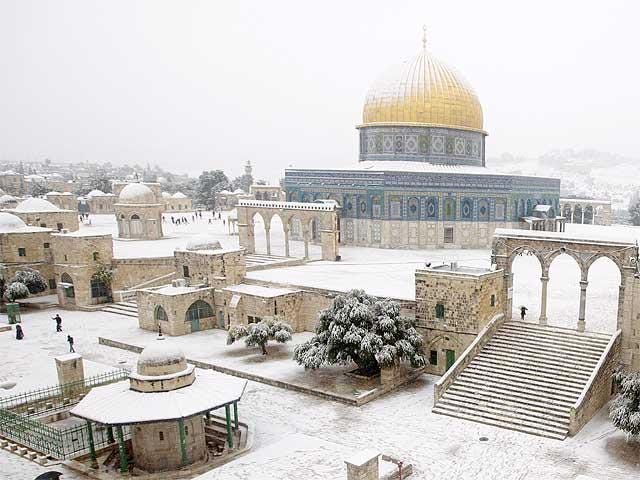
We now turn our attention to al-’Isrā’ wal-Miʿrāj and attempt to discover what took place during this journey. The classical sources offer two possibilities for the event: 1. a real event for the Prophet (ﷺ) including both in body and spirit, the dominant opinion; 2. it was a dream that came to the Prophet (ﷺ) and not involving physical motion on his part, the minority opinion. Both possibilities regard the event as a form of revelation and even the dream since prophetic dreams are considered a form of divine communication to prophets. A clear example of this can be seen in the narrative of the Prophet ʾIbrāhīm (ﷺ) in which he saw himself sacrificing his only son; he set about doing so until Allah intervened to save the child and ordered an animal to be offered in his place.
Some have argued that the sequence of al-’Isrā’ wal-Miʿrāj have taken place more than once in the life of the Prophet (ﷺ), one time in body and spirit and another time in a dream while in a state of sleep. The majority of Muslim scholars have taken the position that it took place only once, and in both body and spirit. They offer verse one of chapter seventeen as categorical textual evidence for their opinion. The scholars maintain that since the verse begins with “Glory be to Him,” which is used for a matter of great significance, not a mere dream. Furthermore, Quraysh would not have raised any objections if the Prophet (ﷺ) had said, “I had a dream in which I took a night journey to Bayt al-Maqdis and back in a short period of time.” However, Quraysh used the incident in an attempt to discredit the Prophet (ﷺ) and his followers. The fact that it was a miracle in body and spirit made the episode of al-’Isrā’ wal-Miʿrāj so difficult for Quraysh to accept that they embarked on testing the Prophet’s (ﷺ) knowledge of Bayt al-Maqdis. The sources mentions that the Prophet (ﷺ) answered every question they had about Bayt al-Maqdis, and provided specific description of the city and the roads leading to it.
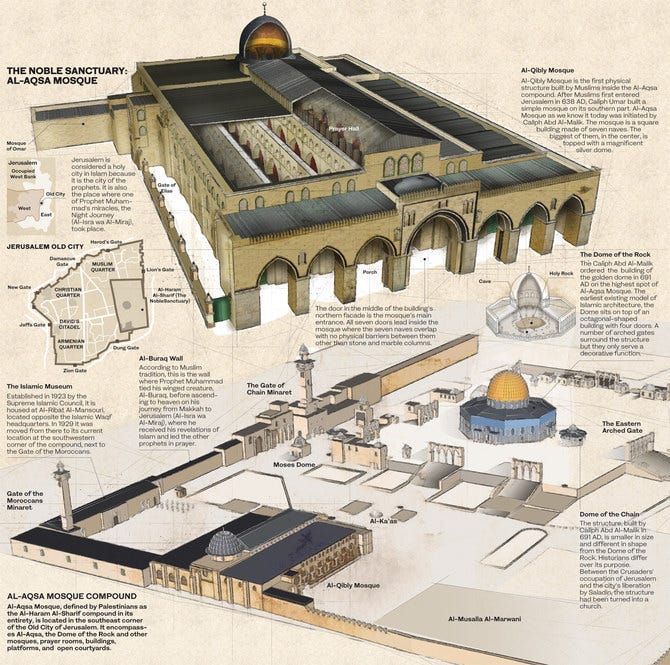
Another critical issue which has caused disputation among Muslim scholars is whether the Prophet (ﷺ) saw Allah with his own eyes or not. The first opinion is that of ʿAbd Allāh ibn Abbās who affirms the seeing of Allah by the Prophet (ﷺ) and with his own eyes. The second originates with ʿĀʾishah bint Abī Bakr who argued that it was a seeing, but by the means of the eye of the spiritual heart, and not through the naked eye. Furthermore, ʿĀʾishah cited the Qur’anic verse, “We appointed the vision which We showed you as a test for mankind,” maintaining that the prophet did not make al-’Isrā’ wal-Miʿrājin his body; but only in his spirit. In support of this, ʿĀʾishah testified that the body of the Prophet (ﷺ) was not absent at any point during the night of al-’Isrā’ wal-Miʿrāj. However, the scholars did not accept ʿĀʾishah’s testimony as decisive on this point since at the time of the events. The scholars maintain that ʿĀʾishah was not yet married to the Prophet (ﷺ) and did not share a bed with him until after the migration to Medina, which means that her testimony must have been based on a third-party report that was left unidentified by her. ʿĀʾishah’s position therefore conflicts with the dominant opinion and the verse cited by her cannot be regarded as a sufficient proof to negate the miraculous nature of al-’Isrā’ wal-Miʿrāj.
On the same issue, ʿĀʾishah also cited verse 103 of chapter 6 of the Qur’an stating: “Vision comprehends Him not, but He comprehends all vision,” which might imply the impossibility of humans seeing God with their own eyes. To this Imām al-Nawawī and ibn Ḥajar al-ʿAsqalānī have responded that the verse speaks of the ability to comprehend and encompass Allah, which is impossible for any human, but does not negate the prospect of seeing him which, in the view of both scholars, is something made possible by His permission on judgment day, the verse does not constitute proof of absolute impossibility. Furthermore, Imām al-Nawawī commented that ʿĀʾishah’sstatement was not based on any ḥadīṯh she had from the Prophet, because if she had had one she would most certainly have used it. For al-Nawawī, ʿĀʾishah’s position is based on her istinbāt (inference or deduction) from the Qur’anic verse, and a number of companions have disagreed with her on the subject. Accordingly, the issue becomes one of Usul (principles of jurisprudence), since the expressed position of a given companion is challenged by another companion endowed with understanding; the earlier opinion loses its validity and is no longer admissible as evidence. The position of ʿAbd Allāh ibn Abbās is straightforward and has several ḥadīṯhs to support that the Prophet (ﷺ) saw his Lord during the al-’Isrā’ wal-Miʿrāj. Ibn Abbās is reported to have said: “As for us, the children of Banī Hāshim, we say that Muhammad has seen his Lord twice,” a statement he supports with various narrations of ḥadīṯh and statements by companions. This is the position taken by the majority of Muslim scholars.
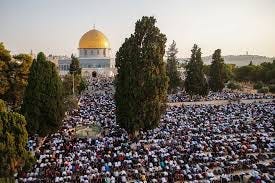
Ḥadīths Describing the al-’Isrā’ wal-Miʿrāj
Ḥadīth collections include several narratives of the event with some clear differences present among the reports, on the basis of which a number of conflicting conclusions have emerged among the scholars. In order to represent the most widely accepted narration of al-’Isrā’ wal-Miʿrāj, we will use the ḥadīṯh appearing in Ṣaḥīḥ al-Bukhārī as the foundation and then indicate differences from other reports. The decision to use Ṣaḥīḥ al-Bukhārīis due to the fact that it is the most widely accepted collection of ḥadīṯh and is recognized, at least among Sunni scholars, as containing the most authentic narrations of prophetic reports. In doing so, we are only attempting to narrow the field and deal with a manageable set of reports, not to exclude or discount others. The following ḥadīṯh describing the events of the al-’Isrā’ wal-Miʿrāj appears in Ṣaḥīḥ al-Bukhārī:
“Anas bin Mālik said that the Messenger of Allah (ﷺ) said: “al-Burāq was brought to me. It was a white animal somewhat taller than a donkey, but smaller than a mule. Its step covered a distance equal to the range of its vision. I mounted it and rode until I was brought to Bayt al-Maqdis. Then I tied it to the ring which the prophets use. Then I entered the mosque and prayed two rak’at there. I came out and Jibrīl brought me a vessel of milk and a vessel of wine. I chose the milk and Jibrīl said, ‘You have chosen the fiṭrah.”
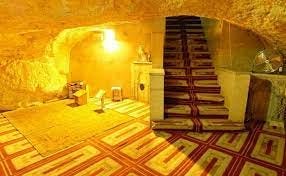
“Then he went up with me to the first heaven. Jibrīl asked for it to be opened and a voice said, ‘Who is it?’ He replied, “Jibrīl.” The voice replied, “Who is with you?” He replied, “Muhammad.” It said, “Was he sent for?” He replied, “He was sent for,” and the door opened for us. I found Adam who welcomed me and prayed for me. Then we went up to the second heaven and Jibrīlasked for it to be opened. A voice said, “Who is it?” He replied, “Jibrīl.” It said, “Who is with you?” He replied “Muhammad.” It said, “Was he sent for?” He replied, “He was,” and the door was opened for us. There I found my cousins, Īsā ibn Maryam (Jesus) and Yaḥyā ibn Zakarīyā (John the Baptist). They welcomed me and prayed for me. Then we went up to the third heaven and the same thing happened. It was opened for me and there was Yusuf(Joseph). He had been given half of all beauty. He welcomed me and prayed for me. Then we went up to the fourth heaven and the same thing happened. I found ʾIdrīs, and he welcomed me and prayed for me. Allah said, “We raised him up to a high place.” (Ch. 19, V. 56) Then, we went up to the fifth heaven and the same thing happened. There was Hārūn (Aaron) who welcomed me and prayed for me. Then we went up to the sixth heaven and the same thing happened. There I found Mūsā (Moses) who welcomed me and prayed for me. Then we went up to the seventh heaven and the same thing happened. There I found ʾIbrāhīm (Abraham) leaning against the Frequented House (Al-Bayt al-Ma‘mur). Every day, seventy thousand angels enter it and do not emerge.
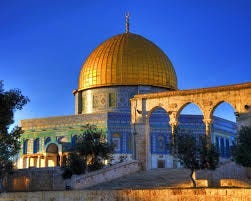
“Then he took me to the Lote-tree of the Furthest Limit whose leaves are like the ears of elephants and whose fruits are like earthenware vessels. When a command from Allah covers it, what is covered undergoes a change, which no creature is capable of describing due to its sublime beauty. Then Allah revealed to me what He revealed, and He made fifty prayers every day and night obligatory for me. I came down to Mūsā and he asked, “What did your Lord make obligatory for your people?” I replied, “Fifty prayers.” He said, “Go back to your Lord and ask Him to lighten it. Your community will never be able to do it. I have tested the Banu Israil and know by experience.” So, I went back to my Lord and said, “My Lord, lighten it for my community!” So, He deducted five prayers. I went back to Mūsā and said, “He deducted five for me.” He said, “Your community will not be able to do that, so go back and ask Him to lighten it.”
“I kept going back and forth between my Lord and Mūsā until Allah said, “Muhammad, they are five prayers every day and night. Each prayer counts as ten, so that makes fifty prayers. Whoever intends to do something good, and then does not do it, a good action will be written for him. If he, does it, then ten will be written for him. Whoever intends to do something bad and does not do it, nothing will be written against him. If he, does it, then one bad action will be recorded.” Then I went down to Mūsā and told him about that. He said, “Go back to your Lord and ask Him to lighten it.” The Messenger of Allah (ﷺ) said, “I have gone back to my Lord so often that I am ashamed before him.”
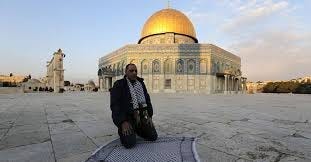
In his work, al-Sirāj al-Wahhāj fi Ḥaqā’iq al-’Isrā’ wal-Miʿrāj, Abū Isḥāq al-Nuʿmānī al-Shāfiʿī narrates a total of 14 ḥadīṯh on the subject, each slightly different from the others. Taken together, they constitute a well-authenticated collection on the subject. Abū Isḥāq also mentions at the end of his work the presence of two complete and extensive ḥadīṯh collections on the subject, one by ‘Abd al-Ghanī ibn ‘Abd al-Wāḥid al-Maqdisi and the second by Sheikh Sulaymān bin Sulaymān al-Busti entitled, Shifāʼ al-ṣudūr. Ibn Kathīr also narrates a number of ḥadīṯhs relating to these events that differ from that cited above and add more details. The ḥadīṯh related from Anas bin Mālik by Ibn Kathīr (cited by Abū Isḥāq as well) has the following additions in the beginning:
“we (the Prophet (ﷺ) and Jibrīl) ended up in al-Bayt al-Muqaddas and Jibrīloffered me three containers [in another version of the ḥadīṯh it says only two containers, and another mentions four], one with milk, one with water and one with wine, and I drank the milk, and Jibrīl said you have chosen the fiṭrah. … Then Adam and the rest of the prophets after him were sent forth and he (ﷺ) led them in prayers on that night.”
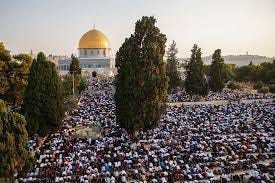
The above ḥadīṯh is taken from Ibn Kathīr’s commentary on the first verse of chapter seventeen. It seems that the ḥadīṯhoriginating with Anas bin Mālikhas a number of variants resulting from different chains of transmission, as we can see from the two mentioned above. Al-Bukhārī ḥadīṯh takes precedent over that used by Ibn Kathīr since one comes from a muḥaddith (specialist in ḥadīṯh), while the other is from a commentary on the Qur’an. Since the muḥaddith is concerned with establishing the authenticity of the ḥadīṯh his narration has higher consideration than all others outside of the field. However, if the ḥadīṯh of Ibn Kathīr is also found to be authentic, then it is admissible as evidence and may not be rejected as a description of what took place in al-’Isrā’. The addition in Ibn Kathīr’s ḥadīṯh does offer another important element, the gathering of all the prophets for a meeting and a group prayer led by Prophet Muhammad (ﷺ). It is this aspect that is often cited as providing evidence of Prophet Muhammad (ﷺ) having received the trust of the land of Bayt al-Maqdis from all the earlier prophets.
When we examine the text of the ḥadīṯh cited above, it seems that we are dealing with two distinct parts: one being the prophet’s own narrative of what took place and the other someone else’s report: “Then Adam and the rest of the Prophets after him were sent forth and he (peace and blessings upon him) led them in prayers on that night”. In al-Bukhari’s ḥadīṯhwe see an immediate transition from the drinks test to a meeting with Adam in the first heaven and other prophets in the second, third, fourth, fifth, sixth and seventh, with each time a prayer being offered by the resident of the particular level visited. It might be that this prayer was confused with the initial stage of the al-’Isrā’ and a collective prayer was included in the first stage of the episode.
Part Three:
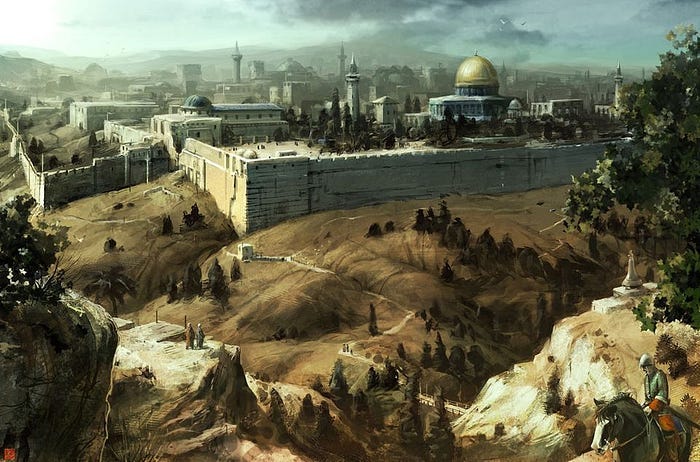
In the second major ḥadīṯh collection, Ṣaḥīḥ Muslim, the ḥadīṯh concerning the al-’Isrā’ has the prophet reaching Bayt al-Maqdis, “entering the mosque and praying two rak‘at then going out.” In terms of ḥadīṯh collection, Ṣaḥīḥ Muslim is ranked high, but has slightly less authority, for purpose of legal judgments in Islamic jurisprudence, than Ṣaḥīḥ al-Bukhārī. However, a ḥadīṯhranked as authentic and meeting the criteria of both al-Bukhārī and Muslimhas much higher authority as evidence than either of them individually. Thus, from Ṣaḥīḥ Muslim we derive an authentic ḥadīṯh that shows the prophet praying in Bayt al-Maqdis, which does not appear in al-Bukhārī’scollection. Another reference to this prayer is found in Mujīr al-Dīnal-’Ulaymī al-Ḥanbalī’s book, Uns al-Jalīl bi-Taʼrīkh al-Quds wa-al-Khalīl (The glorious history of Jerusalem and al-Khalil), where he quotes another ḥadīṯh which goes farther than the one cited by Ibn Kathīr. There the Prophet is reported to have said:
“When I entered the mosque (al-Aqsa) I found the Prophets and messengers had assembled there for me, having emerged from their graves. They were sitting in rows awaiting my arrival and they greeted me. I said, ‘O Jibrīl who are they?’ He said, ‘they are your brothers, the prophets and messengers. Quraysh claims that Allah has partners, the Christians claim that He has a son, so ask these prophets does Allah have any associates?’ Then he (Jibrīl) read “And ask all other prophets whom We sent before you if We have ever appointed any other gods to be worshiped beside the Beneficent.”(Qur’an, Chapter 43, Verse 45) Then Jibrīl assembled them for prayers and advanced me and I led them in a two rak‘at prayer.
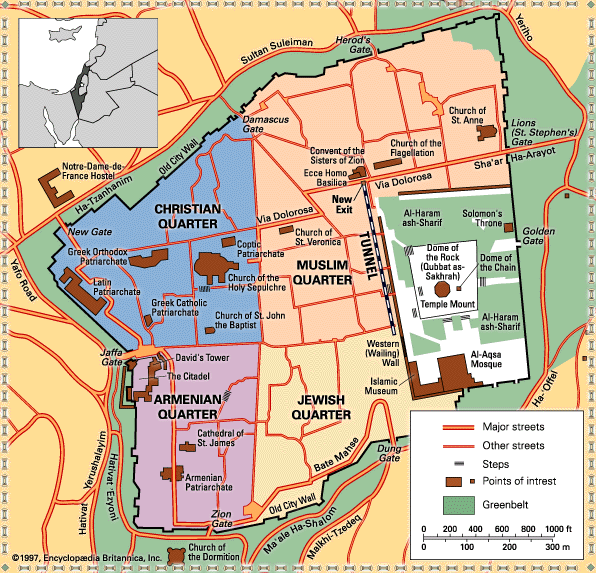
In Mujīr al-Dīn’s account, we see all the prophets being “assembled” for an important encounter with Prophet Muhammad (ﷺ) who is being guided by Jibrīl and called upon to ask them if “Allah have any associates.” Jibrīlanswers the question with a verse from the Qur’an, which is understood to have been revealed in al-Aqsa mosque in al-Quds on the occasion of the al-’Isrā’. The end of the ḥadīṯh cited by Mujīr al-Dīn has another marked difference with al-Bukhārī’s narration, which has the prophet is seen leading all the prophets in prayer and being advanced to this role by none other than Jibrīl himself. The significance of this for the Muslim understanding of the events of al-’Isrā’ and the status of Bayt al-Maqdisis obvious.
Leading all the prophets in prayer meant that the Prophet’s role was not limited to being the designated leader of the Muslim community, rather in this episode he was also chosen to lead all the prophets in prayer, thus confirming his high rank. It seems from the ḥadīṯh that all the prophets were agreeable to being led in prayer by Prophet Muhammad (ﷺ), for they all were gathered there for his sake and by Allah’s permission. In general, leading others in prayer often is a sign of the spiritual rank of the one assigned the role, as indicated in this case by the Prophet being forwarded to it by Jibrīl. Also, we may understand this to mean that the role of Prophet Muhammad (ﷺ) is to abrogate the revelations of earlier prophets and any claims by their followers to continuity of mission since the prophets accepting to pray behind him is a clear act of affirmation to the new prophetic reality represented by him.
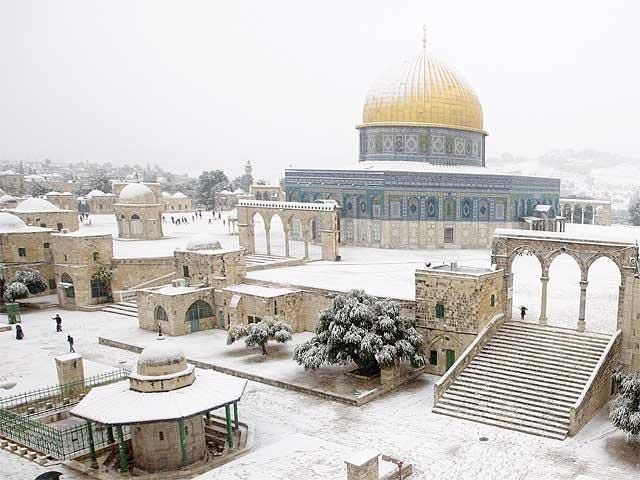
The Prophet’s prayer in Bayt al-Maqdis and at al-Aqsa mosque is central to Muslim spiritual affinity and connection to the location. Al-Aqsa stands apart from all other mosques, for it is the location where the Prophet led his predecessors in prayer, and the spot from which his ascension to the heavens began. The two factors have combined to produce a lasting imprint on the hearts and minds of all Muslims without exception. One possible meaning for the prayers in which he led all the other prophets might be a transfer of title to Bayt al-Maqdis and al-Aqsa mosque, not in a real material sense, but in the spiritual sense, to the last prophet and what he represents. In such a case, the title of owner is held by the last vicegerent on earth who is given authority to rule, by the permission of Allah, over the sacred territories in Mecca and Bayt al-Maqdis, which are explicitly linked in al-’Isrā’ wal-Miʿrāj episode According to Islamic understanding, real title to and true ownership of any and all parts of this earth (and the entire universe for that matter) belong to Allah and He has the authority on what is to be done with them. Therefore, a spiritual title to a sacred site held by a community is always subject to Allah’s continued approval of the holding of a given title and allowing it to be asserted. It is therefore possible for a spiritual title to be held by a community, but not allowed to be continuously asserted, for a purpose that Allah alone knows.
Further, praying behind the prophet is an indication, for Muslims at least, that the earlier prophets were surrendering to the last vicegerent and accepting to be his followers, for the prayer has the highest rank in terms of agreeing to follow someone beyond that of a temporal position. Prayer is a relationship of humans to Allah and accepting to follow someone in the expression of that relationship is a far more precious undertaking than any worldly protocol.
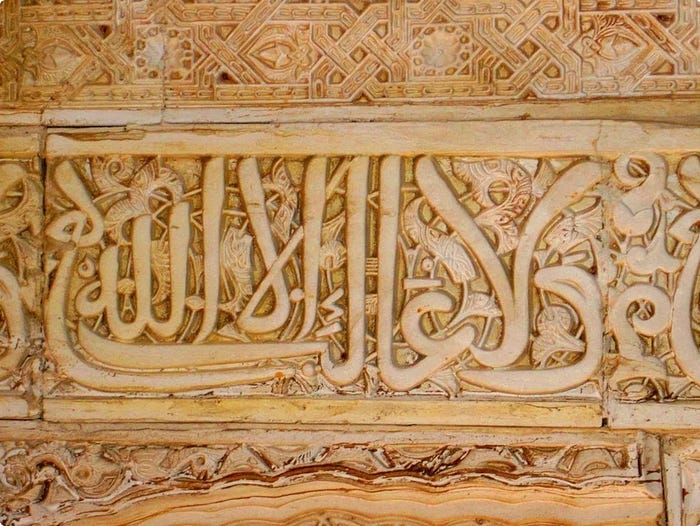
Al- Imām al-Nawawī, a Shāfiʿī scholar, in response to the question whether it is firmly established that the prophet did actually lead all the prophets in prayer, remarked: “Yes, it is firmly established that the prophet did lead all the prophets (may Allah blessings be upon them all) in prayers on the night of al-’Isrā’ in Bayt al-Maqdis. It is possible that this took place before his ascension to the heavens, and it is also possible that it took place after his descending from the heavens.” In al-Nawawī’s mind the prayer in Bayt al-Maqdis is thus firmly established, but its precise timing is open to dispute. In addition, whether it took place before or after the ascension will affect the question of precisely what the prayers consisted of. As can be seen from the long ḥadīṯh in Ṣaḥīḥ al-Bukhārī, the prayers of Islam were prescribed in the heavens, and thus if the Prophet (ﷺ) led all prophets in prayers before the ascension then some other kind of prayer must have taken place.
For Imām al-Nawawī, the prayers were obligatory before al-’Isrā’ episode, given clear evidence in the Qur’an calling on the Prophet (ﷺ) to remain awake during the night for prayers. However, the word prayer in Arabic (Ṣalāh) has a specific and a general meaning: the former is a set of motions and actions mandated by the Sharīʿa and the latter encompasses every form of worship and supplication to God without any clearly defined characteristics. If the prayer led by the Prophet (ﷺ) took place before the ascension, it would have been of the general kind, and if after, of the specific formulation recognized in sharīʿa.
In addition to al-Nawawī, al- Imām al-Suyūṭī in his book, al-’Āyatu Al-Kubrā fī Sharḥ Qissat al-’Isrā’, maintains that the prayer actually took place when the Prophet (ﷺ) descended from the heavens to Bayt al-Maqdis. Al-Suyūṭī argues that when the Prophet (ﷺ) first came to Bayt al-Maqdis his intention was to attend to the purpose of his coming, namely, to enter the divine presence; in this spiritual context the prayer can be seen as delaying the encounter. Also, the Prophet (ﷺ) is seen asking Jibrīl in each level of the heavens about the prophet who was meeting him; if he had already prayed with prophets in Bayt al-Maqdis, he would have had no need to inquire, for they would already have been known to him.
It might be that they were so numerous at the prayer gathering in Bayt al-Maqdis that it was impossible for him to recall all of them. However, it seems that the main prophets mentioned in the ḥadīṯh would have been in close proximity to the Prophet (ﷺ) during the prayers. For al-Suyūṭī, the most likely narration is the one that places the prayers at the end of the episode, not the beginning, appropriately so considering that the Prophet (ﷺ) had been summoned to a meeting with Allah and anything else would have served as a delay from the purpose of the journey. After the meeting with Allah and being recognized as the servant of Allah, the Prophet (ﷺ) returned to earth to take his place as a leader of all prophets; he was forwarded to lead them in prayer by Jibrīl, who only fulfills Allah’s commands. It was His intention for the Prophet (ﷺ) to be the Imām of all earlier prophets.
The ḥadīṯh cited above, in addition to a number of Qur’anic verses, establish the veracity of the al-’Isrā’ wal-Miʿrājepisode in Islamic sources. In addition to chapter 17 of the Qur’an, chapter 53 is largely dedicated to this episode and all the explicit and implicit significance it ascertains. Commentators on the Qur’an have maintained that chapter 53 encompasses the complete meaning of submission to Allah, based upon the comprehension of what is revealed to mankind through the agency of the Prophet (ﷺ). The unifying theme of chapter 53 is the contrast between following the God’s revelation in contrast to basing one’s life on mere supposition and desires.
The al-’Isrā’ wal-Miʿrāj event was a defining moment for those who believed and those who had weakness in their hearts. When the Prophet (ﷺ) told the people of Mecca about what had happened to him the night before, they mocked him and called him names. A number of those who believed in his message committed apostasy because they could not bring themselves to accept this miracle. On the other hand, Abū Bakr, when confronted by the leaders of Quraysh about what the Prophet had said, proclaimed: “If he said it, I believe it.” Abū Bakr after this event came to be known by Abū Bakr al-Ṣiddīq, a name that refers to the one who confirms the truth, which means that the first Caliph had earned his well-known title from the al-’Isrā’ wal-Miʿrāj episode as well.
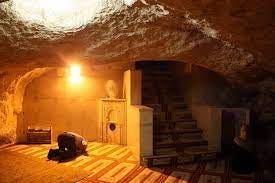
In the ḥadīṯh, the Prophet (ﷺ) had the honor of leading all the previous prophets in prayer. For the prophets to pray behind the final messenger signifies on their part the recognition of his role as an abrogator of rights that had been accorded by them to their respective communities. In a famous ḥadīṯh, the Prophet (ﷺ) is reported to have said to ʿUmar ibn al-Khaṭṭāb, that “if Mūsā (Moses) were alive today, he would have no choice but to follow that which I brought forth.” It is in this abrogation of earlier prophetic dispensations that the significance of the congregational prayer in al-Quds lies. Furthermore, this prayer happened as part of the Prophet’s (ﷺ) journey, which included al-Miʿrāj, and an encounter with the Allah. The prayer of the Prophet (ﷺ) also stands in fulfillment of verse 81 of chapter three, which states:
“When Allah made His covenant with the prophets, (He said): “Here are the scriptures and the wisdom which I have given you. And afterwards there will come to you a messenger, confirming that which you possess. You shall believe in him, and shall help him.” He said: “Will you affirm this and accept the burden I have laid on you in this matter?” They answered: “We will affirm it.” He said: “Then bear witness; I will bear witness with you.” (Qur’an, Chapter 3, verse 81)
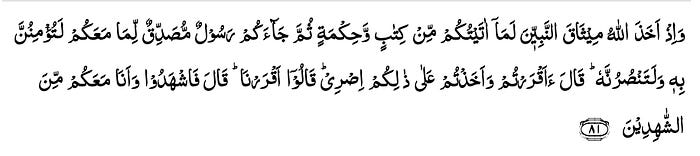
The verse above constitutes a foundation of belief, for it conveys the fact that every prophet has foretold his followers the future coming of the last Prophet (ﷺ), Muhammad (ﷺ) and asked them to believe in and support him. For Muslims, Islam represents the final revelation, and Allah in the Qur’an says that He does not accept any other path to him except al-Islam, and all the prophets, as seen in the verse above, have accepted the covenant from Allah. All the prophets praying behind Muhammad (ﷺ) is a further amplification of the covenant and provide the textual proof that the only acceptable path to Allah henceforth would be Islam.
Thus, the episode of al-’Isrā’ wal-Miʿrāj with the Prophet’s (ﷺ) prayer in Bayt al-Maqdis, the meeting with all the prophets, the ascension to the heavens and his encounter with Allah, are all monumental events which have had a profound impact on the consciousness of Muslims. The effect of the al-’Isrā’ wal-Miʿrāj is far reaching and provides a rich connection to the first prophet, i.e. the first human, Adam, mediated by all the prophets who proclaimed the same principle, to glorify the One and Only God. The details of al-Miʿrājprovide a view of the unseen world, paradise, hellfire and the heavens, together with all that they contain. It might be observed that the details concerning Bayt al-Maqdis are few by comparison. This is true but does not lessen the significance of those details for the sacred status of Bayt al-Maqdisand al-Aqsa. The miraculous al-’Isrā’ wal-Miʿrāj episode cement the temporal link between the two Islamic sacred sites, Mecca and Bayt al-Maqdis, and the gateway to Allah’s Throne that was opened to the Prophet (ﷺ) and through him and because of him to his community and humanity as a whole (And We have not sent thee except as a mercy unto the Worlds (Qur’an, Chapter 21, Verse 108).

