A few days ago, I sat with a close family member who has owned and operated restaurants and small businesses for almost forty years. Four decades is a long time to read the pulse of an economy from the cash register, long enough to know the difference between a bad season and a structural failure. He has lived through the inflationary years of the late seventies, the recessions of the early nineties, the dot-com bust, the 2008 financial collapse, and the pandemic. He is not a man given to hyperbole. He is a man given to invoices.
And what he told me, in plain language, is that the current business environment is the worst he has ever seen. Costs are skyrocketing on every line of the ledger at once. Profit margins in a sector that already operates on thin single-digit returns have collapsed to near-unprofitability. He is now preparing to raise his prices across the board, not because he wants to, but because the alternative is to close. The choice is no longer between growth and stagnation. It is between passing the pain forward to the customer or absorbing it until the doors come off the hinges.
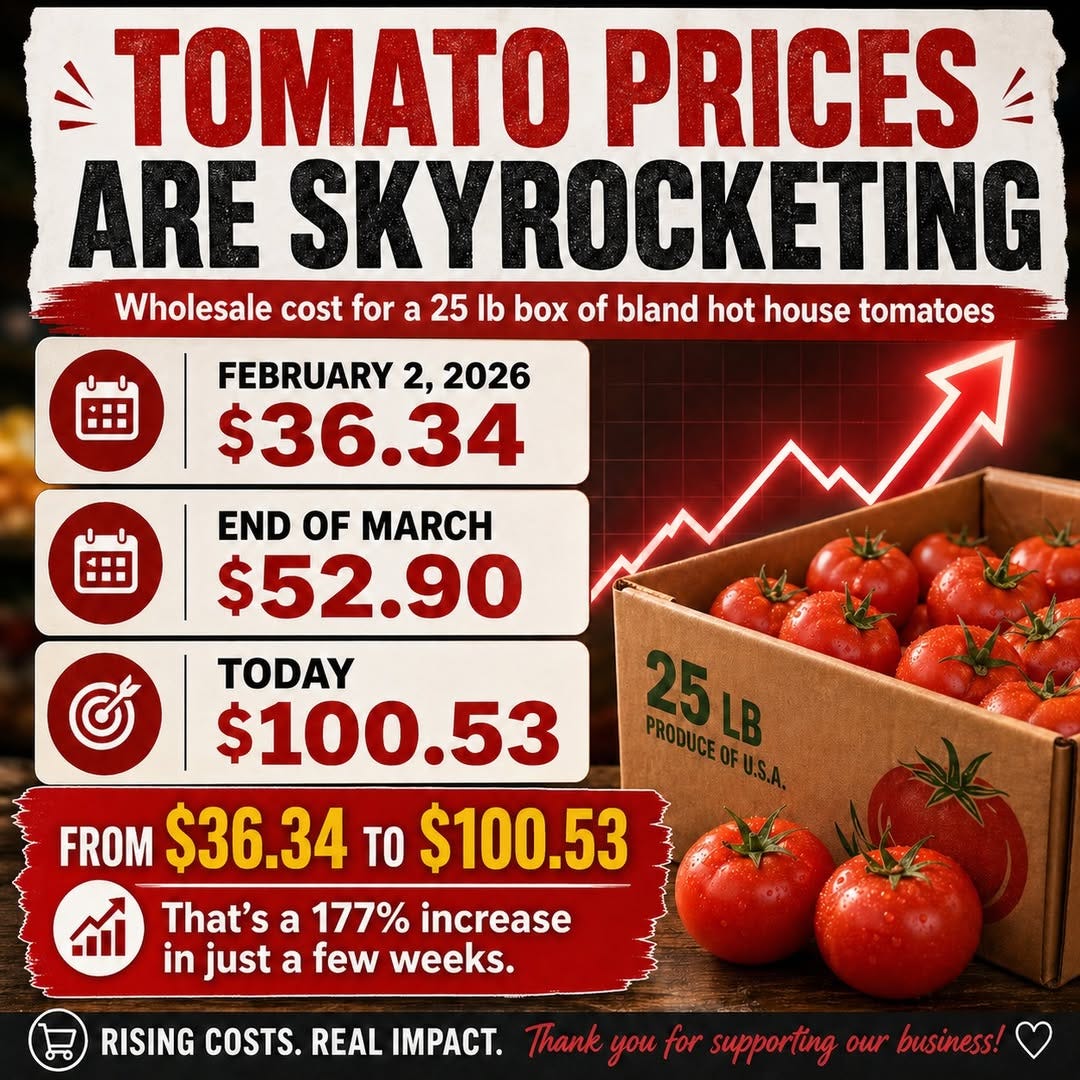
He gave me one example, because, he said, one is enough to tell the whole story. A box of tomatoes, the kind of staple no restaurant kitchen can function without, used to land in his walk-in at a wholesale price of between eight and twelve dollars. Over the past few weeks, that same box spiked to around $60 before settling at $47. A four- to fivefold increase. And tomatoes are not a luxury good; they are, quite literally, the base ingredient of everyday American food. He can repeat the same exercise across his inventory, cooking oil, produce, dairy, paper goods, dry storage. The numbers vary, but the trajectory does not.
Then we talked about the line that had been lodged in my mind all day: the 3.8 percent inflation figure reported by the Consumer Price Index is misleading. And not in some abstract economist’s sense, misleading in the way a thermometer is misleading when it is held outside the burning room. Energy costs, he pointed out, have effectively been stripped from the headline calculation, even though energy is now embedded in every other cost he pays, the diesel that delivers his shipments, the gas that runs his kitchen, the electricity that lights his dining room, the petroleum-based packaging he serves food in. Producer prices jumped roughly 6.3 percent in the most recent reading, and that wholesale shock is now being pushed downstream onto the retail consumer, who will feel it not once but many times over, at the grocery store, at the pump, in the rent check, in the utility bill, in the daycare invoice, in the insurance premium and in anything that is bought in the market.
Four decades behind a counter teaches you something the macroeconomic dashboards in Washington seem incapable of registering: that headline inflation numbers can be engineered, but the till cannot lie.
Two Economies, One Country
What my relative is describing is not a glitch in the system; rather, it is the system functioning exactly as designed for the people it was designed to serve.
There are, in 2026, two American economies operating in parallel and increasingly unaware of each other’s existence. One is the economy of the Wall Street trading floor, the hedge fund, the private equity rollup, the tech oligarchy, and the asset-holding class. By every available metric, that economy is in an extraordinary state of euphoria. The president's own investment portfolio is making 60 daily average trades on Wall Street, and why not when the number keeps going up! Equity indices are at or near record highs, and many are celebrating. Concentrated wealth at the top of the distribution has reached levels not seen since the Gilded Age. A small number of individuals now possess fortunes that exceed the combined GDPs of dozens of nations. Few companies are larger than the economies of all the countries combined, except the US and Chinese economies. They are insulated from inflation because they own the assets that are inflating; rising rents enrich them, and rising food prices enrich the commodities desks they trade through. Rising energy prices enrich their portfolios, and the pain of the rest of the country is, for them, a tailwind. Happiness can be measured by the number of zeros of Wall Street valuation, and it is an impressive set of zeros.
The second economy is the one my relative inhabits, and that the overwhelming majority of Americans inhabit alongside him. It is the economy of payroll, rent, fuel, groceries, childcare, and the dwindling buffer between a paycheck and a missed bill. In this economy, the question is not how to optimize a portfolio with more zeros, but how to look at a bank account that is constantly ending the month close to zero with no relief in sight. It is whether to fill the tank or pay the electricity. Whether to renew the lease or move the kids again. Whether to keep the restaurant open or let go of the employees who have worked alongside you for a decade. By every credible measurement, this America is suffocating. Household savings have been drawn down, credit card debt has reached a historic high, and delinquencies on auto loans are climbing. Food bank usage in major cities has surged. People are not, as the official commentary keeps insisting, better off than they realize. They are, in the most honest reading, one or two paychecks away from financial catastrophe, and they know it, even when the dashboards say otherwise.
The gap between the two economies is no longer a gap. It is a chasm. And a republic that contains two such radically divergent realities inside its borders cannot indefinitely hold itself together by rhetoric alone.
What the Epstein Files Were Always Really About
It would be a profound mistake to read the slow, contested, and ferociously resisted public release of the Epstein files as a story about one criminal financier and his sexual predation. That is the surface scandal, the tabloid version designed to be consumed, exhausted, and forgotten. The deeper story is structural, and it is the story of how the same Wall Street oligarchy, tech billionaire class, and politically wired billionaire network that benefits from the inflation crushing my relative’s restaurant has spent decades operating as a closed cartel, exchanging access, immunity, and influence among itself, under the explicit protection of both political parties and federal law enforcement.
Read the flight logs, the contact lists, the photographs, the financial records that have trickled into public view, and the picture is unmistakable. The same names that appear on the donor lists of presidential campaigns appear on the visitor logs of a private island. The same names that sit on the boards of major investment banks appear in the address books of the convicted. The same names that fund pro-Israel advocacy infrastructure, that underwrite think tanks pressing for war with Iran, that own newspapers and acquire social media platforms, those names recur, in different combinations, on every page of the unredacted record. This is not a coincidence. It is a portrait of a class.
The Epstein affair is significant because it is a rare moment when the working architecture of the American oligarchy becomes briefly, partially, and accidentally visible, the way an X-ray reveals the skeleton beneath the skin. What it reveals is a network that operates above and outside the legal, financial, and moral rules that apply to everyone else. A network in which intelligence services and private wealth are not adjacent but interpenetrated. A network that does not merely influence public policy but in many cases writes it, and that uses the apparatus of the state, including its prosecutorial discretion, its surveillance capacity, and its capacity for war, as an extension of its private interests.
That this network has been able to suppress, redact, delay, and re-bury the documentary record of its own conduct, across multiple administrations and through the cooperation of agencies nominally tasked with public accountability, is itself the lesson. The same political class that cannot find the courage to release a complete file on a deceased sex trafficker can find, without difficulty, the resources to finance an open-ended war in the Middle East on the public credit card. The priorities are not hidden. They are advertised.
Israel’s Wars, America’s Bill
The connection between the Epstein network and the question of war is not metaphorical or conspiratorial. It is documentary, and it is financial.
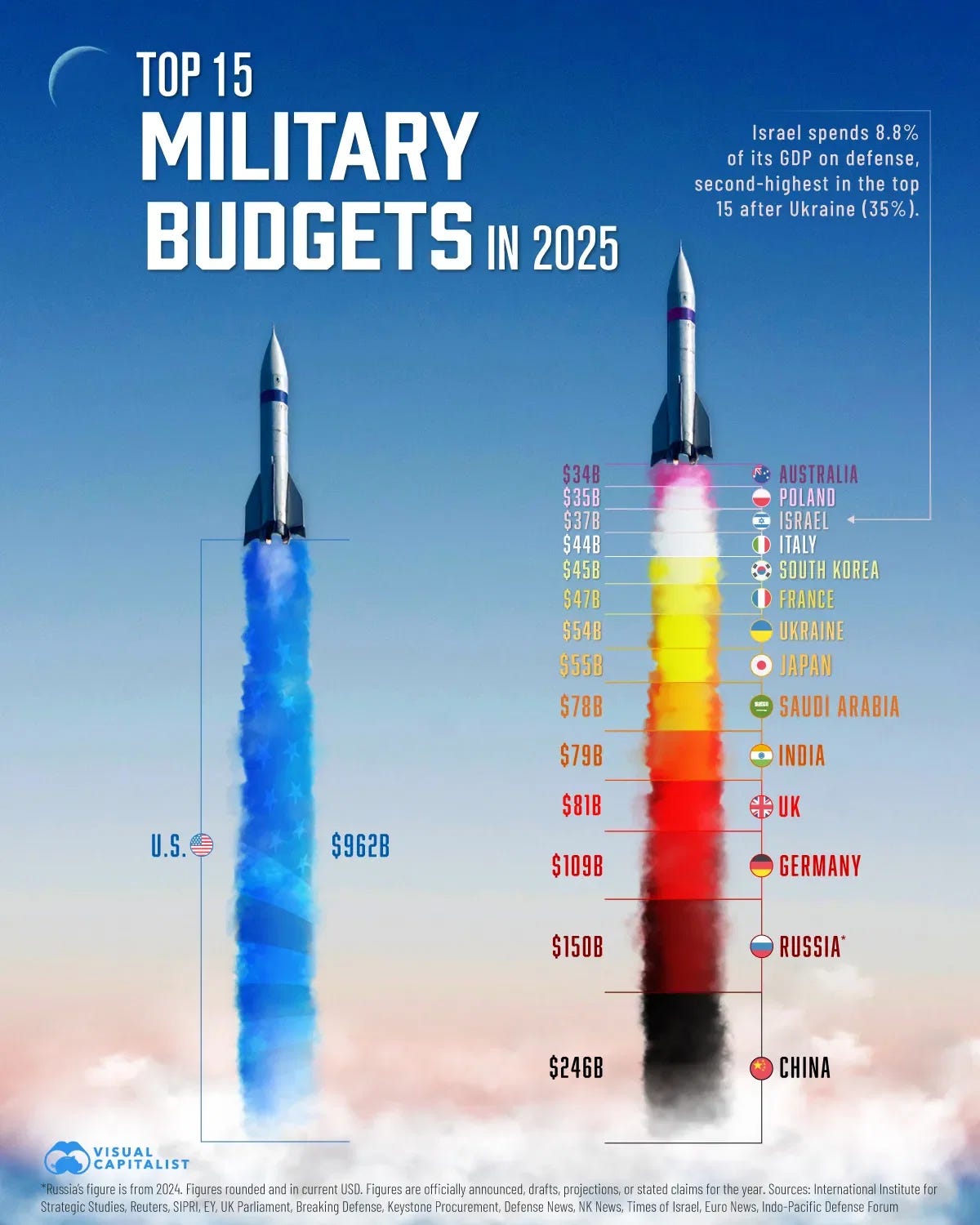
For more than two years, the United States has functioned as the indispensable underwriter, supplier, and political shield of an Israeli campaign in Gaza that the world’s leading genocide scholars, human rights organizations, and international legal bodies have described in the gravest terms available to international law. That underwriting has been extended, in real time, to the bombing of Lebanon, to strikes on Syria, to operations against Yemen, and now to an open and escalating war with Iran. Each of these theaters has been entered not because the American public demanded it, every available poll indicates the public did not, but because the same constellation of donors, lobbies, defense contractors, and ideologically aligned policymakers that the Epstein record helps us see clearly demanded it.
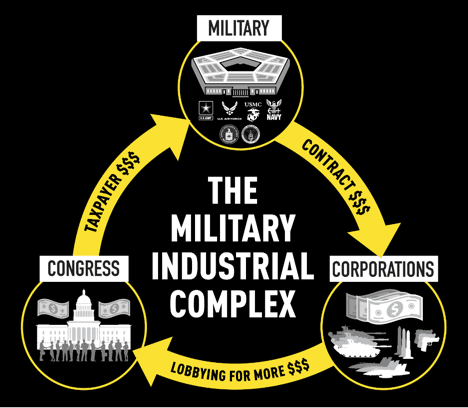
And every one of those wars produces the same domestic outcome: it transfers wealth, on a colossal scale, from the American taxpayer to the American military-industrial complex, and from there into the equity portfolios of the same Wall Street oligarchy whose pricing power is currently breaking my relative’s business. Lockheed Martin, Raytheon, Northrop Grumman, General Dynamics, Boeing, Palantir, Microsoft, Apple, AI companies, the energy majors, and the shipping conglomerates are not abstract corporate entities. They are publicly traded equities whose share prices rise whenever a new front opens, and whose largest shareholders are the same hedge funds, sovereign wealth pools, and family offices that populate the donor class and, in many cases, the Epstein record itself.
The arrangement is, when stated plainly, obscene. A genocide in Gaza becomes a quarterly earnings catalyst in Manhattan. A strike on Iranian infrastructure becomes a buy signal for a defense ETF. The screams of children pulled from rubble in Khan Younis or Beirut or Sana’a are translated, through the alchemy of the modern American economy, into rising dividends for institutional investors and rising prices at the checkout aisle for everyone else. There is no functioning democracy in which that translation could be made openly without consequence. That it is made daily, in plain view of the C-suite and the cable news anchor and the congressional appropriations committee, tells you precisely how much functioning democracy remains.
The Tomato, the Tanker, and the Pump
Defenders of the war with Iran, particularly those operating from the comfortable distance of think tank panels and op-ed pages, have advanced a curious argument: that the United States, having become a net energy exporter, is now insulated from the economic consequences of Middle East conflict. The argument goes further that with the Strait of Hormuz closed or contested, American oil and gas producers will simply sell more oil to a world starved of supply, and the country will profit handsomely from the disruption. War, on this account, is no longer a cost; rather it is a market opportunity.
This is one of the more dangerous and shortsighted positions currently being advanced in American public life, and it should be named as such.
The price of a gallon of gasoline at a station in California is not determined by the geography of where the oil was extracted. It is determined by the commodity markets of New York and London, where futures contracts are traded, where risk premia are priced in, and where Wall Street trading desks set the global benchmark to which every regional retail price is indexed. When the Strait of Hormuz is closed, those benchmarks spike, not because American refineries have suddenly lost access to crude, but because the global price of the commodity has been repriced upward to reflect the new risk environment. The fact that the United States is a net exporter does not insulate the American consumer from that repricing. It guarantees that the American consumer pays the new, higher world price for a fuel that was, in many cases, drilled from American soil. The exporter benefits, and the driver pays.
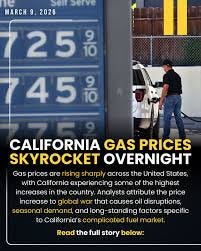
The numbers are already in. The price of a gallon of regular gasoline in California has reached $7.60 at major metropolitan stations, with credible projections that it will cross $8.00 as the summer driving season opens. That is not the cost of a war happening somewhere far away. That is the cost being charged to a single mother filling up to drive to a second shift, to a contractor pricing a job, to a school district running a bus fleet, to a restaurant taking delivery of a box of tomatoes. It is, in the most literal sense, a tax, but it is not a tax paid to the United States Treasury for the provision of any public good. It is a tax paid, twice over, to two beneficiaries: to the Wall Street commodity traders who collect the spread on every barrel repriced by the war, and to the foreign government whose wars the United States is financing in the first place.
Every American who pulls up to a pump this summer is, whether they understand it or not, writing a small check to that arrangement. The line item does not appear on the receipt. But it is there. It is the surcharge for an empire that has, at this point, fully merged its foreign policy with the portfolio interests of its donor class, and that has decided, on behalf of its citizens but without their consent, that genocide abroad is an acceptable price for the maintenance of asset values at home.
The Tomato and the Empire
It is tempting to read the price of a box of tomatoes as a story strictly about domestic policy failure, but it is not. It is a story about an empire in late decline that refuses to behave as if it is, and therefore bleeds wealth, legitimacy, and stability across every front simultaneously.

Consider what has been layered onto an already strained domestic economy in the last twelve months. A sweeping and chaotic tariff regime that has functioned, in practice, as a consumption tax on the working and middle classes, paid not by foreign exporters but by American purchasers at the checkout counter. Immigration raids in agriculture, food processing, hospitality, and construction that have stripped labor from the very sectors that supply the wholesale items my relative buys, and that have, predictably and immediately, driven those wholesale prices upward. A renewed and dangerously open-ended military confrontation with Iran that has put a permanent risk premium on global energy markets, destabilized shipping lanes, and pushed the United States into the kind of multi-front imperial posture that has historically signaled the late stage of every overextended dominant power.
These are not unrelated stories. They are the same story. The tomato in the walk-in cooler in a small American restaurant is connected, by an unbroken chain of cost, to the bombs falling on Iranian infrastructure, to the migrant farmworker hauled away from a tomato field in a pre-dawn raid, to the tariffs imposed on the fertilizer used to grow the crop, to the diesel burned to truck it across the country, to the insurance premiums that now reflect the heightened risk of a wider regional war. Every one of those costs is borne, at the end of the chain, by the customer walking through the door of a neighborhood restaurant, and by the owner who can no longer absorb them and has to raise the prices or reduce the number of employees!
Ibn Khaldun, writing in the fourteenth century in the Muqaddimah, observed that dynasties enter their period of collapse not when they are externally defeated, but when their ruling classes lose their ʿasabiyyah, their internal solidarity, their shared sense of common project or common good, their capacity to bind the powerful to the fate of the governed. Decline, in his analysis, is signaled by ostentatious wealth at the center, predatory taxation at the periphery, the hollowing out of productive sectors in favor of rent-seeking, and the increasing reliance of the state on coercion and foreign adventure to sustain a legitimacy it can no longer generate domestically. Read that diagnosis again with the price of tomatoes in one hand and the Pentagon’s Iran briefing in the other, and ask honestly whether it describes anywhere other than the country we are presently living in.
Rome, in its late imperial period, debased its currency to fund frontier wars while the urban poor went hungry. The Ottomans, in their long decline, layered tax farm upon tax farm on a peasantry already incapable of bearing the load, while the court in Istanbul performed a wealth and ceremony that had become entirely detached from the lives of the governed. The pattern is not new; the actors merely change costumes.
The Political Class and Its Crime
And so we arrive at the question that polite commentary in this country is desperate to avoid; who, exactly, is responsible?
The answer is not, primarily, the supply chain, it is not, primarily, the weather, and it is not, primarily, the abstractions of the market. The answer is a bipartisan American political class that has, over forty years, governed in the explicit interest of asset holders and against the interest of wage earners; that has financed wars it will not honestly account for; that has fused its foreign policy with the portfolio interests of its donors and the strategic ambitions of a foreign government; that has manufactured a permanent state of foreign emergency to justify a permanent state of domestic austerity; that has criminalized labor while subsidizing capital; that has dismantled the civil society institutions, public schools, public health, public broadcasting, independent journalism, neighborhood organizations, houses of worship as actual centers of community life, that once gave ordinary Americans the capacity to act collectively in their own defense.
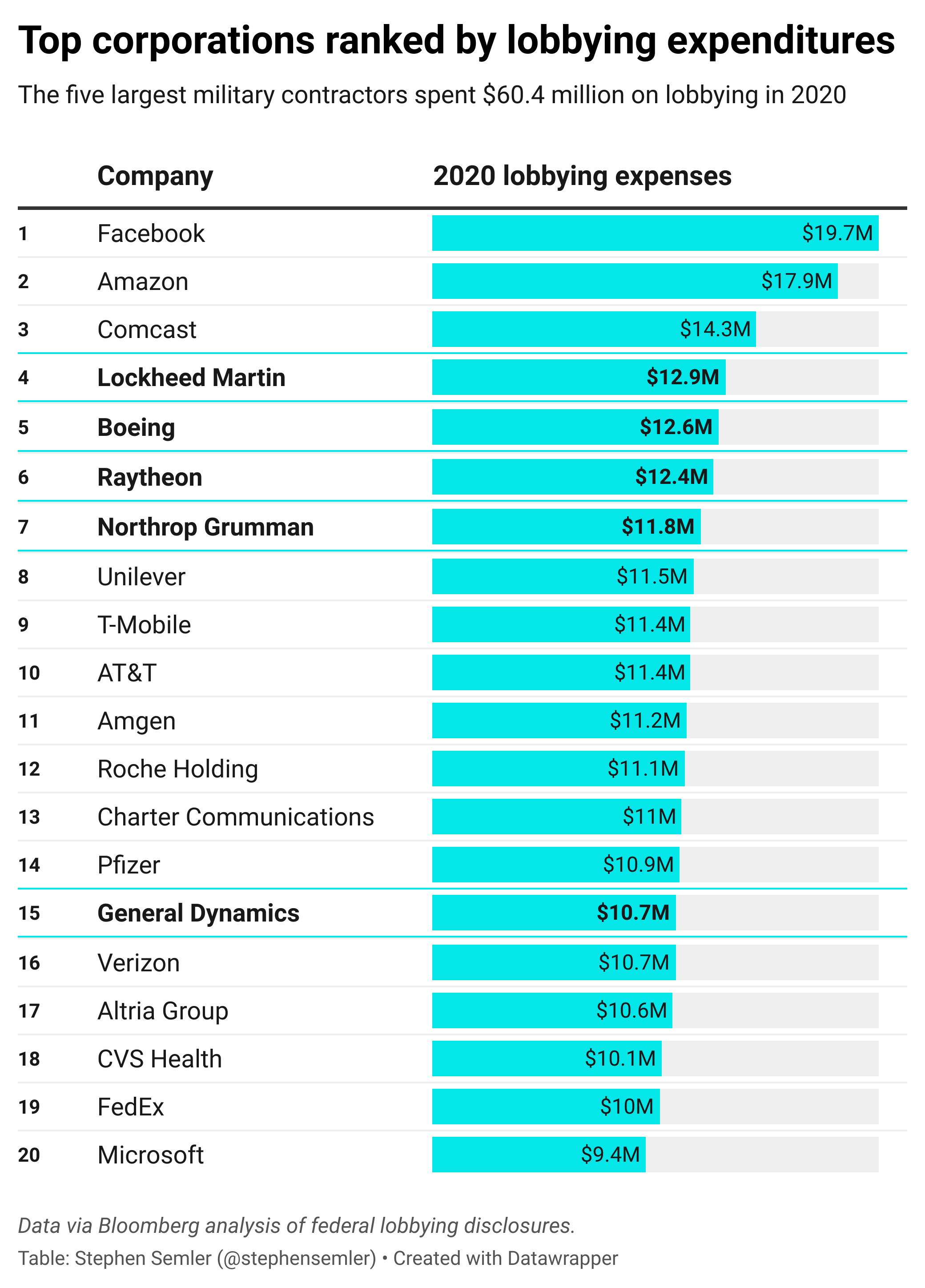
This is the same political class that cannot find the courage to release a complete Epstein file because the names on it are the names that fund its campaigns. The same political class that cannot find the courage to halt a genocide because the lobby pressing for its continuation pays its rent and finances the election campaigns of both parties. The same political class that cannot find the courage to regulate the commodity desks driving gasoline to eight dollars a gallon because the executives on those desks fund its leadership PACs. It will not stop on its own. It has no internal mechanism for doing so. It has been bought, comprehensively and on both sides of the aisle, by the very interests that benefit from the inflation, the wars, the deregulation, the asset concentration, and the impunity. It governs in their language, schedules its priorities around their calendars, and answers to their phone calls. The 98 percent of the population on whose backs this arrangement rests is, to this class, a polling abstraction, a turnout problem to be managed, not a constituency to be served.
When a restaurant owner with forty years of experience tells you that the numbers no longer work, what he is describing is not his personal misfortune. He is describing the lived consequence of a long, deliberate political project. When a wholesale tomato hits forty-seven dollars a box, what is being signaled is not market volatility. It is the audible cracking of a social contract. When a gallon of gasoline hits eight dollars while the same defense contractor whose missiles are striking Iran posts a record quarter, what is being demonstrated is not an unfortunate coincidence of unrelated events. It is the machine working exactly as it was built.
The oligarchs at the helm of Wall Street will, in the literal and the metaphorical sense, make a killing. The everyday American will be killed, slowly, quietly, by the cumulative weight of rent, fuel, food, debt, and despair, and under the pressure of an economic decline engineered for someone else’s benefit. The Israeli wars will be paid for by the same Americans who can ill afford to pay for their health insurance or pay for their kids’ education. The defense contracts will be honored. The commodity spreads will be collected. The Epstein names will be protected. The bombs will keep falling. And somewhere in a quiet kitchen, a man who has stood behind a counter for nearly forty years will hand a customer a slightly thinner sandwich at a slightly higher price, and will know, without needing to be told, that he is paying, personally, for a war he did not choose, for a class he will never meet, and for an empire that has long since stopped pretending to govern in his name.
This is, in the most precise sense available to language, a moral failure on the part of those entrusted with public power. Not an error. Not an oversight. Not a regrettable side effect of complicated policy trade-offs. A failure of the kind that, in any system with a functioning conscience, would end careers, dissolve parties, and trigger a national reckoning. That none of this is happening that the same figures continue to cycle between cabinet positions, lobbying firms, defense contractor boards, foreign-government-funded think tanks, and cable news contracts, untouched by anything resembling accountability, is itself the most damning evidence that the rot is not at the margins. It is at the center.
Empires, as Ibn Khaldun warned, do not announce their decline. They reveal it in the small ledgers of the people they have left behind. A box of tomatoes is a small ledger. A receipt from a California gas station is a small ledger. An unpaid credit card bill is a small ledger. A redacted page in an Epstein deposition is a small ledger. However, they are also taken together as an indictment. And the political class that has produced them, that has, in fact, required them as the necessary domestic cost of the global posture and the private impunities it refuses to abandon, has earned every syllable of the judgment that history is currently preparing for it.
My relative will raise his prices this week or next. His customers will pay them, or they will stop coming. Either way, he will keep the lights on for as long as he can, the way small business owners always have, because that is the discipline of forty years behind a counter. But the lights, eventually, do go out. And when they do, no one in Washington will be held responsible unless we, who sit on the other side of his counter and inside the wreckage of this two-tiered economy, finally decide that they will be.
That decision is the only one still left to us.

